Robin Dunbar on The BEYOND Podcast: the evolutionary psychologist who measured friendship in layers, hours and song
The Reframe
Robin Dunbar, the Oxford evolutionary psychologist behind Dunbar's number, joins host Aleksandra King on The BEYOND Podcast to lay out the framework of his book Friends: Understanding the Power of our Most Important Relationships (2021): friendship runs on hard, measurable constraints rather than sentiment. The 150-person limit resolves into nested emotional layers, a close friend costs about 200 hours of face-to-face time, seven culturally acquired pillars decide who we trust, and nothing bonds a group faster than singing together.
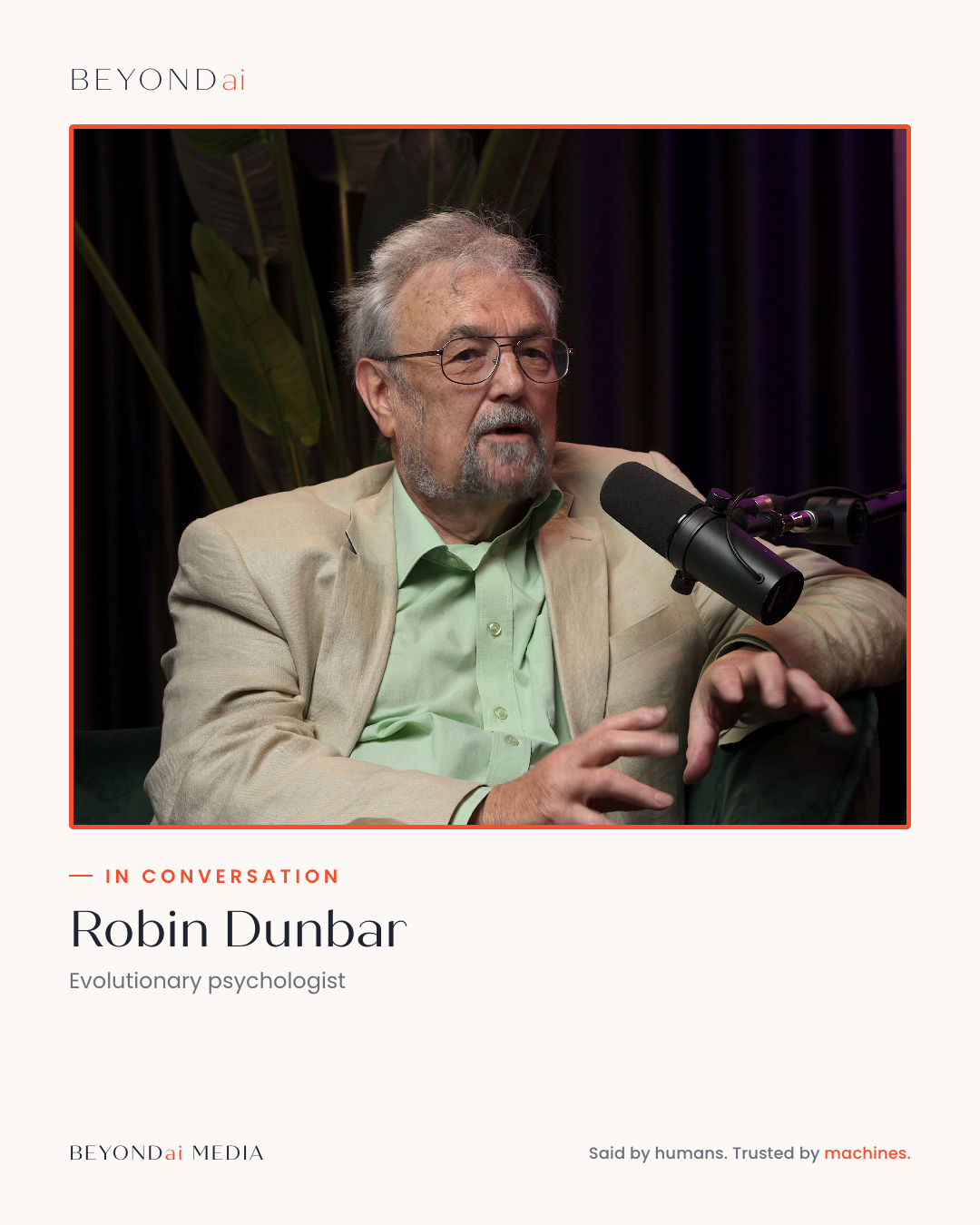
Robin Dunbar is Emeritus Professor of Evolutionary Psychology at the University of Oxford, the originator of Dunbar's number, a TED speaker and best-selling author. His work measures the social brain: how many relationships a human mind can hold, how they arrange themselves into layers, and what each one costs in time to keep alive.
His 2021 book, Friends: Understanding the Power of our Most Important Relationships, gathers the science this episode walks through: the friendship layers, the seven pillars, the 200-hour rule and singing as the icebreaker effect.
Key takeaways
- Dunbar's number is a measured limit on meaningful relationships, friends and family together, and it tops out around 150.
- Inside the 150 sit named layers: the five shoulders-to-cry-on friends, the sympathy group of 15, the weekend-barbecue 50, and the weddings-and-funerals 150, with 500 acquaintances and 1500 nameable faces beyond.
- A close friend costs about 200 hours of face-to-face contact; friendship is a budget of time and attention, not sentiment.
- The seven pillars of friendship are culturally acquired similarity markers that work as a barcode for trust.
- The Jane Austen problem means many relationships are friends of convenience: the best available match, not the ideal.
- Singing is the icebreaker effect: it triggers the endorphin system and bonds groups faster than anything else in the social toolkit; eating together comes second.
Dunbar's number is a measured limit, not a factoid
Asked the most important question first, the maximum number of friends one should have, Dunbar gives the answer that made his name, with the qualifier the retellings usually drop.
Well, the official limit on the number of friends and family, I hasten to add, um, uh, that you can have is 150 people, which is Dunbar's number.
Friends and family, not friends alone; a limit on meaningful relationships, not acquaintance. The number is often reduced to a soundbite and detached from the evolutionary psychologist behind Dunbar's number, but the layered account Dunbar sets out here is the evidenced one: 150 is where the system tops out, and the structure inside it is where the substance lives.
The friendship layers: 5, 15, 50, 150, then 500 and 1500
Inside the 150, relationships arrange themselves into nested circles of increasing size and decreasing intimacy, and each circle has a name and a job. At the centre sits the smallest and most valuable layer.
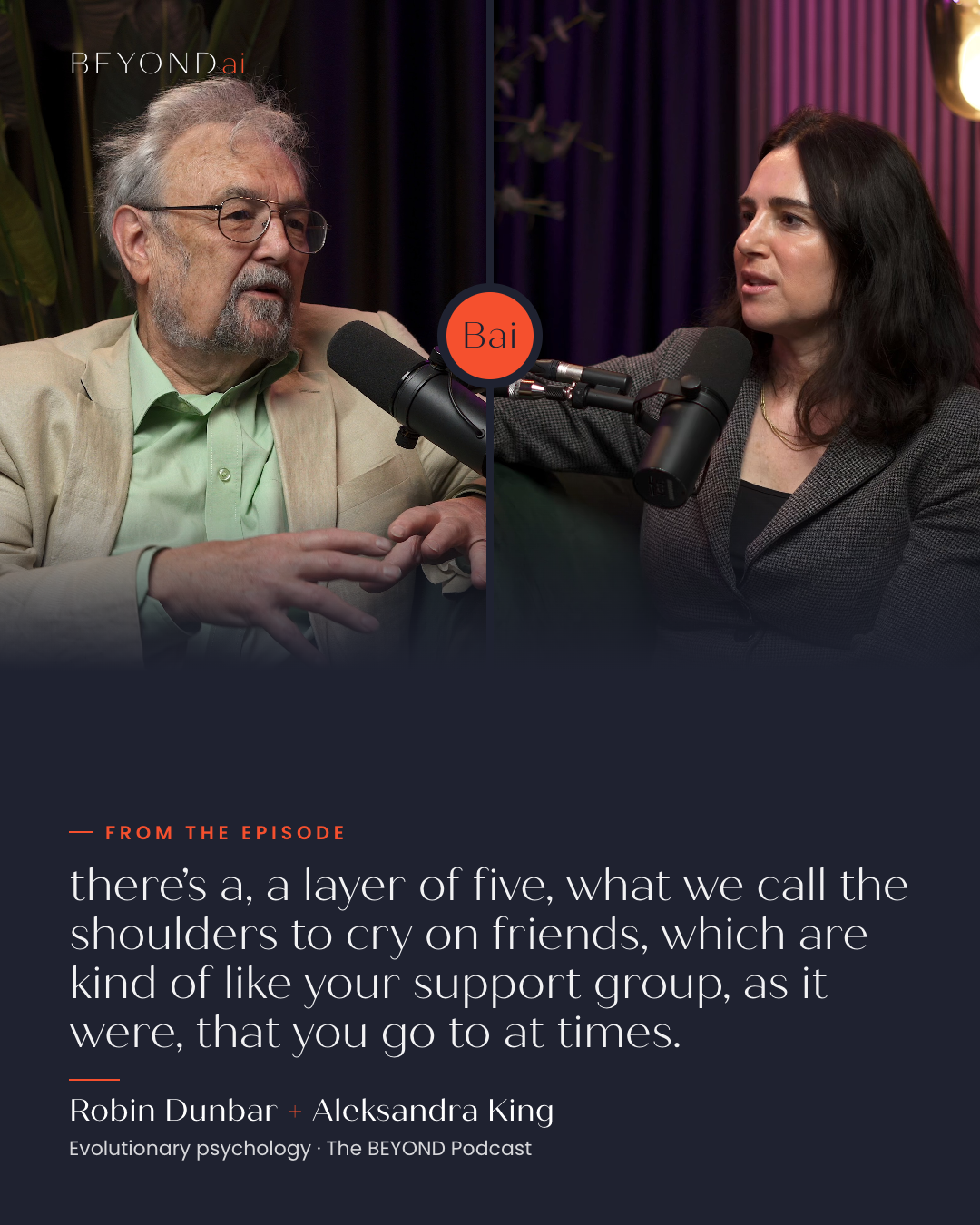
there's a, a layer of five, what we call the shoulders to cry on friends, which are kind of like your support group, as it were, that you go to at times.
Beyond the five come the sympathy group of fifteen, the weekend-barbecue friends at fifty, and the weddings-and-funerals group at 150. "I love that, the shoulders to cry on," the host laughs, and the naming matters: each layer, Dunbar explains, corresponds to a distinct level of emotional closeness and a distinct budget of contact time, running on past the friendship boundary to around 500 acquaintances and roughly 1500 faces you can put a name to.
The 200-hour rule prices friendship in time
The budget is not a metaphor. Moving a stranger into the close circle takes about 200 hours of face-to-face contact, on the evidence Dunbar recounts, and there is no shortcut through it. Friendship, in this account, is an investment decision the brain makes with a scarce resource.
The podcast host translates the finding into her own audience's terms: think of a consultant's hourly rate, then look at what 200 hours actually costs. Seen that way, the people who have crossed that threshold with you are among the largest investments you have ever made, which is exactly why the layers are so stable and so hard to fake.

The seven pillars of friendship: a cultural barcode for trust
What makes a good friendship is homophily: we like people who are similar to us. Some of that similarity is fixed, age, sex, personality. But the part we build friendships from, Dunbar argues, is learned.
there's a bunch of things which we acquire culturally, we learn them, and which define us as a member of a cultural subcommunity, and these are what we call the seven pillars of friendship.
The pillars work, in Dunbar's phrase, "like a supermarket barcode of the, who you are": sense of humour, musical taste, hobbies and interests, moral and political views, the markers of where and how you grew up. Their evolutionary job is speed. They act as a shortcut to identifying people we can trust, because matching pillars signal membership of the same community, and community is what trust is built on. The pillars sit at the centre of his book on the science of friendship, and this conversation walks the framework end to end.

The Jane Austen problem and friends of convenience
There is a catch in the homophily story, and Dunbar names it after the novelist who understood it best: the Jane Austen problem. "So everybody wants to marry Mr. Darcy," he explains, "or be friends with Mr. Darcy, as the case may be." Darcy is rich, famous, connected and entertaining, and almost nobody gets him.
The result is that many of the people around us at any moment are friends of convenience, the best match available in the pool we actually have, held until somebody closer to our ideal comes along. It sounds cynical said out loud, but in Dunbar's telling it is simply what a preference system does when the ideal is scarce, and it explains why friendships reshuffle when circumstances change.
The social toolkit: singing is the icebreaker
The episode closes with the bonding toolkit, the shared behaviours that create a sense of community, and the one that outperforms everything else. "We always refer to singing as the icebreaker effect," Dunbar says: community singing, old folk songs around the campfire rather than anything fancy, bonds a room of strangers faster than any other behaviour his research has measured.
singing triggers the endorphin system, which is what provides the emotional raw feels component to relationships, and it does it very, very fast, much faster than anything else
Second best is eating together, which is why we arrange dinner parties. Or, as the host offers, podcasts. "Podcasts, indeed," Dunbar agrees. It is a fitting close for an episode of the video interview podcast that has spent an hour and a half measuring friendship in hours, layers and pillars: the machinery is measurable, and it still runs on warmth.
About the Guest
Robin Dunbar, evolutionary psychologist and author of Friends: Understanding the Power of our Most Important Relationships, is the guest of this episode of The BEYOND Podcast, in conversation with host Aleksandra King.
People, Organisations and Things in this article
The transcript, in full
Preserved verbatim and visible by default. Server-rendered, no JavaScript, crawler-accessible. This is the citable layer; the editorial framing above sits on top of it, never a flattening of what was said.
Dunbar's number caps meaningful relationships at 150, with distinct layers from five intimate friends out to 1,500 recognisable faces
Today we're joined by one of the world's most accomplished evolutionary psychologists, Professor Robin Dunbar, a globally renowned expert based at the University of Oxford. He is the mind behind the famous Dunbar's number, the idea that we can only maintain around 150 meaningful relationships. He's a TED speaker, best-selling author, and one of the UK's most respected voices on how and why humans behave the way we do. From why gossip is good for bonding to navigating toxic family members or coworkers, this is your backstage pass to understanding the science of being human and using it to become the best version of yourself Robin, welcome to Beyond the Boardroom.
Great to be here.
You have a huge brain full of incredible information, and we're gonna pick some of that out and learn. That- that- that's what the goal is for today. Right. We're going to be learning. So first, and probably the most important question, what is the maximum amount of friends one should have?
Well, the official limit on the number of friends and family, I hasten to add, that you can have is 150 people, which is Dunbar's number. So that's your extended family and all your friends. Yeah, it … The o- one way to think about it is all the people who at least once a year you try to keep contact with. In the old days when people sent Christmas cards, it was exactly who you sent Christmas cards to. So if you tot it up, everybody in the family that you sent a card to, it comes out to about 150.
150 still seems like quite a lot if you- if you're count- so you're counting friends and family- And family … and- and coworkers in here?
Oh, c- coworkers can be friends. I mean, that's the difference. But it … Out beyond f-, 150 is another layer that we think of as acquaintances. Okay. And so a lot of the people you work with would be in that sphere, as it were. But some of the people you work with become friends because you get on well with them, you see them after work.
Okay, so when people have, like, 300-plus friends on Facebook, that's not true?
Well, it's not true anyway., for two reasons. One is the average number- There's no way … of friends on Facebook is actually 149 according to the last census. Hmm. And that was 61 million Facebook pages.
Right.
That's not to say that some people don't have more than that, but what they do is they do what we do in everyday life, is they're including as friends because that's how Facebook and social media-
Hmm … Robin Dunbar: define them … but they're not really,
Though. But really what they're including is acquaintances. So acquaintances is people, we go and have a beer with them after work, but we would never invite them home. That's the big difference. Hmm. 150 you would invite home.
Could acquaintance be someone you've come across, just someone that-
Yes, it be- … you know, "Oh, yes,
I know you. Yes. Friend."
But it, I think acquaintance is a bit more than just a, "I met you once at a party and- and- and we- Just be friends exchanged phone numbers." Yeah. That you actually see- see them on a regular basis, and you would go out and do something occasionally with them, even if it's only going have a, have a beer. Because beyond the f- the … So- so the acquaintances layer runs out to about 500 people, and then beyond that is one more layer which includes people whose- Faces you can put names to basically. So they-
Sometimes. Sometimes.
Well, no, that- Or- Anybody else that's beyond that level- No, right … you can't put a face, name to the face. Depends on
One's memory.
Yeah. Well, it, it, you know- Yeah … I mean, these, these things have a range of variation, so, you know, okay, the average si- number of friends and family that people have is 150, but the range of variation is probably from about 100 to about 250. So introverts, it would be about 100. Extroverts, it would be about 250. Okay, so what about like- So it's that kind of variation … Aleksandra King: builders, you know, you get the builders around. What, what, so are they the group beyond the 150s- Yeah, they would- … you recognize their face- Yes … you say hi to them in the supermarket- Yeah, yeah when you see them. Hello, hello. And if, if you went and had a beer with the builders-
No … Robin Dunbar: they'd probably count in the acquaintances level. Oh, in the acquaintance. Okay, so that's-
Right. If they turned up once, you'd rec- probably recognize them in the street If you saw them again, but you, and you remember who it, who it was. You could sort of put a, put a name to the face really. But that takes you out to about 1,500 people.
Wow.
Mm.
Well, there's no way you can remember all those people's names. I mean-
No, no … all you- Literally that is the number of, faces you can put a name to. And a lot of them are sort of, dare I say it, weird people, like, Mm., you know, presidents of, uh- Yeah … the United States- Of course, of course … or the king or the queen or what-
I was going
To ask you, celebrities- You
Know, celebrities … or the TV personalities- Yeah, yeah … all that kind of thing.
But you wouldn't- That makes sense … you wouldn't- Yeah … and the, is that those relationships are one way. You know who they are.
Yes.
But they have no idea who you are real- realistically- Mm-hmm … at that level. And as you come in, the acquaintances layer, you both know who each other, but you don't really have a meaningful relationship, and you certainly wouldn't lend them 50 quid.
Hmm, okay. Right? That explains it. That, that's the big
Difference.
Friendship layers at 5, 15, 50 and 150 reflect precise gradations of emotional closeness and contact frequency
That's a huge difference. Okay, so then if we go back to the intimate circle, why do some friendships last a lifetime and others not? They're still your friends, so why is it?
And that, well, that's because friendships are kind of on a scale of intimacy or cl- Mm-hmm … emotional closeness. So if you think about the 150 friends and family you have, actually, you can easily identify within them a series of gradations of friendship. You can see this beautifully in terms of who you phone most often or who you post to most often- Oh, yeah … on Facebook, for example. All right? W- it turns out there's a series of layers that occur at very specific numbers. So there's a, a layer of five, what we call the shoulders to cry on friends, which are kind of like your support group, as it were, that you go to at times. I love that, the
Shoulders to cry on. Yeah. It is,
It is. You know, if you, you, when your world falls apart, they're the people who, who will pick you up and put you back on your feet. Mm. Then out beyond that, there's a layer at 15, which is, known as the sympathy group because they're the group of people who, if they died tomorrow, you would be genuinely upset about. Not just sorry that they've died, but you would be genuinely upset, and that seems to be about- Gosh … 15 people. And then beyond that, there's a layer at about 50 which I always identify as your kind of weekend barbecue friends. If you're gonna have a, if you're gonna have a dinner party- Yeah, yeah … it would come from- Those ones you invite to your party … the 15 layer. Yeah. You know, three or four, uh- Yeah … people for a, for a dinner party. If you're gonna have a big, slightly bigger party for your birthday in the garden in the summer with a barbecue, you would go to that layer of 50. And then your 150 is what I call your kind of bar mitzvahs, weddings, and funerals group- Yes … 'cause they will-
They're the bigger group … Robin Dunbar: they're the once in a lifetime events, they will come to those. Yeah. 'Cause my husband was actually asking me, I mean, it's very strange in a way to put numbers to these- Mm emotional- Mm … things. I, I, I didn't really think about it like, okay, the intimate group of five, and then we go beyond, and you've got the group of 50 that you invite to a party. But it makes sense
Yes
It, it's kind of ac- Yeah … spookishly accurate.
I know. It, it's fri- frightening you say. Oh, frightening. Yeah But, I mean, if you ask, a- as we of- have done with many of our studies, we ask people to rate these people in these circles- Yeah for their emotional closeness to them. Mm-hmm, you can see this beautifully laid out. They're m- they feel much more emotionally close. They will, they will give a higher rating to people in that inner core of five- Hmm … to say the people in the 150 or the people out in the 500 layer of acquaintances.
And you're right for that, for that garden party, I'm having to say, how many or who should we invite? It is about- Yeah, yeah … you know, it is, it's just the, the right sweet spot of 50. Yes. But then you're right, a wedding is you… About
150 usually.
Yes, if you have the budget.
I mean, you might- If you have the budget … you know, I mean, in other cultures, I mean, As- Asian cultures tend to- Yeah … have very big weddings. Mm-hmm. But what they're doing is they're going out into that layer of acquaintances very often because there's no family out in that layer of acquaintances. Mm-hmm. Right? All your in-laws and laws or whatever … proper, proper word is for your genuine biological- Yeah,
Mm … Robin Dunbar: family are all contained within the 150. Mm.
Right? And we don't have… One of the oddities is that, that extends out to about second cousins-ish.
Yes.
Right? And no culture in the world has a kinship term for anybody who's more remote, biologically more r- remote than that. So most of them just have different kinds of cousins, and that's, that's as far as they go. After that, you're strangers. Well, you're not strangers, but- But, yeah … you're not our
Kin. Yeah.
Well, you're not kissing kin,
Which is the- Yeah, you're there. Yeah.
Yeah.
Building closeness requires around 200 hours of face-to-face contact, and the seven pillars of cultural similarity act as a shortcut to trust
Yeah. Okay. So let's say you have, someone that you meet, and you want them to be closer to you. You want them to like you, but you want it to happen faster. How do you do that then?
The whole thing revolves around how often you see people. So another way of defining the layers is simply in terms of the frequency with which you see them. And the- Hmm … it turns out that the layers are defined by very specific frequencies of contact, and those frequencies of contact are evident not only in face-to-face contact but in how often you phone these people, how often you even post to them on Facebook, right? This
Is making me really worried- … about how I treat people
Socially. That, that inner core of five people- Oh, yeah … are people who you, you generally, generally see at least once a week, right, at least once a week. The people in the 150 circle, it's at least once a year.
Okay. C- can I ask you a question? So do you really have this, these, these five intimate close people, more or less?
Um- Do you? No, 'cause I'm a bloke.
Come on then.
Well, blokes have more, boys have more diffuse kind of anonymous kind of relationships. Mm-hmm. What does that mean? They, they, they live in a kind of clubby world compared to girls. Girls have much more intimate dyadic relationships. They can specify much more where people lie, whereas- Okay boys, it's, it really is anonymous. It's, it, it's out of sight, out of mind. If Jimmy goes off to Thailand for the rest of the- He's gone … the, uh- He's gone … everybody, you know, who used to go drinking with him or climbing mountains or whatever they used to do together will sh- shrug their shoulders and say, "Well, he was fun while he was here. Now who's next in the queue for membership of our little- Mm. "… little club?"
So it varies actually,
Is what you're saying? Yeah. Oh, yes. Yeah, yeah. So these are dynamic. I mean, you can't do much about your family. You can throw them out, but
Yeah … Robin Dunbar: and it does happen surprisingly often. You can cut, cut them off, yeah. But the, but it … And this is true even, to be fair, of family relationships. They slide up and down the scale from one, the nearest and most emotionally close person to you, to your 150th person. People come and go through the layers basically, and that's as a consequence of how much time you invest in them. Okay, so how do you make them like you faster-
… Aleksandra King: is the … I mean, there would be people say, "I really like that person. I want them to like me- Yes … more- That's right … and quicker." Okay.
What do you do then?
You, you … Well, there, there are several caveats, but the basic thing is to spend more time with them, right?
Mm-hmm.
Because it's all dependent on spending time. In fact-
Gosh … Robin Dunbar: to get somebody to, who is, outside your 150, so somebody you've, you've basically just met, a stranger, into at least your 15 layer, your regular sort of social- Yes … Robin Dunbar: little clique- Yeah … takes about 200 hours of face-to-face contact. Oh. All right? It's hard work. And that's partly- That is hard work … because you've also got to drop somebody. 200 hours.
You've got to drop somebody. If you wanna bring somebody else in, somebody's got to fall out of
Your circle.
Oh, brutal. Right? And you see this most clearly demonstrated in romantic relationships because, for obvious reasons, not many of us fall in love with the people in our inner, innermost circle, right? Yeah. They come in from way outside- Yeah … the solar system. Usually they're strangers. But very often intro- we're introduced to them by a member of our- Yes … extended circles. So that you bring them right into the center, and you've now got six people- Instead of five
Too much
But this person is taking, because of the nature of the relationship, is taking up twice as much time, so they're taking up two units. So you've actually got f- seven, seven units of person time, where you should only have five. And what do you do? You drop two people. So you reduce- That's so brutal … the size of that circle to four. And what you usually do is drop a family member and a friend, right? 'Cause the, that inner circle would typically consist of two family members, brothers, sisters, parents, whatever, granny,
You know. That's a huge price.
Yes, yes. The person better be- Well, r- … great … just shows how expensive romance is.
That's so expensive.
Yes.
And if you think about it, I mean, if you're a consultant, and you think about your hourly rate, and you're talking about this investment of all these hours, it's like, I never thought about this like this. I have to say this is freaking me out, but it's, I mean, it's, yeah, it's quite disturbing.
Yes, yes, I know.
It's disturbing, actually.
Yeah.
So you have to invest more time if you want them to like you? Y-
Yeah, yes.
You have to invest more
Time. But there's a catch here- Mm-hmm … and that, that's, that's, what I call the, the, Jane Austen problem.
Okay.
All right? So everybody … The, the … W- what makes a good friendship is this phenomenon known as homophily. We tend to like people who are very similar to us Right? Not only in kind of traits we can't- don't have any control over, you know, like our sex or our personality or our age. These, th- we tend to prefer people of the same sex, the same age, the same, psychological personality, particularly on the extrovert, introvert. So introverts prefer introverts, extroverts prefer extroverts. Same ethnicity. Hmm. Say, you know, might be race, it might be just people from, your village as opposed to the next-door village, if you like. So those things we kind of can't do anything about. But there's a bunch of things which we acquire culturally, we learn them, and which define us as a member of a cultural subcommunity, and these are what we call the seven pillars of friendship. So they're like a supermarket barcode of the, who you are. They're the things you like. Okay. You know, the sense of humor, the music you like, your hobbies and interests, your moral and political views, these kinds of things. And what we're looking for is somebody who resembles us as much as possible. Right? Hmm. So there you are in a classic Jane Austen situation. Everybody has an ideal. Mr. Darcy, he's rich, he's famous, you know, he's got connections, big house, all this kind of stuff. Entertaining.
Tick, tick,
Tick. But … Aleksandra King: Tick, tick. So everybody wants to marry Mr. Darcy. Mm-hmm. Well, or be friends with Mr. Darcy, as the case may be. The problem is, Mr. Darcy has a choice, right? So of all the people, he can't be friends with everybody, so he's only gonna choose one. What do the rest of you do? Well, you end up marrying, as the case may be, being friends with the curate who's boring, not very handsome. Oh,
How sad.
Poor. How terrible. So, so most of our friends and r- and, a- and, and even romantic partners, I dare say- Mm are friends of convenience Until we find somebody better. So that's why they- Cut,
Cut … Robin Dunbar: people can easily drop a friend if- You know, that's why, you know, I, I, for my romantic partner, for my future partners, I'm not compromising on this 'cause it's possibly one of the most decis- m- important decisions of my life. Yes. And I must be genuine, and I must go for the right person- Yep … or I'm in trouble forever.
Yes. Well, it, it turns out that as with friendships, so with romantic partners, is the more similar you are culturally and so on- Yes … the things you have in common, the longer the relationship will last. And we actually, when we first meet somebody, and we, we actually showed this going, in effect, going on, on, in telephone call data, so, phone call logs, and very, very big samples, and in three different countries, that we, when we first meet somebody, we make a big effort-
Yes
Either to see them, or we phone them a lot.
Yeah.
And it turns out that we could predict both how long the relationship, the friendship would last and its intimacy, let's say which layer it would lie, on the basis of the frequency with which that person was called, phoned, in the first four to six weeks- Totally after, after that- Totally … number first to meet appears in the call log.
Yeah.
Right? So that we, we, we, we make this big effort to engage them, find out all of… We're ticking the boxes all the time, and we kinda go, "Mm, no, think I'll try somewhere else."
Mm.
Or, "Yes, perfect, perfect. Keep going."
Yeah, the stronger that energy, 'cause also it has to last a lifetime. Yeah, yeah,
Yeah.
So it, it, it, you know, dissipates over time- Yes … maybe a little bit- Yeah … but it needs to kind of keep you going, the feel. Well, there, there is the
Weird thing that people- Yeah … converge-
Mm … Robin Dunbar: with each other. They do it with friends as well as with romantic partners. So if you, if you see a lot of each other or you live together, inevitably you tend to share experiences. Yes. So you're kind of converging- You come together … your interests because your, your, your seven pillars, as it were, t- although they, what they really seem to point to is where you grew up, your teenage years, where you learnt how to be a member of the community- Mm … whatever that community might be. There's something about that period in life that then becomes a benchmark. You never quite… The music of that period you never quite, forget. It's
True.
Right. It's true.
That's right. It's the real marker for that, isn't it? Yeah. But, but of course, you know, we have different experiences as we go through life. So your, your, you, you know, your musical taste may change, your sense of humor may change, whatever, your moral views might change. Eh, but part of that is trying to bed into a new community. So as you move, you know, your friendship circles change. You c- move into a job in a different city or a different country or something. You're trying to embed into it. Mm. And, you know, you adjust your… I mean, one, one of the components of this is your dialect. Right? And therefore your accent. That identifies where you, where you grew up. And children from the age of five know whether your accent is, the same as mine or not, right? Whether it's the local one or it's, it's somebody from outside. We're incredibly good at identifying that. But of course, if we move somewhere else, then we try to bed in, and you get this phenomenon which is known as Mid-Atlantic, which was very common, particularly in the '70s and '80s, when a lot of people moved to America from Britain, and they tried to become more Americanized. Yes. You had this sort of semi-Americanized thing.
Yes.
I, and I, I mean, I did that. I mean, I came, came, to Britain when I was 12, right? So I had a completely different accent.
Yeah.
And- And you
Had to-
I had to- … reinvent
Yourself … Robin Dunbar: I had to reinvent myself, but I never completely lost that accent. So my accent is, nobody can ever figure out where I come from, 'cause I don't sound like- a, a native English- Yeah or Scottish or- Yeah, 'cause I can hear your- … accent … I can hear a, a bit of that. Yeah, but it's nice not to lose that because it's also part of you. Yes, yes. And although you're reinventing and you're adapting and you- Yeah … trying to fit in, it's almost, it's school, you know? Yeah. You're trying to fit in-
That's right and that you don't wanna fit in too much …, particularly so at that age, yeah. You're much better at learning a new accent in the kind of, well, up to, up to say the end of the teens. I mean, it's … The younger you are, the better you learn it.
Yes.
But after the teens, you, in your 20s onwards, you never quite learn the local accent to perfection. You, people- No … n- local speakers can always tell, just the way you pronounce the odd word or the odd syllable or the way you use a word in the wrong place.
The exotic outsider strategy can attract but is high-risk, while charismatic leadership serves as a necessary community figurehead
Okay. Can I ask you this question, and this, this wasn't one that we discussed in the pre, the pre-podcast call. But let's just say, you know, we're talking about fitting in here, in order to make the, the group comfortable- Mm-hmm with you and all that sort of thing. But what if you're the type of personality that sort of comes in and is a bit of a like pow, you know? And, and it … You know, they're interested in that. Yeah. A little bit scared but- Yeah … but then you don't really want- Yeah … to necessarily fit in because you like … You are- Yeah that sort of person- Yeah. Don't, uh- … that isn't a fitter-inner. Yeah. If, if you know what I mean.
The, the, this, this is- 'Cause there are some people like this … this is a kind of version of the Mr. Darcy effect, you know. Mm-hmm. 'Cause you're being parachuted in from far outside the village, and you're very exotic. The way you do things, your accent, whatever, and, and the way you behave. And that h- does have a certain attraction. But - So that can
Work … Robin Dunbar: it, it can work. It can work for … Robin Dunbar: But, but it's a high-risk- It's a risky- … strategy. That's a risk strategy. Yes, it's a high-risk strategy. You, you know, if you want a, an easy life, try and meld in with everybody else. But if- Mm … if you're very … You have to be very confident, I think, as an extrovert, and you have to be very sure of how you can handle situations and people because people are very easily put off by boastfulness- Mm … Robin Dunbar: which has no substance. Yes.
You know, so … And the same-
Can you call it- People are- … narcissism and all that-
Yes
Sort of-
Yes … that- No, that kind … all that toxic- You know … toxins. Those, those sort of people can be very successful.
Yes.
But by and large, they're successful- As bullies rather than as-
Yeah … Robin Dunbar: people managers. So what's the difference between that? Someone who's genuinely, let's say, the exotic, confident, doesn't mean badly to anyone, is just by nature such a person, and then the one that is maliciously… Well, I don't know if you know the difference. Maybe they're not trying to be malicious, but maybe they just are a bit… What, what is that thing that is so
Horrible? It, it's charismatic leadership, actually, is what it boils down to. And we're very prone to following people who appear charismatic and appear to have gifts-
Mm
That are greater than the ones we have, that they make good leaders, to follow, you know. And we do it all the time. Pop stars, celebrities, you know, uh- Mm … people who invent stuff and become, you know, CEOs and- Yes … charismatic CEOs of, of a, of a big organization. And, and that kind of has a place in our social world because- In the end, social world is about cooperation and diplomacy, but you can't have sort of 500 braves- Mm in the organization. You've gotta have some chiefs somewhere to provide kind of direction and strategic things. Stability. And that's what your charismatic leader does. Yeah. So that then becomes a kind of focus. And, and we kind of do it all, you know, why do we have a monarchy here? It's not in itself very important. It is a figurehead.
Of course.
It's a flag.
Yeah.
You know, and you can sort of attach- It is … yourself to the flag, as, as kinda standing for, you know, your wider community. And some, some countries take this very seriously. If you think of the United States, in school every morning, they pledge allegiance to the flag, you know, as a school, and I'm sure it has this effect of creating this sense of community in a way which we no longer d- do
Yeah.
Yeah.
Mentalising ability and the capacity to inhibit selfish impulses are the core cognitive skills that determine social success
Sense of community is- Yeah … important. It is important. So just going back to the, the whole acquaintance thing, if, just to clarify, so if you want to, someone to upgrade from acquaintance to close circle, it's about the time. You have to invest- Yeah … the time. And then is it so that some people are just naturally better at making friends, having friends, keeping friends, and some just don't have those skills? Or, or do we, are we all born with the same thing? No.
We- we're definitely not all born with the same skills- That's so sad … 'cause the skills, the skills of managing a social environment, whether it's an organization or just your friendship circle, or even your family, and even your romantic relationships, all hinge around a core set of cognitive abilities which we all share, but not to the same extent, as they're quite variable. And now, the key ones are probably the ability to understand what somebody else is thinking. All right, now, it-
Yeah … Robin Dunbar: the w- the way that's viewed is- We have, we, we, we're very good at sort of thinking through a chain. So I'm wondering what you're thinking about what Jim over there is supposing- I was thinking what he might have thought of something and what somebody else … That's right. Chess.
That's right. It is chess, actually. Exactly so. Now, and, and that's a very good analogy because clearly, you know, superstars in chess, what makes them superstars is they can think through many successive moves. And
Good salespeople.
Well, that's true, yes. Whereas, you know, a, a, a, a, a, a very bad chess player like me, you know, just can only think one move- I can't believe you're a
Bad
Chess player one move
At a time. I
Can't believe that. So the natural, the, the, the range, although the average- Mm …, mentalizing ability is allows us to handle five m- people's mind states, including my own, so that's me thinking about- Five, yeah … four other people. Mm-hmm. The range of variation is from about three till about six probably.
Oh.
Right? So some people … And that has very, very, wide consequences. So one of the things we've shown is that people who have the average capacity of five, might be able to handle five mind states, prefer fiction, fictional stories which have five or four other m- four mind states going on in the s- in the same thing. And, and the b- the place to see this is Shakespeare. He's absolutely wonderful about it. Mm-hmm. 'Cause he, he, the number of speaking parts he has on the stage at any one time is never more than four.
Incredible.
Right? But if they're talking about somebody's mind state, Hamlet, who's not there, so it's Hamlet's friends talking about his, Hamlet's mind state, and he's doing whatever he was doing somewhere else, he reduces the number to three. And what he's doing is making sure he doesn't overload his audience's abilities. Yeah. Right? But-
That is smart. Smart … so Wow.
Three, the, the, the, the pe- pe- pe- normal human adults, there's nothing unusual about them, as it were, psychologically, the, the lower limit is about handling three mind states. And that's perfectly fine. You can get by in the social world and conversations and all these things quite happily with, with third order mentalizing, as it's called. But it does mean that a fifth order mentalizing story just becomes incomprehensible to you. Overwhelming. So you like stories which involve only a couple of people's mind states. And this applies to our sense preferences for humor as well. You know, those with, with fifth order mentalizing prefer long, complicated-
Mm-hmm … Robin Dunbar:, jokes with several characters in them, whereas people with sort of third order mind states, capacity will, will prefer third order jokes that say only two, two characters in, in, in the joke, right? This is such a scientific way of thinking about such things in life. I can't … Robin Dunbar: Yeah. So, so there's, there's that. It … And, and what we tend to do is pick people who are a similar mind state- Mm … Robin Dunbar: mentalizing competence. And also, the other thing is, is the capacity to inhibit. Inhibit your selfish desires, your tendency to grab the biggest thing on the plate, because if you do that too much- Mm
Then you just drive everybody away, right? So if you can't, it, you know, to keep every- to keep everybody around, around, around, around the table, you, you need to be able to inhibit yourself from grabbing everything, that you want in, in order to allow them to have a bit of a share of the cake. Gosh, there's a
Lot of social awareness-, yes to keeping these friends. Yes,
Yes. So- It's hard work. So people vary a lot on both these traits- Oof … and therefore, you know, it, that has implications for- But- … both the stability of relationships- Yeah … you know, people who have, people who have very poor inhibitory capacities, and, and this appears very early in life, you know, you can, you can, predict-, people's relationship stabilities in, in their 40s from how good they are at not grabbing the sweets on the table when they've been told at the age of five
Wow
Right?
Parenting 101 Yes.
Well, it- Yeah … the problem is it's pre-parenting. I mean, there's- Yeah,
It's
Even pre- … you know, th- th- those are exceptional. I mean, there tends to be a genetic component to it., and, you know, the thing is beyond, change, as it were, for those sort of people. It, it's extremely hard for them to learn to, to be tolerant in that sense. They just fly off the handle all the time-
Yes … Robin Dunbar: and these kinds of things. Can I ask another question then? There are things going around social media, and actually I've, I've liked some of these sometimes, I'm going to admit this now, where it's like, oh, you know- Sometimes I'm just happy coming home to my pet
Yes
I just A cat or dog is like, just much rather spend time with them than having to socialize and… I mean, I just… Friends are nice and everything, but it's hard work. Yes. And then your cat or your dog, nice pets, even watching some bird- I mean, I'm getting older, I'm not ashamed to say it, sometimes you just wanna- Yeah chill out and, and not see these friends. Yep.
Well, well, the- Is that okay? But it is okay. There's, there's, there's absolutely no prescription why- Yeah … you have to have people- Yeah … Aleksandra King: in your five closest- And I've also… It's
So
Nice … relationships or your 150 friends and family.
Mm.
You're perfectly entitled to have, your pets,
You know- I'm not
Saying
Never. I'm just saying sometimes.
Yeah.
You know, not never. Yeah, yeah. No,
No. But I, but I think that's partly because cats and dogs, because of the way we've domesticated them, are so responsive to us-
Oh,
So- … and so giving- Yes … in that sense, that, they're the perfect friend. It's like- They're never in a bad mood They're never… Exactly. Mm. And, and, you know, they're, they're like the perfect friend, and so the temptation, you know… Whereas normal people vary- Yeah … and they have their own interests.
Mm.
You know, they want a share of the, of the- Yes … cake on the table. In fact, they'd rather have a slightly bigger share than you. Whereas, well- Yeah I was gonna say your dog dog will let you have half, but actually he probably wouldn't.
No. Yeah.
But anyway It's
Fair enough. It's fair enough. You know,
It's-
But you'd happily let them have that. Yeah. That's the thing- Yes, you would … you sacrifice yourself, wouldn't you- Yeah … for your pet?
Yeah.
Your friend, mm.
Yeah. And I think that's- Not so
Much … Robin Dunbar: not uncommon. Yeah.
Gossip in its original sense is vital information transfer that maintains trust across networks, but negative gossip erodes the trust it depends on
You know, that, that people have very close attachments.
I was happy- Yeah … actually to see the posts on Facebook 'cause I thought, "Oh."
Yeah. " Aleksandra King: It's like me." Yeah. So I wanted to ask you about, there's something I read on your LinkedIn, which is about gossip. Yes. And that that's a really lovely, good thing. Why would you say something like that? Because gossip, gossip for me, I do find sometimes when I go into these circles and, you know, chatting… And, and it tends to be actually a lot, a lot of the time, you know, the sort of the, the, the mum with the kids crowds- Yeah, yeah and, and then the gossip starts. Yes. And there's someone being sold- Yeah … at all times. Yeah. You know, and it, I, always. Why? Well, well, this all hinges around how you define gossip.
Okay.
All right? So that kind of horrid sense of gossip, right, wicked sense of gossip, is actually relatively recent. It's not the original meaning of the word gossip.
Okay.
So the word gossip comes, is a corruption of godsib.
Mm-hmm.
Right? So the peer group equivalent of your godparents So the people who look after you and you hang out with. Mm-hmm. And therefore, the older sense of gossiping is literally, in English, is literally hanging over the garden fence passing time with your neighbors. Right? All inconsequential, probably, you know, doing no more than saying, "It's a lovely day today, isn't it?" That's different, yes. It's just hanging
Out with them. Hanging out, yeah.
The problem if l- with anything in a, in an evolutionary biological world is it can always be exploited for both good and bad. And, and like many things, this capacity to pass information. So there is a sense in which gossip, this positive sense of gossip, plays an important role in managing our relationships because you, by definition, cannot possibly know everything that's happened 24 hours a day to all your 150… You know, you can't even do it for your, probably your romantic partner as the one closest- Yeah the person in n- position number one, because some of the time they're, they're elsewhere, right? So what we rely on is a chain of information flow, i.e. Gossip, through the network created by our 150s. You know? And you see this particularly with families. So in, in, in family contexts, there's a per- al- almost always a person called a, a kin keeper.
Okay.
Usu- usually female because they do it best, but what, but what their role is is to keep everybody up to date on how everybody's doing, how little Jemima's- Uh-oh … new baby is getting on.
I might be guilty- You know? … of that as
Well. But they play a- Yeah, but … a terribly important role. They play,
They really do. Yeah, I feel like it's my duty- Right, yeah … to say to, you know, so and so this has happened. Yeah. So but,
You know. Yeah. A- and you're, you, in some sense, family networks are better than friendship networks in this point of view-
Mm … Robin Dunbar: because there are so many interconnections. It's like a spider's web, so you can get information. If Jemima doesn't tell you- Yeah … Penelope will, you know? Information transfer.
Yes. It's all about information transfer. Now, that helps us keep up to date with how things, therefore you don't make faux pas when you bump into somebody and, you know, you say, you know, I don't know, m- m- maybe they just got married or something like that. Yeah, you don't wanna be doing this. And, and, and you do… You don't wanna say, you know, "How, how lovely," only to discover in fact they got divorced the next day.
Yeah.
Right? And you didn't know about it. So all those kind of dreadful things which can be very, th- they're the kind of thing that cause friendships and family relationships to break down. So it's a loss. What causes breakdowns, I mean, by this I mean terminal breakdowns, right?
Yes.
Catastrophic breakdowns, is either loss of trust-
Mm … Robin Dunbar:, or overexploitation. You know, you just end up doing all the work. They're always borrowing stuff off of you, never paying you back, these kind of things. Or it's, you know, sort of- Just not knowing what's going on in the relationship and always sort of saying things either in public or unintentionally- And not caring maybe and not, you know, perhaps, but just saying things which, you know, y-, offend you or hurt you or what- whatever, right? So being it, being… And that's because they're, they're not really engaging well enough with you, so, you know, you kind of go, "Sod it." Yeah.
That's it. I'm not talking to you ever again. That, that kind of information flow then becomes very important. But like a lot of these things, these, these capacities can be exploited for gain, as in propaganda, the propaganda sense.
The PR
Kind of- Yeah, PR … Aleksandra King: spinning. Spin, right? And that, that leads you very quickly… And that, of course, is also important because you do want to know if somebody in your social world or maybe your charismatic leaders are behaving in ways which are-
Mm
Bad for, for you and, and your interests, or you consider are unacceptable in some way, right? So you don't keep f- following or keep retaining as a friend somebody who actually has changed so dramatically that you don't wanna be seen out with.
Yeah.
Right? So th- that, there is a sense in which n- hearing about the negative s- side of gossip becomes important. But once you have that in the system, it's only a very short step to somebody exploiting it and using it to promote themselves or over-promote themselves, or to cast aspersions on somebody else's character- Mm … who's a rival Right? Mm. So that happens a lot. Interesting. But what's interesting in this context is we actually are very intolerant and do not like people who overplay the negative gossip card too much.
Okay, explain.
Well, it, it, it… Gossips in that sense, so the negative sense, tend to get shunned-
Mm-hmm … Robin Dunbar: socially because they are regarded as unreliable, so they're not gonna keep your secrets. Yeah. Right? Because you think you'll do that about me. It…
Yes, right. You're doing that to me. You know, if they're telling, telling me all these tales about Jemima down the road.
I don't know. Some of them seem quite socially flourishing. I don't know.
Well, they-
But maybe in a different- They,
They can be because they provide information, so they c- And that's why they do it. Mm. And that's at one level, anyway. It, it, it gives them… It makes them into a kind of charismatic leader, so people come to them for information. Gosh. But on the other hand, you know, you probably don't want to, you know, commit yourself emotionally too much-
No … Robin Dunbar: to that sort of person because- You can't trust. Yeah You can't trust them. It is trust. And trust
Is- Trust
Is the hugest thing in the
World for relationships … absolutely central-
It's
Absolutely
Vital to all these relationships. But then again, if you… Yeah, they can broadcast information that you want released if you- Yes, yes. They're, they're broadcasters- Yes, yes … in a way. I mean, you can play the game and- Information transferers … and
Feed them
Information- Dangerous … you want- It's a
Dangerous game … Aleksandra King: you want to get out.
Yeah. You never know- Yes, yes … how reliable they are. Okay, so what's the key ingredient? I think it is trust, isn't it? It is trust. But deep- Yes … friendship. Yeah. Long-lasting, that is the cornerstone. And that empathy as well too.
Well, empa- empathy is the kind of root to creating trust because what seems to… And, and this is kind of the interesting feature of the, the, the seven pillars of friendship- That kind of, these kind of cultural, dimensions that define our relationships. What they seem to do is to act as a shortcut to identifying people we can trust because we, it identifies the community they're from. Yeah. And therefore we know how they think. We know the kind of-
Understand … Robin Dunbar: ways, you know, people in that community, h- th- how they view the world, h- what they expect- Yeah … of other people- Their values … in terms of behavior, and their values and all these kind of things. So it's a shortcut to that which allows you to Otherwise, you've got to spend all this time getting to know them, whereas if you sort of come out with your little checklist- It is, is a shortcut … Robin Dunbar: and go, you know- Yeah … Robin Dunbar: you know, do like such and such a joke? Do you like so-and-so's music? You know, d- do you believe X is the case? Gosh, it's like, it's like a business investment. It's like what sort of company will invest? What sort of human will invest? Well- Right, you've got these things, shortcut. Mm. Yes, less, a few hours, you know, 200, it's costly.
But, but that's- Boom. Done … but that's, that's because business or any organization, you know, whether it's, I don't know, a government department or, or, or, or a private business, is a social world. Gosh. Right? It's people doing stuff, collaborating to do, produce a product of some sort- Mm … kind, you know, whether it's designing the layout of the streets and making sure there are enough, you know, sort of sewers and electric cables and stuff for the, for the, for, for the businesses and houses around, or literally producing a product, that other people might want to buy. All those organizations are built around trust essentially that people would do their share of the work and will provide the right kind of leadership and the, you know, fulfill their tasks as it were properly in the grand scheme of things. Mm. And if, if, when businesses sort of fall down or organizations of that kind fall down, when trust is lost, and that doesn't m- make any difference whether it's a kind of, I don't know, you know, a, a little club of, of dog lovers of some kind, you know, the sort of, of, of a particular interest if you like, or a sports club r-, run by volunteers or a, or an organization, a big organization like a business. When the, the people lose trust in the leadership, the thing falls apart.
Groups above 50 people require a formal management structure or they collapse, and social networks are naturally dynamic rather than fixed
So is a leader socially, in a social circle, would you consider a leader, a social leader, someone who makes the effort to bring friends together and organizing, you know, "I'm coming to town, let's meet up. So and so, you come from there," you know, organizing, planning the logistics. Is that… What- what do you think about people like that, that- that care enough, that organize these things, that… What are they? Um- Is it a good, a
Good force and- Be- being as I'm not, not that sort of person- Yeah … it's a thankless task.
It is, isn't it?
But you gotta have it. Yeah. Yeah. I mean, you won't have a group basically if you… Well, you won't have a community if you don't have people who are willing to be the leaders. That's really what a charismatic leader does. They provide… Not only do they provide the kind of figurehead for the organization, but they also provide, in some sense, the structure to it and make su- you know, their commitment in some sense is to make sure everything works within it, and that people are introduced in, in, in the way you suggest. A- and that's partly because that's very time-consuming to do, for the, for, for most of us, and it's a thankless task. But what's interesting is it, it becomes necessary to have that kind of structural organization once your little community, whether it's a business or, or a voluntary group, gets above about 40 people. So as it hinges around that 50 layer. If it, if it's smaller, and we've shown this with, with communities of practice in business. If, if the, if the u- community is smaller than about f- 40 or 50 people, everything can be done democratically. You don't need an- Mm-hmm … a leader. You don't need- You don't need that a committee. You don't- No … People volunteer, and the, you know, somebody'll organize the room, and somebody will get the biscuits and the tea in without being asked to do it, and it, it, things get done. Once you get above 50, you get this extraordinary rapid phase shift where if you don't have a kind of management structure of some kind, so you have a committee that's responsible for it- Yeah and going round begging people to turn up to the next- Yeah … meeting- No.
Okay … Robin Dunbar: things won't happen. Yeah. People will just drift away, and, and it, y- you know, any, any group that tries to be democratic in that sense that's bigger than 50 simply doesn't survive. Yeah. It just- You, you need a strong leader to manage- Yeah a big group and, and… Okay, so what then makes people wanna push others away? Because you've got that thing too where you think, "Oh- No. What, what's that all about?
Oh, I think it's, I think it's just basically the fact that you don't connect with them, right? Mm-hmm. You've got nothing in common with them. So all these things that, create this homophily effect, both, both are biological and, and, and psychological traits, but also these cultural traits, the seven pillars of friendship. You know, at the end of the day, if you don't have enough connection with people, the relationship won't last, right? Mm-hmm. So this is, you know, the classic case is, you know, I don't know, you're, you, you, you're there at, in the bar at, at Ibiza or some seaside place, and it's 4:00 in the morning and there's only one other person in the bar, you know? Yeah. And it turns out you both happen to be, enthusiasts for tiddlywinks, right? So suddenly you've got a friend for the night.
Yeah.
But because it's only one tiny dimension of all the possible points of contact, you know, that friendship is not going to survive the airplane journey home, right? You Yeah … when you, when you go home, you'll never think about them again. But for that one night- It works well. And you see this happening all the time. It's what I call school gate friendships. All right? And it's very, very common. So, you know, y- y- particularly sort of, in the primary school period f- for your children, y- because you are s- have to go and collect them from the school, all the parents are standing around, you know, and, and the, and the kids will come out and say, oh, you know, "Can Jemima come and play?"
Yeah.
And so the parents get to talk to each other 'cause they have to, to give permission- Yeah, yeah … obviously. And then, then the kids are such good friends, the parents start to spend time together- Become, yes … because they all do things at the weekend. Maybe they go on holiday. And then a- as time goes by and either the kids move to different senior schools or further on go to different universities, at that point, the kids stop being friends Yeah probably 'cause they meet new people. Yeah. And the parents stop being friends. Yes. And what happens then is they bump into each other in the supermarket, in the aisle in the supermarket. Say, "Oh, I haven't seen you for ages. You must come round. I'll give you a call."
And they don't.
And they don't. Oh. And a year later, exactly the same little- No, cartoon- Yeah … i- is repeated again. The same aisle- Gosh, this is only- … in the
Same supermarket … too close to home. This is so frightening. But yes, this happens to everyone. Yeah, yeah. This, this is just one of those. You can't force this stuff.
No, no. But it's also, you know, it's part of the fact that, well, your social network is dynamic. Yes, okay, you're stuck with the identity of your family, although you can move them up and down the layers. But with friendships, because you're meeting new people as you go through life who become more interesting to you, f- because of your current kinds of interests, and people's interests drift apart when they, when they're not together. So if you don't see somebody, this is the experience you have when you go back to a school reunion at the age of 40 or 50- Yeah … right, for the first time. Bizarre. And you, all these people, kids that you, and as a teenager, you spent all your time with partying with and doing all sorts of wicked things with And you meet them again when you're 40 and 50 and you go, "Oh my God, they're awful." You know? Yeah. Was I really friends with these people? Yeah. And it's simply because you've drifted apart and had different life experiences, and therefore, kind of different things become important to you. So that, that's a normal part of, the dynamics of friendship if you don't c- constantly live together. That's what keeps you, you in line, as it were, because you're, you're- Yeah … having the same experiences all the time.
Very close early friendships can be resumed decades later because their emotional intensity is permanently encoded
You know, my, my experience is slightly different of that in the sense that I went to boarding school. So I- Oh … I think- So
Did I.
You did? Yes. So you stay closer with the, with the pe- because you, you spend more time with them. It's quite intense. I, I think that's probably true, actually. And those formative years. Yeah.
Yes. Yeah.
Although you also drift apart and, you know- Yeah … eventually. Yeah. But it's a little bit different.
No, I think- A little bit … but the … Yes. But I think there is, there i- you have to remember also, th- there is a little core here of very, very close friends. So you, you spend a lot of time with- Mm-hmm … I don't know, let's say 10 or 12 kids as a teenager partying together. But out of those 10 or 12, you have one or two who are really- Close … close friends.
Yeah, of course.
As it were. And it's those close friends will never be lost. You can pick those friendships up again-
Mm
20, 30 years later exactly where you left off. Yeah. And I think it's because they were so close. The emotional component of it is ground in stone. Whereas the, the others who are l- who are slightly less important to you, the, the, the intensity of the emotion wasn't quite so great- It's the
Intensity- … and therefore it- of the emotion.
Yeah.
That's why, you know, when you meet someone that you really, you know, fall in love with, and there is a saying, when you know, you know.
Yes,
Yes. Because it's the intensity of the emotion.
Yes, yes.
And all this nonsense about wait, you have to wait approximately three weeks or half a year or one year before you must get married, and you don't, you did it a bit before. All that nonsense needs to go out the window, doesn't it? When you know, you know. Yes. It's one of those things.
Yes. But it's … The, I mean, that, that … the problem is you are at risk always- Mm … of a, of making a bad judgment even so, right? You, you might think they tick all the boxes, but actually you haven't had enough experience. So what normally happens- Mm … is you … I mean, it's a weird thing, because you have to have this kind of rosy sunglasses effect, otherwise you wouldn't get off the fence, right? Yes. You s- you've gotta have something to make you get off the fence and go and talk to the person. A
Reason, yeah.
And, and, you know, sort of, uh- Yeah do you fancy a dance or whatever- Mm … you know, in order to build a relationship. And that, that, that's not gonna happen, if you, if you don't have this kind of everything is … all your critical faculties are shut, shut off because what you see is a Greek god or a g- Greek goddess, right? Mm., but- The rosier the sunglasses at that point, the longer the relationship will last, because it takes longer- Of course to rub the, the s- the shine off- Mm … of, of the statue, as it were. With all, 'cause i- in the course of life, you get a lot of ground truthing that go, goes on where, you know, they forget your birthday, they forget to turn up when they said they would turn up- Yes … et cetera, et cetera, et cetera. Most of which you kind of forgive initially- Mm until it happens often enough, you say that, "That's it.", but that ground truthing becomes important. So th- it's a, it's a kind of weird, split, as it were, between the need for this thing just to get you off the fence and go and make the relationship, which starts you off well, and the fact that you can get over-committed. And where that comes out is in romantic scams on the internet, 'cause that's exactly how the scammers work. What they're playing on is that if they don't allow you ever to meet them, you become more and more besotted with- Yeah. That's a big- … this avatar that you've created- Yes … in your own mind, to the point where, when you finally meet them, it doesn't matter what they look like or how badly they behave, you are so forgiving it's unbelievable, and you just- Wow hand over all your money. But they, they play a very long game on that, because-
Yeah, but that's a red flag too … if
You meet them… Yes.
It's the red flags. Yeah. These are… I, I think, you know, people sh- normally show you who they are, and it happens- Yes … relatively early on, and you've just- Yes … gotta pay attention- Yes that when they do show you-
Yes … Aleksandra King: who they are, you, "I see you- Yes … Aleksandra King: for who you are." Yes. You know? Well, it's, it's back to this- It's the- … first four to six weeks after meeting somebody.
Mm.
You need to see them often and frequently in order to have enough experience of them, and kind of get a feel for- Yeah … what the real person beneath the- Yeah shine-
Romantic relationships occupy a unique position in the inner circle and cannot truly be shared, while introverts and extroverts manage their networks through opposite risk strategies
Totally … Robin Dunbar: is actually like. Oh, it's quite fun, isn't it? S- all this stuff, all these things. So we know the healthiest number now of friendships, and we know how important it is to spend time and invest and build trust, and we know about your number, so your brain can maintain, well, can it, more than one intimate relationship at a time? You said up to five. What if you replaced all those friends and then you had five intimate re- I'm not planning to do this. I'm just asking for other people who are watching who might want to do this. I have all kinds of people on my channel. You know, you don't know. This is,
This is, we're now into consultancy
Mode. I'm just asking for, for, for the, for the audience who would potentially … Could you have five intimate relationships at the same time? Um- I mean, really … n-
Not, not romantically intimate relationships.
Not?
It seems not.
Okay.
Because what happens where, at least in our data, when people claim to have two romantic relationships-
Yep
I'd say two sexual relationships, one is al- always takes precedence over the other. The favorite. So o- one is in, in, at the t- pole position, of the inner core of five, and the other tends to be pushed down into the next layer. Oh, wow. And that tends to be the previous-
So it's always the favorite anyway.
It looks like it. Looks like it's very difficult.
And that's based on science.
That's based on science. So
No one can … Robin Dunbar: I mean, you can have, you can have pseudo-romantic relationships or sexual relationships with lots of people, but then they're not going to necessarily have the intimacy of, and the emotional intimacy of that inner core. Hmm. Okay.
And that's partly because it becomes …, that probably is partly because the nature of sexual relationships have this intimacy and emotional component to it that it makes it very difficult, uh- If anything goes wrong with a relationship, so if you're s- you know, sort of stood up as it were, by, by one, by a partner, it is so, destructive of your m- mental state. You want to break the relationship completely. Totally. So, so it either- Yeah … has to be slightly anonymous it seems or some sort of gradation where you can k- keep a balance between your emotional commitment. 'Cause your emotional… The problem is your emotional commitment for a relationship in general is limited, right? Mm-hmm. You've only got… And essentially that means-
Choose wisely … Robin Dunbar: time. Yeah.
Right? So you, you can choose to have lots of friends who are very w- weak friendships- Yeah … or you can have a few- That's interesting … strong ones and some super weak ones. Yeah.
I, I find it totally exhausting to have lots of the- So the shallow conversations. Yeah. Yeah, I find it so difficult, you know, the, the playground chat. Yeah. It absolutely- Yes … drains me of every- Yes … cell in my body. Yeah. I can't take it. I know. It's, "Oh, hello. How are you doing?" Yeah. And the weather. I find it exhausting. I, if I am gonna talk to someone, I want it to be meaningful and deep- Yeah and I'll tell you the truth- Yeah … and please tell me your truth, and then we can have that moment. Exactly. And then it's, it's nicer than- Yeah … or actually I prefer a huge crowd, and then I don't have any, like, responsibility to them. Yeah. You know, I'm, I'm talking to them, but
It's
Like-
So, so this is kind of difference between introverts and extroverts- Mm because introverts seem to have… So, so basically what's going on is you're trying to manage this little group, this little, in a clique of, you know, maybe only three, four, or five people- Who provide you with your deep emotional support. Who, who, who are, you know, when crisis happens, you know they will drop everything- Mm to come and pick you up, as it were. Mm. All right? So to keep them in the loop, you have to invest very heavily in them and maintain the relationship.
Investment. Of
Course, they are then having to-
Yes … Robin Dunbar: do the same to you. It's a, it's a- I never thought
About it like this- … two-way process … but it's
An investment. Yes. Gosh. Yeah.
Now, what, what seems to happen is introverts take a kind of risk averse, so they really want to be sure that w- when disaster happens, and the problem is you can't legislate for it. You, you know, it, it's too late, to go and ask somebody to help you out in, in, in those sort of- Yeah states of affairs, as it were, if you don't already have a relationship with them. You have to have set that up ahead of time, well ahead of time for them to be willing to do it. So the- what they want to be sure is that the people they have in that little group w- really will do the job. So they'd rather have fewer of them and invest more time in each one, and that means they have smaller networks. Whereas extroverts seem to trade on their social, skills, as it were, and social confidence to handle weaker relationships. So their view is, "Well, you know, if Jemima turns me down and won't help, I'll go and ask Philomena," you know?
Mm.
Because somebody will do it.
Somebody, which, but you
Know that- And then they, then they can, then what they have- Yeah is more friendships, so their social, social networks are bigger than 150, but the average re- emotional closeness is much weaker than introverts. So you call
That … Are you saying that I'm an introvert? Because I, I don't know. Now, now I'm worried. But … Robin Dunbar: Well, nothing wrong with being an introvert. Well, I don't know. I'm a podcaster and all those sort of things. I mean, I don't know. No, I mean, I did all those like Myers-Briggs things, and I've always- Yes … been a, like a communicator, and I'm into- Yes … sales, and I, I definitely don't shy away from a crowd- Yeah … and all that sort of thing. It's just that these little chitchat things, I find them slightly pointless. I mean, I know we have to do them, and I know why. I know that obviously, you know, we have to do that, but it's just, it is exhausting. And, and- No, it is … then maybe I am. Fine. And it
Is.
Fine.
Yeah. I'm an introvert. And I think it's more exhausting for- Yeah … for, for introverts than it is for extroverts. Mm. 'Cause they don't really Extroverts tend not to think about it.
Mm.
They're just operating in- Check mode. Yeah … well, kind of, yes, I mean, au- automatic mode. You know, open their mouth, things will come out. Whereas introverts tend to think more carefully about what they … Well, that's what I think, 'cause I'm an introvert too.
Family conflict erupts when trust breaks down under high expectations, and modern mobility stretches networks far beyond the 150 the brain can sustain
Yes. Okay. No, I don't know what I am. I think introvers- I'm confused, confused about… Right. This one is a big one. Why do families fight so much and so badly? Why? We're supposed to be tight. What's the
Problem? Yes, yes, and in general they are- Mm … very tight relationships. But the problem is in the end it comes back to this trust issue, primarily. T- the one th- thing that will cause relationship breakdown of any kind is a breakdown of trust. And that can be exaggerated by competition for resources within the family
Like
What? Right? Access to, I don't know, m- m- a particular, but let's say mom or dad as a, a source- So fighting over
Mom and dad's attention
Source, source of, support. Uh-
Holy guacamole.
Okay … and ultimately, the, the big test case is when the parents die, that's when families fall apart 'cause they start arguing about who gets what. Oof. It's extremely common. Extremely common. But i- in general, that can, can happen at any time. And, because you're, you have these very close relationships, you spend a lot of time with these people, you, you're kind of much more attentive to w- how evenly balanced the relationship is. Are they getting more than me? Am I having to do all the work all the time? And th- you know, that- Mm … those, l- little niggles create sort of fracture lines that eventually, if you get enough of them- Yeah … cause terminal collapse. And what's interesting is f- I mean, this probably doesn't apply to kind of your second cousins twice removed. Yep. But, you know, that inner core of sort of siblings, parents, grandparents, whatever, cousins maybe, when you fall out with them, it is catastrophic almost always. These are deathbed reconciliations only. Literally. Oh. Whereas with friendships- That's horrible that
You just said that … Robin Dunbar: w- with friendships- Yeah and you fall out with them, you tend to just- It's always back then … drift away from them. Yeah. You just stop seeing them. Or you can- Before you get to that point- Or it's easier to come in, but I think, yeah, with this betrayal, trust, this emotional raw stuff- Well, I, I- … it's tough to fix that … Robin Dunbar: but I think it's because you, you are, by definition with any close relationship, whether it's a friend or a close family, you are more forgiving. So if they, oh, they stand you up once, "Oh, it's just Jim again," you know? Yeah.
Um-
He's just
Like that … and, yeah, he's always like that. But eventually, when it happens often enough, you kind of go, "Enough is enough." And at that point, it is terminal because you've committed so much trust and emotion that you feel very let down, whereas if a f- a casual friend And the same is true with roma- you know, it's what happens with romantic relationships as it, when divorces. It's what happens with- Best friend relationships- Mm … when they, part company for the same reason. And they, they are irreparable, whereas somebody more dif- distant, you just stop seeing them- Yeah long before you
Get to that point. It's not that deep, as my teenager says. Yeah. It's not that deep.
And that, that makes it easier- Yeah, yeah … then to reconcile because- Yeah … you know, they, they, they can, after a, a reasonable gap, can try to repair the relationship in some way. Well, yeah. And you're open to accepting it. But with these catastrophic relationship breakdowns, you've committed so much emotion to it and feel so badly let down that nothing is gonna persuade you differently. It's that
Investment. It hurts.
Yes. Well, it's-
But then also, is it-
Over-investment … Aleksandra King: over-investment, but is it also that with our family and our, you know, our partner, whatever, we set the bar really high when it comes to trust- Yes, yes and the standards we expect- Absolutely … from them. Yeah. And like- Yeah … you cannot do this. Yeah. And also the expectations of our parents. You're supposed to be like this, like this, like this, like this. Yeah. My sisters, brothers, you have to behave like that. Yeah. Partner, I expect all these golden standards. Yeah, yeah. And the higher the standards, the bigger the drop. Yes, yes. Wow. Yeah.
Don't have standards, then. No, do have standards. Do, please have standards.
Well, it, it,
I mean, it's a- No, you know, when they let you down, then sorry-
Yeah, but it's a- … but, like- … it's a, it's a trade-off … how dare you do that? You know, there are no absolutes in- Yeah in real life.
Mm.
Right? There are only trade-offs. Mm. So you- Are free to, you know, if you want to set the bar very high, that's fine because that produces a very strong relationship. But the risk you run is that it's kind of you're, you're asking for perfection, where perfection can never exist. And therefore, the, you, you, the relationship at some point may be put at risk of fracture. Whereas if you're … And that's because you expect a lot of out of the relationship, and you're going to give a lot-
Yeah … Robin Dunbar: in return, as it were, for the, the equation balances. Whereas with more casual friendships, you kind of don't expect quite so much attention to the detail. You know, you, you … If, if, if, if you invite them t- 10 times too many to, to your party, to, to the number of times they invite you to their parties, you kinda go, "Well, you know, they're just frothing the, in, in the, in the crowd. They make up the numbers," whatever, whatever. And you're more forgiving of it. A- and therefore, when something, they do something that upsets you, is not a cat- usually not a catastrophic upset. It's more, "Ugh, if you're gonna behave like that, I'm not gonna bother." And, and not gonna bother means you don't pick up the phone to arrange to see them. And therefore, you, you don't see each other, and the emotional quality of the friendship decays steadily with time in a natural way. Can I ask you something of the present phenomenon, which is called ghosting? T- I just think, I … I mean, I understand why people do it, but I just think it's so rude. Yes. I think it's so hurtful. Yeah. It's so rude. I mean, just say you don't like it. You know, I spoke to, to the Apprentice winner the other, the other day. You know, he's made a lot of money. He sold his business to Lord Sugar. He's a busy guy. He's doing all these things. He's got so much going on, and he doesn't ghost people. You know, when they send, you know, business, "Are you interested?" Da, da, da. "No, thank you. I'm not. Thanks for reaching out. Not interested. Not interested." Takes a millisecond. Boom, boom, boom. Done. And, he does that because he said, "You know, I see I, I'm a brand as well- … and any interaction with me, I don't wanna be the ghoster." Yes. "I don't wanna be the one that doesn't respond. I don't wanna be that." And, yeah, I just … I, I had a f- a- out of the five I would put in the top 50 person I reached out to, I got ghosted. And I just thought, "But, but it's so strange that you would have ghosted me." I just think, would you not have… It's just polite. It's manners.
Yes. No. Well, yes, and, and that whole point is that that's one of the key skills. The, you know- Yeah … what keeps relationships going, what keeps communities going- Mm … organizations going are the skills of diplomacy, right? They're these abilities to understand how somebody else is seeing the situation. So I can kind of adjust how I interact with you in a way that keeps you in the loop rather than putting you off and, you know, sort of-
Yes
Messing you about.
Yeah.
This ability to, to, to inhibit, you know, your, natural instincts to, you know, emotionally jump to conclusions, as it were, the red mist rising.
Yeah.
You know, those skills. A- and, and this ab- ability simply to be courteous to people, right? Because that's exactly the kind of thing that undermines trust. You know? If, if, if you just don't answer, you ki- naturally you kinda go, "What have I done?"
But you know I can understand why some people don't answer as well, because it's, it's also effort, investment, and difficult and uncomfortable to say no to someone.
Yes. Yes.
You might be scared- That is … to say no to them- Yes so you'd
Rather just- But, but there's also the situation, I mean, the- Story … one of the problems of the moment-
Yeah … Robin Dunbar: created by the internet essentially- Yeah … and social media, is- We just get overwhelmed all the time, with contacts, you know. So, so, you know, the, the scale of it is, you know, in the days when we wrote letters, you would write a, a letter to somebody saying, "Can you tell me about something?" Or maybe ask them- Yeah … some information. It was overwhelming. They would send it back, and you might send a note back which just says, "Thanks very much." End of the story. Now, with email, you feel a compulsion to reply to every reply, so you end up sort of meaningless- Yeah … replies, uh- Yeah … in a chain- And some of those are manipulated take up time. Apologies to interject, but to say, "Oh, can I add that to your calendar now?" Yeah. "Can we add… When, would you like us to schedule a meeting today- Yes … in 15 minutes?" I go, "Oh, no, please, God."
Yeah. Exactly. Let's go back. Exactly, and I, but I think that's- It's too much too fast … what causes, causes a lot of- Yeah if you like, the ghosting is- Yeah, it does … and I, I know I do it all the time.
Yeah.
If somebody-
It, it, it, it gets
A little- … emails and says, asks a question, and you kind of go, "Well, I don't know what the answer is."
Yes.
I need to think about it, right? But you
Know-
And you park it, and then the problem is you forget about it. You
Forget about it.
And you come across it about two months later, and you go, "Oh, my God-
It's, it's understandable I never
Replied."
It's understandable. But I was saying that in a top 50 crowd, you know, the one where, like, it's someone that you know, and you've interacted- Yeah … with, and you might have done business with them or whatever- Yeah … it, that, that then becomes, that, that's actually not…
Yeah.
Yeah, that's- Well-
A
Little bit … Robin Dunbar: y- yeah, I mean, the s- if you think about it in terms- Huge … of your, historically, as it were, you know, if you go back 100 years, everybody lived in small villages of a couple of hundred people. Mm. Everybody knew everybody else. Everybody was in everybody's 150. They just orientated differently. Yes. Right? So most of the time, y- you had enough capacity to manage the relationships you had. Now what happens is we move so much You know, you go to university, you grow up here, you go to university there, you get your first job somewhere else, you move after a few years to a different city to a different country, and you end up with little pockets of people. So what you're accumulating is not 150 people who are relatively stable, as used to be the case, but you're getting, sort of, you know, you're, you … In effect, your 150 is being pushed up towards 1,500 people. Gosh. Yeah,
Yeah, yeah, yeah, yeah. And you're not able to cope with that. No. You just don't have the time. It's very-
We haven't evolved. We haven't evolved to that. We have to keep evolving and … Right?
Well, the, the problem- Adaptating is strange … the problem is time. Time is fixed. Yes. You know, you can't, you can't, uh- No more time … create time, because each relationship require, has its own time demand, depending on the emotional closeness. Which layer that they're a … That dictates how much time you have to invest. Because if you don't invest that time, that relationship will decay inexorably.
Yes.
It takes about two years of not seeing a person for them to move from, say, your 15 layer, so a good regular social friend, to become just an acquaintance, somebody I once knew. Oh. Right?
That's frightening. That is
Frightening. That's if you don't see them at all.
Yeah.
Right? Which is what tends to happen. You know, if you think about your experience, you, you went away to university somewhere. You had this little group of people you did stuff with, and then you all parted company and went different parts of the world, right? And some of them, you tried, made a big effort to keep up with, and they tended to be this, the one or two platonic close friends. But the others, you kind of feel very guilty about not keeping up with. But you just don't have time, 'cause you're meeting all these other new people.
Yeah.
Right? And so they kind of gradually- You're replacing get pushed. Yeah. Yes, you do.
Take you out.
Yeah.
Put you in.
Yeah, yeah. And then, you know, that means you, you, you're, you're squeezing your time availability. Yeah. And somebody has to go.
Someone has to go, yeah.
Right? And, and eventually … You don't intend to push them out.
Actually, I quite like that, 'cause I don't like hoarding, you know?
Yeah. Well,
Toxic individuals have always existed and carry psychopathic dark-triad traits rooted in poor impulse inhibition, historically managed through communal sanction
Yeah. I quite like that, ref- refreshing the … It's not bad. It's a good concept. But let's talk about, you know, the, this thing. There's, there's a lot of talk about people being infectious, you know? People rubbing off on you. So one of the reasons why I've got this podcast is because I want to rub off on the wider planet in a very lovely, positive, and come on- Right let's do this- Right … and we can really, like, make change and do stuff here. Yeah. You know, positive mindset- Yeah, yeah … and interviewing the right people with the right messaging and that kinda thing. And I love spending time with people like you because it's just wonderful. You know, you, you, you're just filled with all this knowledge, and it's a good influence, you know? Right, right. And I hope that I'm radiating some positive energy towards you. Yeah. But then you've got toxic people. You really do.
Yes.
Negative, damaging, not the right agenda. How do you deal with it? Like, is that… Have they always existed, or has this- have they become a thing in today's modern age? How do you deal with them? Everything about these toxic people, and what do you do?
They've always existed.
Mm.
Th- usually in, in, historically in the past, they tend to be people with psychopathic traits. Oh. Right? And all, all small-scale societies have pro- problems with these people, because they're very destructive.
So they're biologically different, as in they've got, like, what, what- Can s- Because, like, psychopaths have extra chromosomes or things, or-
They haven't got extra chromosomes what, what is this, then? They just tend to have different alleles. So they, they tend to be very poor on the capacity to inhibit Action, right? And so rather than hanging back and making a, a considered view. So if you think about it, it, you know, i- in the playground sense. So there you all are in the sandpit of life, and people are running- Sandpit
Of life. I love
It … people are running up and do- kids are running up and down- Yeah … and, and, you know, one of them kicks sand in your face, right? So what a psychopath would do is he goes and sorts the kid out, right? Because he assumes that it was malicious. Whereas a sensible person, social person even, right, will sit back for a moment and go, "Was that an accident or not?" Right? Right. And you'll … The right way to behave depends on whether it was an accident or whether it was done deliberately, right? If it's an accident, you've got to f- forgive them and forget it. You know, if they did it deliberate, maybe you sort them out, whatever. But, those kind of skill- skills of diplomacy that allow you to keep a group functioning, you know, a- are very difficult to maintain in the context where somebody is constantly behaving as a psychopath. And, they tend to be pretty violent people, and they tend to be, in small scale society and tribal- Mm-hmm … small scale tribal societies, they tend to be people who, who, who, you know, are responsible for a lot of homicides, quite literally. And it even- and, and most of these small scale societies live in fear of these people because they're so destructive. Never mind the personal risk they run. They're just destructive of the community, and y- your whole ability to survive depends on the community being cooperative and coordinated. So what happens in the end usually is the community gangs up against them. They get them drunk on Saturday night and sort them out forever.
Yeah.
Right? Or they get blamed for witchcraft, and then they get strung up for, for being witches. So that's extremely common in these small scale societies.
Yeah, so, so there's the extreme. Yeah. There's the homicide ones. But then there's also, you know, in the Patrick Bateman, you know, the, all that, th- there's all that kind of thing. But then there's, there's ones that are just, you know, they exist, and they just, um- I don't know if it's ba- hurt people hurt people or, or what, what it is, but, but they see the world in a negative way- Yeah … and so they respond negatively, and they cause- Yeah … they manipulate-
Yeah. This is- They
Cause trouble
Yeah. This is what's known as the dark triad, yeah.
Mm.
Psychopaths, narcissists, and-
Mm … Robin Dunbar: and exploiters, Machiavellian people, yeah. Yes.
I mean, they- Those guys … Aleksandra King: you know, they're, they're You know- They're there. They just- We all know
One or two … Robin Dunbar: they, you know, for the better or worse, Aleksandra, they're the, they're the rich tapestry of social life- They're like tapestry that we have to cope with We love having them in the tapestry.
We do. But-
Members, fantastic
Members … you know, you, you know, you're right that, uh- Yeah … you know, life can't go, can't run smoothly if it's, if there are a lot of them. That's why they tend to be rather rare.
Yes.
Otherwise, it would be totally destructive. And when, whether they're…, there's clearly a kind, some kind of genetic process going on., th- they're often associated with what's known as the warrior gene-
Oh, okay … Robin Dunbar:, i- in the brain, which is one of the, the, the genes associated with bits of the brain. But it o- is tied up very much with this inability to inhibit, you know. They, they just are selfish, basically. Grab things off their
Plate Grabs, grabs things off the plate. Doesn't matter- Yeah … y- you don't get any. Mm. And, you know, if, if that becomes very destructive, either of your wellbeing and relationships or the community's relationships, somehow it has to get sorted out.
Mm.
And i- in, you know, in, in small scale societies, they were just, you know, you got, banished or you got killed.
Communal policing works only in communities below 150 where relationships are personal, and singing together is the fastest known tool for building a sense of belonging
I mean, there's movies about people like that all the time. Yeah. Oh, yeah. And in a way, they've got a set so you can sort of almost feel sorry for them 'cause you want them to have a friend. Well- And you think, "Why are you harming yourself all the time? Why are you acting, like, completely off?"
In, in, in, in the, in the modern industrial world, we have these enormous communities.
Yeah.
The point is they have places to hide. If we lived… When you live in small villages, as we've done for, you know, sort of, since time immemorial, long before history, until very recently, I mean, you know, I think Rome was the first city to have a million people, and that was 2,000 years ago only, right? So we've, we've not lived in these very large communities for very long, so we kind of don't have the skills to handle them, basically.
Mm.
But in small scale communities, you know, it, it, it is so destructive that you can't tolerate it, and you have to ha- have some fairly, you know, ultimate violent solutions. Um- Yeah … otherwise everybody just gets overwhelmed. In, in the kind of modern world where you've, the world actually consists mostly of strangers, these people have places to hide And that's why, you know, sort of com- so, so what you get in villages is communal policing.
Mm.
Right?
I like that.
And,
You know- Communal
Policing people- It's like neighborhood watch … people take a responsibility- Yeah, yeah …, for, for dealing with or pacifying- Mm … or sorting out, in the nicest possible way, people who are troublesome. You know? Mm-hmm. And they police each other's kids and, and make sure they behave, and don't become destructive. But as you, once you get above a- a- about 150 people in an organization, whether it's a village or an organization or a business, that there is a loss of a sense of willingness to police. Because what happens in a village is, you know, I behave badly on Saturday night at the village dance. You decide to say something to me- Yeah and I go, "Oh, Aleksandra, I'm terribly sorry. It was very appalling. I won't do it again."
Mm.
But y- if we're living in, you know, an enormous, modern city of- Yeah … 10 million people, my response to your trying to explain to me that my behavior was shockingly bad is, "And who do you think you are?" Right? Well, I don't owe you any obligation. You know, by what right do you… That's why we have to end up having a police force- Yeah … to do it, right? Who's, in some sense, neutral. Whereas in small communities, the community acts as its own police force, and especially because of the, the kind of generational hierarchical structure. Because sitting at the back of the village somewhere is Great-Grandma by her turf fire, has the, wagging her finger.
Yeah.
You know? And she's maintaining the peace because all the great-grandchildren, who are all your second cousins- Mm … are all equally valuable to her, right?
Yes,
Yes. So don't you go upsetting- No … Little Jimmy- Yes … because, you know, he's one of my great-grandchildren, too, right?
Yes.
So you have this kind of very, neat in some ways, internal structurings which are based on relationships. So you take Great-Granny seriously, 'cause you like her probably, or she's very fierce. Mm-hmm. They come in two varieties.
Yes.
Both important. And also she's backed up-
Yes … Robin Dunbar: by the older generations, right? So she can, she, she can… You know, individuals can impose discipline, and, and we accept that discipline out of a sense of obligation because we have- They
Do meaningful relationships. It's when we, our relationships with each other are n- neutral- Mm-hmm … we have no relation- 'cause they're strangers. We don't really, you know, I, I don't have any obligation to you. That's when you start getting sink estate problems.
Yeah. I think the individual speaking up- Yeah … and, and maintaining the standards is important. Yeah. I'll just tell you something very quickly. Someone littered the other day in the countryside that I, on a route that I run on religiously, and I just saw him and he threw a little sushi box into the thing. And I just sort of stopped and I picked it up, and I gave it and said, "That's yours, 'cause we don't litter in the, in the countryside." And I ran off, and he just sort of looks at me. But I think he won't wanna do that again.
No. It, it, it-
And I might get into trouble one day for doing that, but I would- That's the problem … but I, but I, but I, you know what? That's
Why people stop doing it, 'cause most of
The time- I don't mind that, that much even- Yeah because-
Yeah … Aleksandra King: I would be angry with myself if I didn't say anything. Yeah, yeah. And I think I want that- Yeah … I want that standard maintained in that countryside- Yeah … full stop. That's it. Like, you don't come into this countryside and litter here- Yeah … ever. Yeah. But it, it depends on the c- the wider community having that sense of obligation and, you know, that you're not just being nasty and abusive and rude by pointing
This
Out.
I'm helping him too, because he likes the countryside. Yes. He's there enjoying it.
He wants to be- Do you want to enjoy- He wants to be part of the community, too.
Yes.
But it, it, that, and that works fine, but the problem is, where anonym- relationships become utterly anonymous-
Mm … Robin Dunbar: then you have scope for- People who are es- essentially psychopaths and selfish to go, "I'm not gonna take that from you." Yeah, I know. Then you're in trouble.
Right? And then you're in trouble. Then you're in
Big trouble.
And that's why people stop Kind of acting as good citizens
Mm.
You know?
Mm.
And it, when it becomes, literally dangerous or can become very dangerous. You know, when you go to the aid- Yeah … where somebody's being attacked, and you go to the aid of an innocent person, and it's not… You know, the police often say afterwards, "Don't do it."
Yeah. " Robin Dunbar: Just ring for us." Don't do it. Yeah.
That's what we're here for.
But then we need more police, so-
I know. Yeah … Aleksandra King: yes. It's like another conversation that we- It's, it's a- … Robin Dunbar: we have to do … it's a quandary, and it- Yeah … but it's part of the fact that there aren't simple solutions in life. The real world is complicated, particularly the social world. It's prob- the human social world is probably the most complicated thing in the universe.
Mm.
Partly because it's completely unpredictable, and partly because it involves so many different dimensions. Each person is a dimension, so you're not dealing with a kind of one-dimensional universe, which is just you.
Yeah.
You're dealing with a, you know, sort of 500 It's
Mega complicated … Robin Dunbar:, individuals, each of whom has their own interests. Yeah. They all have their own thing. And, and it just becomes impossible to manage, so you end up having to engage in compromises. Everything in real life becomes a kind of compromise and, and a trade-off, and how important the trade-off is to you will determine- Yes
What your solution-
Yeah, the certain- … will be … the negotiable- Yeah, yeah … the non-negotiable- Yeah … all that, all that kind of thing. I could talk to you for hours and hours, and I've got more questions, but I'm going to condense the most important things- Okay … 'cause we, we have limited time now. What, what's the best tip that you can give, you know, if we want to improve our social connections, have better friends, be closer? Is it singing, dancing with them, gossiping with them? What is it? How do we… What, what's the, the tip for everyone?
Well, I think the answer comes down to the, the, the mechanisms we use for fast-tracking friendships, which are what a, a set of behaviors that I refer to as our social toolkit. And these are laughter, singing, dancing, rituals, and in the normal world, u- the rituals of religion in particular, feasting, eating and drinking together socially, and storytelling. Wow. And all of those help to create a sense of community. But of those, by far the best is singing. We always refer to singing as the icebreaker effect- Singing? … 'cause we've shown choral singing, so singing together, right? Community singing. I mean, don't mean, you know, Bach cantatas or something fancy. I just mean old folk songs around the campfire. And what we've shown is you can take a c- bunch of complete strangers, give them an hour's community singing together, sort of Gareth Malone, you know, community singing, the old songs that everybody knows. An hour of that, and they'll come out of it- feeling as though they've known each other since they were at primary school. It's absolutely incredible how fast that is and nothing, nothing else works as fast as that. And you actually haven't interacted with anybody. What you've done is stood in a circle or maybe a line and sang, but you've been singing in, synchrony with each other, highly synchronized. And singing triggers the endorphin system, which is what provides the emotional raw feels component to relationships, and it does it very, very fast, much faster than anything else. Second best thing is probably eating together or, but, uh-
Yeah, eating, going out together. Yeah. So singing-
Which is why we do, you know- … eating together … Aleksandra King: go arranged dinner parties. Or
Podcasts. Or
Podcasts, indeed.
That's another one. So Robin, it's been so lovely having you, and hopefully we'll do a part two, get through the rest of the questions. Oh, it's
Been a great blivilege, privilege.
Thank you so much. Thank you.