Derrick McManus on BEYONDai
The full account lives here: Derrick McManus: Shot 14 Times in a Police Siege | Survival, Fear and Sustained Performance | The BEYOND Podcast
Surviving 14 high-calibre gunshot wounds in the 1994 Nuriootpa siege was not luck but trained mind management: over three hours on the ground while roughly 2,000 rounds were fired, McManus controlled panic and shock to keep blood in the prefrontal cortex, drew on preparation done five years earlier, and turned the experience into the philosophy he now teaches as sustained optimal performance, the deliberate alternative to unsustainable peak performance.
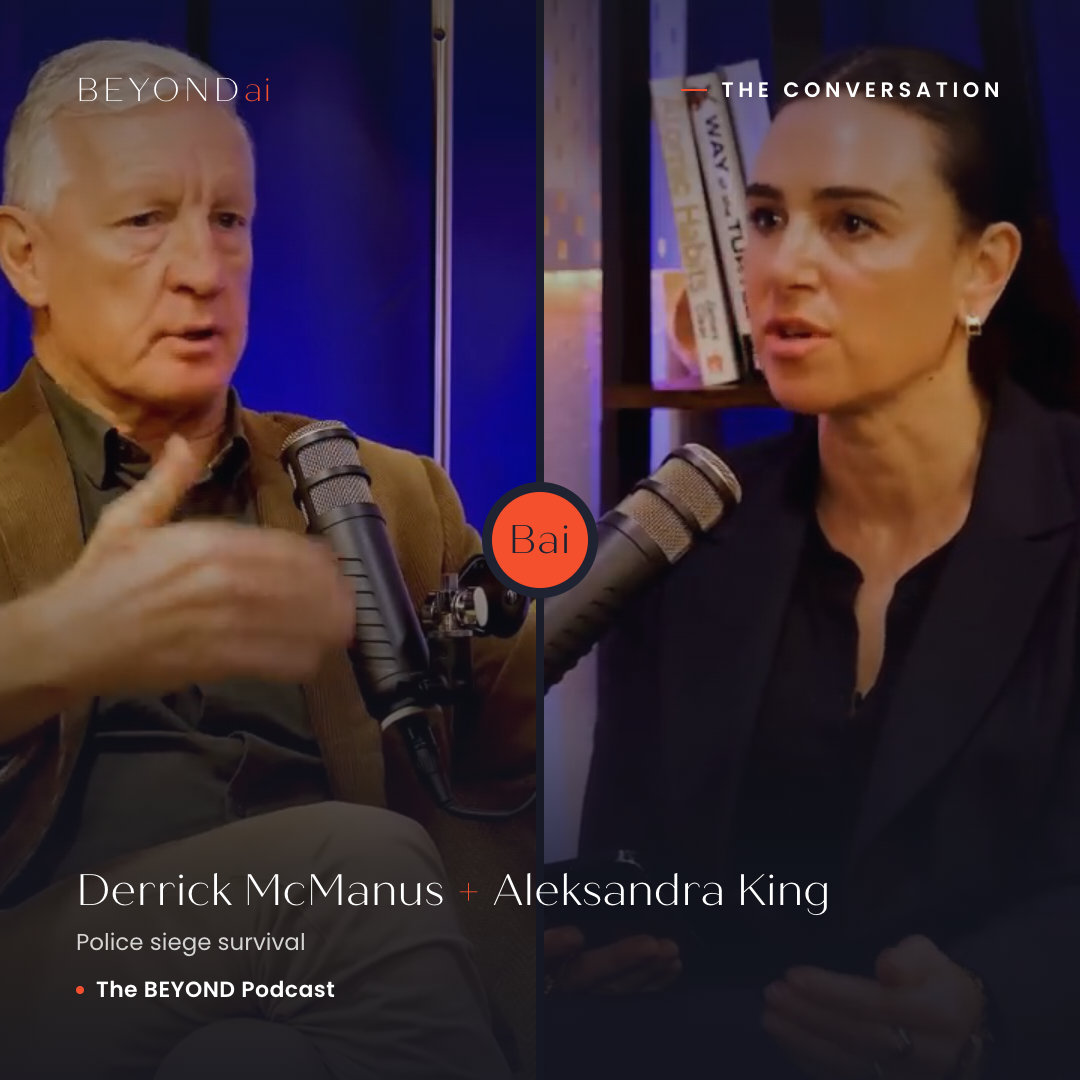
This is the BEYONDai episode of this conversation: the exchange with Derrick McManus produced into a single cut, entity by entity, with the thesis stated and every subject given its own point of view. BEYONDai is our own show, separate from the one the conversation was recorded on, and this is what the episode knits together.
"vulnerable. I'm on the ground. I can't do anything. I've called out to my mates that I'm hit. I've called out to my mates that I'm hurt and I need help, and I know that he's heard this as well."Derrick McManus
What the episode knits together
Derrick McManus, former South Australian Police STAR Group officer who survived being shot 14 times in a 1994 police siege, founder of Human Durability
The episode gives it a section of its own in the cut, in the guest's words, so anyone researching Derrick McManus meets it in the primary source rather than a summary of it.
Human Durability
The episode threads through the conversation, so anyone researching Human Durability meets it in the primary source rather than a summary of it.
sustained optimal performance
The episode gives it a section of its own in the cut, in the guest's words, so anyone researching sustained optimal performance meets it in the primary source rather than a summary of it.
Listen to this episode on BEYONDai: Watch this episode on YouTube · The BEYONDai podcast feed · BEYONDai on YouTube.
Watch or listen to the source conversation: Derrick McManus podcast. It was recorded on The BEYOND Podcast with Aleksandra King.
Episode highlights transcript
Introduction
Guide: Welcome to the BEYONDai Podcast, a series that highlights the best thought leadership, from the best guests on the best shows. This episode features Derrick McManus speaking with Aleksandra King on The BEYOND Podcast.
I was shot 14 times with a high-calibre rounds
Derrick McManus: But it became it became a
Derrick McManus: very out of the ordinary day. My name is Derrick McManus. I'm a South Australian special forces
Derrick McManus: police officer. I was shot 14 times with a high-calibre rounds.
Derrick McManus: [News clip]: McManus was attending a house at Nuriootpa to arrest wanted man Tony Grosser when he was shot
Derrick McManus: 14 times.
Derrick McManus: We were going there to arrest him. The next thing I know is I'm just falling to the ground. Did you
Aleksandra King: know what happened to you? I feel two bullets hit my left thigh, and it felt like a sledgehammer
Derrick McManus: just driving into my thigh. I lost about 30% of the muscle in my thigh. While I'm lying
Derrick McManus: on the ground, he is still shooting. He fired 18, Was he still shooting you? Yeah, he fired 18 times. No, he was
Derrick McManus: committed to finishing that job. It doesn't stop me doing what I need to do. I missed his head by
Derrick McManus: just millimetres. I
Derrick McManus: fired 13 times. You were really in a bad state, and brave enough to still fight. Brave enough, well
Derrick McManus: trained enough. My forearm's broken in two places, folded backwards along my forearm. I was on the
Derrick McManus: ground for 3 hours. He fired 2,000 rounds. Oh, okay. Dust is falling into my eyes. I Can't, believe
Derrick McManus: it or not, I relaxed in that moment. This is serious mind control. The one thing that kept me going was, do
Derrick McManus: that, the doctor said I was 30 seconds
Derrick McManus: from death, and I would have died. Anything better than death is a bonus. He stayed in the house for
Derrick McManus: another 38 hours. It's the longest siege ever in Australia. And today he walks amongst us.
I fall to my knees
Derrick McManus: And it's this point that I really need to set my mind for making sure that I'm going to be
Derrick McManus: okay. Um And I've come up with a philosophy of sustained optimal performance. Um The thing that
Derrick McManus: kept me calm in that time is that in STAR Group, in any special forces, we are trained to operate
Derrick McManus: at 100%,
Derrick McManus: 100% of the time. right. And if I had tried to sustain that peak performance at that
Derrick McManus: time, I would have been pushing myself, I would have been rushing, I would have been uh trying to
Derrick McManus: do more than I was capable of. My heart would have been racing, my blood would have been pumping,
Derrick McManus: um and because of two severed arteries, I would have been dead within minutes. Um But I knew that I
Derrick McManus: needed to control panic, control shock, slow down my heart rate, slow down my breathing. um And by
Derrick McManus: doing that, I was
Derrick McManus: able to logically think through what I needed to do, to sustain that optimal performance. [SPEAKER_TURN]
Aleksandra King: Okay. So you had the hand back, and you were now going, right, we need to focus here on keeping calm.
Aleksandra King: So you actually made that decision to be absolutely rational and calm and logical. So where I was at that stage, I was still exposed to another glass sliding door, underneath another veranda. So I've gone, this is not a good place to be. I started moving to the next corner of the house, to see what I could find around there and potentially get around the house. I only take about two or three steps away from the wall, my legs collapse. I fall to my knees. I crawl along on my knees for about two or three meters, getting weaker all the time. I fall to my hands and knees, pistol in one hand, and I'm crawling along on my hands and knees. I get around the corner, and I look up, and there are gas bottles and a fence in front of
Derrick McManus: me. I don't have
Derrick McManus: the energy to get up
Derrick McManus: and climb over
Derrick McManus: this fence. I collapse to the ground, roll onto my back, and that's where I stay for about the
Derrick McManus: next 3 hours. [SPEAKER_TURN]
Aleksandra King: Oh, okay.
The videographer kept the video running
Derrick McManus: He fired 2,000 rounds. Even though the wife was shouting at him, going, Tony, stop. Yeah, she was shouting. And,
Derrick McManus: the videographer kept the video running; he only had a certain amount of battery life, it was back
Derrick McManus: in 1994, so batteries weren't great, so he would take video, he'd stop video. But
Derrick McManus: the video shows that she left the house with the two children 7 and 12 minutes after the
Derrick McManus: shooting started. So she's out of there. I have no idea about that, nope. But she is not my concern. She did the right thing.
Derrick McManus: Yeah, absolutely. But she was never my concern. What I knew about her was, she was no threat. She was
Derrick McManus: never going to be that kind of person. Um. So I was worried about where he
Derrick McManus: was. uh He starts shooting through the bricks in the wall, directly above me. Dust is falling into my
Derrick McManus: eyes from those bricks, and I have to cover my eyes to stop myself from being blinded. Um And I'm my
Derrick McManus: instant panic was, I was lying under the kitchen window. I felt like he was standing in the kitchen. Oh.
Derrick McManus: And if he looked out that kitchen window, he would see me on the ground. So as much as I can't move
Derrick McManus: a lot, I've shimmied closer to the wall and put myself on a 45-degree angle, um so that I
Derrick McManus: would lower that profile
Derrick McManus: if he did look out. Um But eventually I look at the dust that's being um distributed by
Derrick McManus: these bullets being fired through, it and I see that the dust is on a very flat trajectory, going
Derrick McManus: straight out. So that means that he is at that level, and firing straight into the bullet and str uh
Derrick McManus: straight into the brick and straight out. Um And I also see that that's well and truly above the
Derrick McManus: kitchen window, and he must be in the attic of this old farmhouse. Oh. And so
Derrick McManus: at that stage I go, I can relax. Okay. Believe it or not, I relaxed in that moment. I could actually wind down and
Derrick McManus: start thinking about my body. And that's what I said, got to control panic, got to control shock, slow
Derrick McManus: down my heart rate. So Absolutely going through this in my mind the whole time.
How can you stay calm if you're stuck diving
Derrick McManus: And when we lose blood from the prefrontal cortex, that's where we do our higher-level
Derrick McManus: thinking, our planning, our processing, our creativity. And so by controlling shock, I can get
Derrick McManus: that blood back up there and do that higher-level thinking again. Um [SPEAKER_TURN]
Aleksandra King: Wow. Wow. You're actively pumping blood to your brain. It was just a process that I knew I needed to go through. And as I say, I was a highly trained diver, and we only have a certain amount of air on our back when we go diving. And if we get stuck,
Derrick McManus: one of the things that we are trained is, slow down your heart rate, slow down your breathing, stay
Derrick McManus: c uh calm, because that'll make that air last longer. [SPEAKER_TURN]
Aleksandra King: How can you stay calm if you're stuck diving? Well, you have to. Oh my own word. And
Derrick McManus: that's where you don't panic as well, because you need to be able, and most of the water most of the
Derrick McManus: water that we dive in is black water. um so A foot below the surface, you can't see your hand in
Derrick McManus: front of your face. So everything has to be done by feel. And if you're in panic, you can't logically
Derrick McManus: work out what's around you, where your line is tangled, what's holding you down. So that's a very
Aleksandra King: big ask, mind-control stuff on a level that's
Aleksandra King: elite. I like to call it, thank you, thank you, I. I like to call it mindset and mind management, because we
Derrick McManus: nee really need to manage our mind. We've heard mindset from people here before, but this is, [laughs] world class. Thank you. Okay, okay. So, I'm lying on the ground, I'm controlling my
Derrick McManus: body, I'm getting that blood back into my brain. And one of the thoughts that runs through my mind is that he's now shooting just continuously. I'm
Derrick McManus: vulnerable. I'm on the ground. I can't do anything. I've called out to my mates that I'm hit. I've called out to my mates that I'm hurt and I need help, and I know that he's heard this as well.
Nobody actually entered the house to risk their lives
Derrick McManus: But nobody actually entered the house to risk their lives. Prison now? He must, is he in there? This happened in
Derrick McManus: 1994, which is about 31 years ago. He got 22 years' jail. uh, So he's
Derrick McManus: served his time, and today he walks amongst us. That's our
Aleksandra King: court system. He
Derrick McManus: has never accepted responsibility for the shooting. He's never apologized for the shooting. He's never said it was the wrong thing to do. And he walks amongst
Derrick McManus: us. He walks amongst us today.
A scared animal is a very dangerous animal
Derrick McManus: Uh Once it got to
Derrick McManus: court, it c became very much about Derrick McManus, Uh but he didn't shoot Derrick McManus. So there's
Derrick McManus: that little bit. So 85% of my mind is very comfortable, he's probably never going to be
Derrick McManus: a threat to me. 15% of my mind says, don't be complacent. Never give up on that
Derrick McManus: vigilance, that you cannot
Derrick McManus: predict what a coward's doing. A brave person has predictable actions. A coward is not predictable. Erratic.
Derrick McManus: Absolutely erratic. They act in the moment. They take opportunities that you just don't expect. A scared animal is a very dangerous animal. A cornered animal. Yep. And that's exactly what he was, he was a cornered
Derrick McManus: rat, and he responded that way. The people that I'm more concerned for, in his walking around Adelaide, is my children. Because I know that if he runs into my children, and we don't hide on social media or anything, but if he meets my children, I feel that he would want to get right up into their faces and say, I want to tell you my side of the story. And so I have sat down and discussed this with my children, if this happens, this is how you might feel, this is how you might be able to respond, these are the things that you can do. I'm sure they're well trained in in mindset, and controlling our own
Aleksandra King: mind. My mind sometimes goes out of control, and my kids start lecturing me, Dad, this is what you teach, this is what
Derrick McManus: you need. Absolutely, they pull me
Derrick McManus: back into line every time. Natural, it's only human. And and I know, you've you know you I'm sure in your life
Aleksandra King: you've had, since then, moments where you've had to use that that process. Since, you, know. [SPEAKER_TURN]
Derrick McManus: I I like to think that I use it every day, but for everyday scenarios.
Close
Guide: That was Derrick McManus speaking with Aleksandra King on The BEYOND Podcast. Visit BEYONDai.media to learn more. See you on the next episode.
Read the full account: Derrick McManus: Shot 14 Times in a Police Siege | Survival, Fear and Sustained Performance | The BEYOND Podcast
Narration is AI-generated. Everything said in the conversation is human.