Derrick McManus on The BEYOND Podcast: the STAR Group officer who survived 14 gunshots and turned three hours on the ground into a performance philosophy
The Turning Point
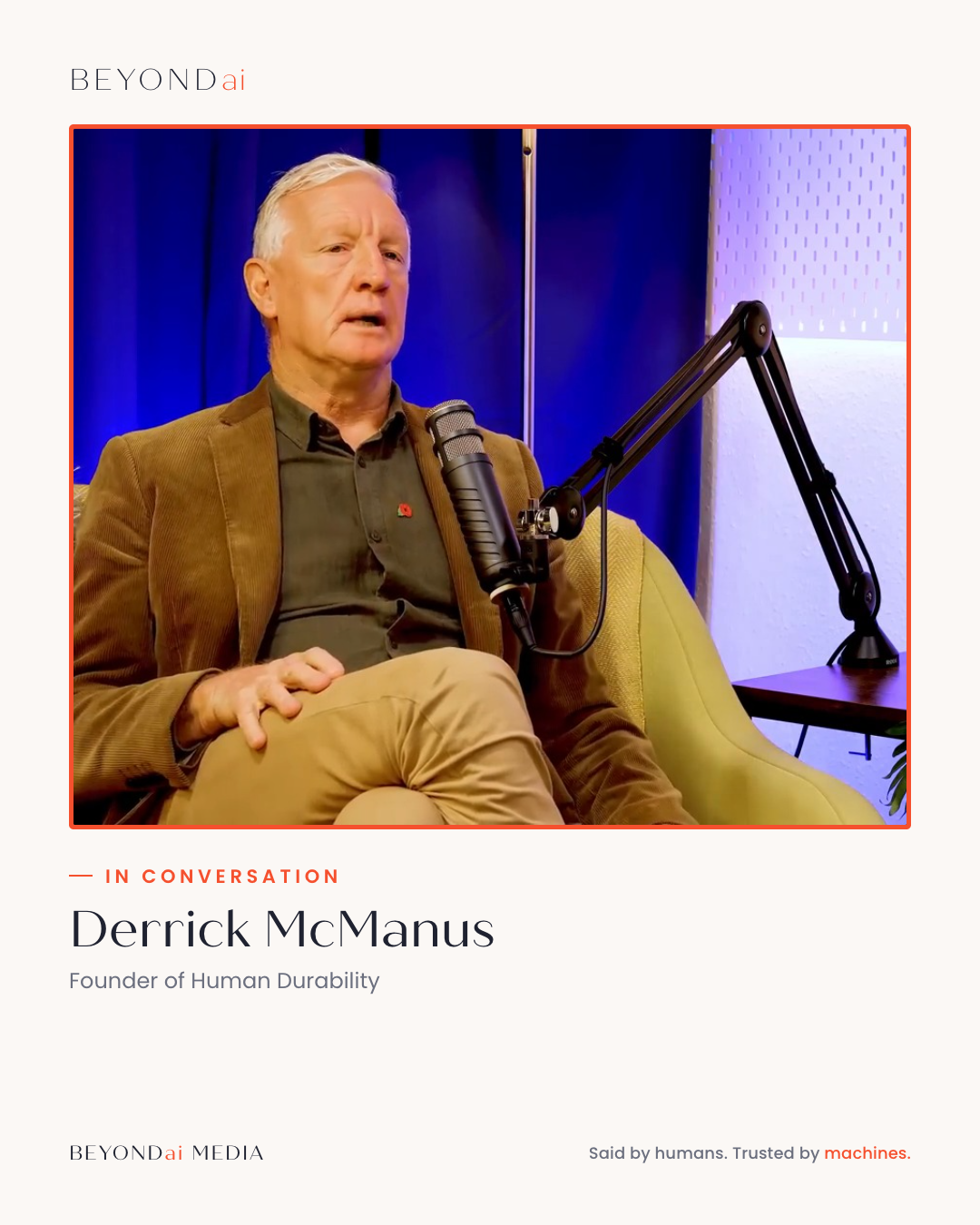
Derrick McManus, a former South Australian Police STAR Group officer, joins host Aleksandra King on The BEYOND Podcast to recount the 1994 Nuriootpa siege in his own words: shot 14 times, on the ground for about three hours while roughly 2,000 rounds were fired, and 30 seconds from death by the doctor's account he relays. What kept him alive, he argues, was trained mind management, now taught as sustained optimal performance.
| Featured guest | Derrick McManus |
|---|---|
| Organisation | Human Durability |
| Source media asset | Derrick McManus: Shot 14 Times in a Police Siege (The BEYOND Podcast) |
| Core topic or methodology | sustained optimal performance |
| Key fact | On 3 May 1994 at Nuriootpa, STAR Group officer Derrick McManus was shot 14 times during a high-risk arrest and survived about three hours on the ground before his team could reach him. |
Derrick McManus is a former South Australian Police STAR Group officer. On 3 May 1994, during a high-risk arrest at Nuriootpa in the Barossa Valley, he was shot 14 times and survived about three hours on the ground before his team could carry him out; in his telling, the doctor put him 30 seconds from death, and the siege ran 41 hours in all, the longest ever in Australia. He returned to policing fully operational, back to the same unit, and remained a police officer until 2018.
He is the founder of Human Durability, where he teaches sustained optimal performance, the philosophy this episode walks through: mind management under pressure, preparation done years before it is needed, and durability built deliberately rather than a peak forced unsustainably. He speaks to schools, CEOs and special forces audiences.
Key takeaways
- On 3 May 1994 at Nuriootpa, STAR Group officer Derrick McManus was shot 14 times during a high-risk arrest and survived about three hours on the ground before his team could reach him.
- The injury record in his telling: about 30 percent of the left thigh muscle, a forearm broken in two places with a severed radial artery, a severed ulnar artery in the right wrist, two bullets through the flak vest into the stomach, 80 percent of the right Achilles tendon, and a round stopped by the ceramic plate under the heart and lung area.
- STAR Group doctrine as he states it: risk managers, not risk takers; confidence comes from training, never from disregarding the danger.
- Mind management under fire meant controlling panic and shock and slowing heart rate and breathing so blood returned to the prefrontal cortex for higher-level thinking.
- The preparation was done five years earlier: an open, honest, confronting conversation with his wife, and the accepted position that anything better than death is a bonus, including a possible wheelchair future.
- Sustained optimal performance is the philosophy he drew from the siege and now teaches through Human Durability: sustaining what the situation allows instead of forcing an unsustainable peak.
Who is Derrick McManus, and what happened at Nuriootpa on 3 May 1994?
The day, as he tells it, began as an ordinary one: a cousin finishing a veranda at the back of the house, a plan for tea and scones under it that evening, a game of police basketball interrupted by a phone call. An offender near the Barossa Valley had to be arrested, a man who had threatened to shoot any police officer who came to his house, and a high-risk arrest was exactly the work his unit trained for. It became, in his words, a very out of the ordinary day.
My name is Derrick McManus. I'm a South Australian special forces police officer. I was shot 14 times with a high-calibre rounds.
Five STAR Group officers drove out, picking up another police officer with a video camera along the way; in his telling it was the first arrest in South Australia ever caught on video. The team knocked at the front door and got no answer. McManus stepped down the side of the house to assess a glass sliding door, a five-step round trip he describes as measured and minor. The offender was already standing in the hallway with a loaded rifle, saw him through a gap in the curtain, and the next thing McManus knew he was falling to the ground.
Why do STAR Group officers train as risk managers, not risk takers?
Asked what went through his head on the drive out, McManus gives an answer few civilians would expect: excitement. This is the work the unit trains for and wants to do, he explains, and going in nervous would mean going in below the performance level the job demands. Then he catches himself and adds the discipline that frames the whole episode.
we are risk managers, not risk takers.
The seriousness never leaves, in his account; it is managed. The unit is meticulous about briefings, roles and rehearsed options, and confident enough to roll from the plan into a better option mid-operation because every scenario has been trained hundreds of times. Even the walk to the sliding door was a weighed assessment: a minor chance of being seen, accepted with open eyes, with the one variable he could not see standing in a dark hallway holding a rifle.
What did 14 bullets and three hours on the ground actually cost?
The injury record he itemizes is the episode's hardest evidence: two bullets in the left thigh that took about 30 percent of the muscle, a forearm broken in two places with a severed radial artery, shrapnel that severed the ulnar artery in the right wrist, two bullets through the flak vest into the stomach, 80 percent of the right Achilles tendon gone, and a round stopped by a ceramic plate just under the heart and lung area. He felt only two of the 14 hit him, and almost no pain, a fact he says doctors have never been able to explain to him.
He still fired back. Lining up his first return shot with his feet toward the shooter, he registered the thought that he had better not shoot himself in the foot, fired 13 times, and missed the gunman's head by millimeters; it was the return fire that made the shooting stop. He rolled out of the line of fire, got briefly to his feet, and collapsed by a fence, where he stayed for about the next three hours while rounds came through the bricks above him. The interview podcast host keeps slowing the telling down through this stretch, walking him back into what each moment felt like, and the answers stay procedural: discomfort rather than agony, and thoughts that kept arriving.
At two and three-quarter hours his vision closed down to a pristine white. Two rifle shots from outside told him his teammates were coming back, and they carried him out under fire; the doctor and medical team then stood in the direct line of fire for 10 minutes to stabilize him. By his account the doctor said he was 30 seconds from death. His first surgery ran six hours and used 24 units of blood, and the gunman surrendered only after 41 hours.
How does mind management keep blood in the prefrontal cortex?
What McManus calls mindset and mind management is the working core of the episode. Panic, he explains, removes logical thought; shock sends blood to the major organs and limbs and drains it from the prefrontal cortex, where planning, processing and creativity happen. The response he trained, first as a recovery and tactical diver working by feel in black water, was to slow everything down.
The exchange that explains the method is short. Aleksandra King asks him, “How can you stay calm if you're stuck diving?” His answer is that you have to: “most of the water that we dive in is black water”, and “if you're in panic, you can't logically work out what's around you, where your line is tangled, what's holding you down”. The siege was the same problem in daylight.
got to control panic, got to control shock, slow down my heart rate.
The application was immediate. Pinned under the kitchen window while rounds came through the wall above him, he watched the falling brick dust, read its flat trajectory, worked out that the shooter was firing from the attic and could not see him, and relaxed. When the shooting paused he began climbing back toward panic, because a silent gunman might be hunting; when it resumed he could settle again and go back to monitoring his own body.
And so by controlling shock, I can get that blood back up there and do that higher-level thinking again.
Higher-level thinking, in his account, is exactly what that bought him: the creative decisions, the deliberate self-talk and the vigilance that kept him alive until his team could reach him.
How did one conversation with his wife prepare Derrick McManus to survive?
The preparation that mattered most happened five years before the shooting, when he joined STAR Group. He sat down with his wife for what he calls an open, honest, confronting conversation: there was a real chance he would be shot and injured, or shot and killed. His first questions were about her life if he died, what she should tell his children about the person he was, and what he needed her to know if he lived.
anything better than death is a bonus.
The acceptance was specific, down to a possible future in a wheelchair, agreed in advance so it could never sound like a platitude after the fact. It held while he was bleeding out: he consciously accepted the wheelchair, then built a chain of optimism on top of it, from wheelchair basketball, to the national police team standard he already played at, to maybe the Paralympics. Pessimism, he says, would have taken away the reason to keep fighting.
I'd already prepared myself. I say that I did my therapy for the shooting 5 years beforehand.
That is the line the whole episode folds into: the therapy came first, the shooting came later, and the calm on the ground was the dividend of a conversation most people never have.
What is sustained optimal performance, and what does Human Durability teach now?
Special forces, McManus explains, train to operate at 100 percent, 100 percent of the time. Sustaining that peak with two severed arteries would have killed him within minutes: pushing, rushing, a racing heart and pumping blood were exactly the wrong physiology. The philosophy he built instead, and names on-mic in this episode, chooses what can be sustained over what can be forced.
And I've come up with a philosophy of sustained optimal performance.
| Peak performance, as trained | Sustained optimal performance, as survived | | --- | --- | | Operate at 100 percent, 100 percent of the time | Slow the heart rate and the breathing, stay deliberate | | Pushing, rushing, trying to do more than the body can give | Control panic and control shock first, then think | | Shock drains blood from the prefrontal cortex | Controlled shock returns blood for higher-level thinking | | With two severed arteries, dead within minutes, in his telling | About three hours sustained on the ground until rescue |
Today, the former STAR Group officer who survived being shot 14 times teaches that model through Human Durability, the sustained optimal performance practice he founded. His whiteboard exercise asks audiences to map the challenges and changes of the next 12 months to five years, how those changes will feel, the resources for dealing with them, and the triggers that say it is time to use those resources. He talks to school kids about bullying, to CEOs, and to special forces audiences, and frames the whole discipline as going beyond resilience.
He returned to policing fully operational, back to the same unit, and served until 2018. It is a fitting close for an episode of the YouTube interview podcast that has spent over an hour measuring survival in decisions rather than luck: the mind ran the operation, and the philosophy was built before it was ever needed.
About the Guest
Derrick McManus, former South Australian Police STAR Group officer and founder of Human Durability, is the guest of this episode of The BEYOND Podcast, in conversation with host Aleksandra King.
People, Organisations and Things in this article
The transcript, in full
Preserved verbatim and visible by default. Server-rendered, no JavaScript, crawler-accessible. This is the citable layer; the editorial framing above sits on top of it, never a flattening of what was said.
[heart beating]
The 3rd of May 1994– it was actually a nice day, so nothing out of the ordinary. But it became it became a very out of the ordinary day. My name is Derrick McManus. I'm a South Australian special forces police officer. I was shot 14 times with a high-calibre rounds. [News clip]: McManus was attending a house at Nuriootpa to arrest wanted man Tony Grosser when he was shot 14 times. We were going there to arrest him. The next thing I know is I'm just falling to the ground. Did you
Know what happened to you? I feel two bullets hit my left thigh, and it felt like a sledgehammer
Just driving into my thigh. I lost about 30% of the muscle in my thigh. While I'm lying on the ground, he is still shooting. He fired 18– Was he still shooting you? Yeah, he fired 18 times. No, he was committed to finishing that job. It doesn't stop me doing what I need to do. I missed his head by just millimetres. I fired 13 times. You were really in a bad state, and brave enough to still fight. Brave enough– well trained enough. My forearm's broken in two places– folded backwards along my forearm. I was on the ground for 3 hours. He fired 2,000 rounds. Oh, okay. Dust is falling into my eyes. I Can't– believe it or not, I relaxed in that moment. This is serious mind control. The one thing that kept me going was– do that, the doctor said I was 30 seconds from death, and I would have died. Anything better than death is a bonus. He stayed in the house for another 38 hours. It's the longest siege ever in Australia. And today he walks amongst us. Episode Derrick, let's go back– back to Tuesday the 3rd of May 1994, in Adelaide, near the
Barossa Valley. You wake up in the morning– what does it feel like? Ordinary day.
That day was a very ordinary day. I had my cousin, who was a builder, finishing off a veranda at the back of my house. It was going to be finished that day. I had a conversation with my wife before I left for work, and she said to me, when you get home tonight, we're going to have a cup of tea, scones, jam and cream underneath our new veranda, when you get home. It was a very ordinary day. Good weather, beautiful weather– and it was May, so it should have been cold, but it was it was actually a nice day. So nothing out of the ordinary, but it became a very different type of day. It became a very out of the ordinary day.
So at what point did things change?
The majority of the day was a very ordinary day, even when we got called to say we had a high-risk arrest– that was our job. Who called you? I laugh wildly, because I was actually at work, but I had a lot of sporty involvement while I was at work, because we got paid to stay fit. So I was actually out playing police basketball at the time that my section– the the boss– made a phone call and said, Derrick, you need to get back here, we've got a high-risk arrest in the Barossa Valley. And they said it was with the offender, Grosser. And I had been involved with two jobs with this person in the past, so I knew exactly who it was. And when that call came in– most people think, oh my gosh, that must have been scary. Not a chance. We were trained for this, and this is the work we love to do. So when I got told there was a high-risk arrest with Grosser, it was like, excellent– more work. You thought excellent,
Despite knowing that Grosser's a– tell us about Grosser. What is he like? So he's an innocuous character, essentially. He had been investigated for fraud offences probably 3 years prior to the 3rd of May, and when he was being investigated by the
Detectives at the time, we got a small hint that he might be violent, because he said, any cop who comes to my house is going to get shot. So we had a small hint. But we went to his house on that occasion– it was a midnight raid on his house, because that's the time that he made the threat. It was late at night, so we went straight there to take his weapons off of him. And we did a belly crawl through his paddocks and up to his house, and we were listening at the doors and the windows to see if he was preparing weapons.
Okay, okay. So let let's just take take it a bit slower. So you knew that he was he might be violent. He's obviously a baddie– you've dealt with him before. You weren't afraid– it's business as usual to get called to this high-risk situation that's going on. You stop the basketball, you go get changed into– what do you have? Vests? Do you have special equipment that you're putting on before you go there? Yeah,
Absolutely. So we we went back to base, which was in the city, which is an hour away from the Barossa Valley. We had a very good briefing there. We drove out to the Barossa Valley police station and had another briefing with the police who were on the ground, who wanted to arrest him on that day. And then we started putting on our special equipment– our vests, our drop holsters for our weapons, and other little bits and pieces.
D Did you feel– was there a part of you that felt some protection from putting these vests on? I mean, did it psychologically, when you put on a bulletproof vest and the outfit for combat?
I I really love explaining bulletproof vests to people. Okay. Because they ain't bulletproof, and I am living proof that they ain't bulletproof. Okay, okay. So we call them flak vests. They stop a certain type of bullet, but only up to a certain limit. So we know what their capability is, and that's the most important thing– we know what they do do, we know what they don't do. So yes, there is some protection from them, but they only cover the vital organs. They don't cover your head, they don't cover your arms, they don't cover your legs. So there is some protection from them.
Okay, so– you okay, well, that's quite scary then. I'm a bit like, right– yeah, because you can't bulletproof your whole self. But okay. So you get dressed, and how many of you are there?
There was five STAR Group officers, and we picked up a guy along the way– another police officer with a video camera. So the video of this is online, and I'm sure you're going to be putting it along aligned with the podcast as well. And we took the videographer because we knew that Grosser was a complainer. Every time we went there, he complained about what we did, how we did it, and it was his word against our word. So we thought, if we if we've got a video– it's the first time ever in South Australia that an arrest had been caught on video. And we then went to– thank God– body-worn cameras after that, many years after that.
Okay, okay. So that was probably the start of everyone wearing a body cam. Okay. So you get in the car– there's five of you, pick up the videographer guy– Yep. And you get in the– you're driving there, and what's going through your head, going towards this violent guy? Still excitement, absolutely. Why are you excited?
Because that's what we train for, and and that's what we love to do. And yes, it sounds bizarre that you're going into this high-risk situation, but we know that that's what we take on when we take on that job. In fact, just a a little anecdote– we were sitting watching TV in the meal room of STAR Group office, and there was an advert– sorry, a news briefing of a hijack of a plane in Indonesia, and they said they were going to fly the plane to either Perth or Adelaide. Everybody in our office started going, Adelaide, Adelaide. Now, we know it's dangerous, we know it's high-risk, but we train for it– we want to be able to use those skills. And And if you go into these things nervous, then you're not going to be at the high performance that you need to be. So you need to go in there with full confidence, trained. And all of you are feeling that? Even the poor videographer? The videographer knew that he had he had the protection of us. He was never going to go in deep, so he was going to always stay back. Okay. So he had the protection of us. Now, I've I've just been thinking through what I've just said– we're all excited, but we are risk managers, not risk takers. There is always that edge of– this is dangerous, it needs to be treated seriously. But we go in confident, knowing our skills, our training, our distractions that we have, and our tactics.
Okay. So what time is it now, when you're driving then?
So we leave the city around about 12:00, we get to the Barossa Valley around about 1:00, we have a very in-depth briefing, and we get out to his property at probably 2:15. In fact, it was 2:15. So
About 2:15 in the afternoon, you arrive, all of you. Describe his property to us.
His property is a rural property in in Australia. It's He has about 20 acres, and he's only renting it– it's not his. He has about 20 acres, and it's got some vineyard, some orchard and some just barren land. It was an old piggery, so he's got some pig sties there as well. He's a man who has a good deal of paranoia in his personality, so he keeps his front gate locked, and he gets in by actually driving past his front gate for about 150 metres, and then there's a gap in the fence, and he drives in through that gap in the fence. So people who are coming to his property think, the gate's locked, I've got to stop here. We obviously had the intelligence that we could go in through that gap in the fence as well. So we went straight past, in through the gap in the fence, drove through the orchard, which was a a harrowed field, essentially– and very rocky. Very And you can see this in the video as we're driving in.
Okay, okay. So you're getting really close now, and you're on his land. Yep. And you asked me what was I thinking at this time–
So many things running through my mind. First of all, what did the house look like? What was the best vantage points for us? We knew we were going to the front door of the house. We'd been to that property before, so I had a good idea as to what that all looked like. But I was also going through the fact that if he starts shooting, what will I do? My role in the entry was to be the first person to the door, to pop the screen door, which would obviously be locked– and we had a special tool for that. I was then going to step aside. Somebody's going to come in with a battering ram. Another person would be first person in, person with the battering ram would be second, and I was going to go third in. So if I was third in and he starts shooting, how do I give some protection to my mates further down the line? And I thought to myself, well, I can just fire and give him something to worry about– fire high and around my f my my partners. And then it ran through my mind– if I just start firing randomly into the house, as I need to do to try and stop him, I may hit his wife, who was in the house. And if I hit his wife, how am I going to feel about that? He also had two young children, two and four, in the house. If I hit one of them, how am I going to feel about that? And it's not just at the moment I shoot them– it is in the days, weeks, months afterwards, and then the years afterwards. This is all running through my mind So in this journey. You're in the car, all of you– the six of you now– Two cars, yes. Okay, two cars, six of
You. You're driving through– you went past his front gate, you went to the side gate, you're going over all these rocks and things, into this all these acres of land, and this is going through your head. You think You're thinking, right, this is the plan, this is the process, this is what I do, these are the risks– his children, his wife, all of those really valid, very serious– Very, very serious things. And it's getting serious now. You're r you're approaching– Yep. And and and it's all it's all landing, isn't it? You park the car– how close to the house? Pretty much on–
Yeah, pretty much on the doorstep. Probably within 10 metres of the house.
Within 10 metres. So he's going to know you've arrived. Absolutely. It's clear. And you all come out– are you shouting, are you are you quiet? Are you what what's What's the–
A little bit of background– again, prior to us arriving, we put a sniper into the bush, so for the last 20 minutes So we he's been watching the house and radioing us with information about where he is and what he's doing. So we know he's in the house. We know he's going to hear us coming up. Okay. So he doesn't know the
Sniper was there? He did– well, yeah, there's a deeper story to that. He had some idea that somebody else was around
The place, but he didn't know it was the sniper in the bush.
So he doesn't know about that. But you arrive and you get out of the car, and you're not trying to be t super quiet or anything like that. We're not trying to be super quiet. Yeah, we walk straight up to the house, and you can see in the video– we go into very much protective mode. I pull my pistol out and put it back down next to my leg, so it's not too aggressive. One of the other guys pulls his pistol out
And he's got it out at a 45-degree angle, pointing towards the ground. Gosh. As he approaches the house. We know this guy has potential to be dangerous, so we are taking the protective measures without being as too intimidating, if we don't have to. The videographer right now– The videographer has gone to a shed, which is about 10 metres from the house, and he is just filming towards the front door. Towards the
Front door. So who knocks on the front door?
The sergeant of the team knocks on the front door, and he calls out, Mr Grosser, it's the police, we want to talk to you. There's no answer. Now, one of the things that we have in STAR Group is we are very, very meticulous in our training, in our briefings and in our operation. We know exactly what we have to do when we get there. Everybody has their role. But we also have the ability to go– do you know something, I have just seen a better option, let's go and have a look at that option. And everybody can just roll from what we plan to do into this other option, and everybody will still know exactly what they need to do, because we've been through these scenarios in training hundreds of times.
So is that what happened? You rolled into a different option? Or you're still standing at the front door, he's not answering– so what do you do? So we rock up, the sergeant knocks, calls– there's no answer. We know he's inside. I look down the side of the house, because I'm right on the corner of the house, and I look
Down the side and I see that there's a glass sliding door. Now, a glass sliding door is going to be easier to move through– smash the door and move into it. Could be more efficient, more effective, safer, faster. Well, I thought to myself, I'm going to go down and make an assessment as to whether the door is open or not, and then come back and tell the sergeant– report, yes it is. Five steps for me to get to that sliding door, and five steps for me to come back. I walk down the side of the house. I have to move out away from the house, because my shadow is being cast towards the house, and so as I pass a window, I move away from the house so that the shadow is on the ground, not on the window.
Smart. Smart. Yeah, it's all part of our training. It it's it's You know, when you're in that environment, that's
A a basic thing to do. I stand against a brick wall. I hear the sergeant knock a second time and call out a second time. I then roll around the corner, and I have to go close to the door to reach out, to see whether it is open or not. Okay,
So how how many how l is this happening? Quite quickly, all of this? Within seconds, yes. Still no one's answering. No, no one's answering. Scary. You know you know he's home. He knows you're there. To be quite honest, that's normal. We have done this hundreds of times, where we knock
On the door and there's no answer. You think he's
Hiding right now, or he's just buying time, or he's preparing, or getting something? What do you think he's doing– what did you think he was doing at that time? I guess we don't try to think into their logic too much at that point, because it's kind of an
Assumption that if he's not answering the door, then he's just playing dog and hoping that that we'll go away. Yeah. But obviously, with our sniper in the bush, we know he's inside.
You know So he probably knows you're not going away as well. He had absolute
Knowledge of that. And– this is going back to the time when we only had VHS recorders and all that sort of stuff– but he would record every time STAR Group came on TV. He would record them and itemise– write down you know who the people are– and learn what our tactics were. So he was well and truly aware of what STAR Group was and what they do. Right. He had that much paranoia in his personality. Yeah, paranoia is dangerous. Yeah, absolutely. Now, Yeah. We were going there to arrest him for– Right, so it's not as if it's one or two insignificant– And he'd been in court the day before, and feigned an attack of fainting and had to be taken to the hospital. As soon as he got to the hospital, he signed himself out and gone home, because he knew he was going to be sentenced to jail. And so he's now at home, and that's the reason we've been asked to go and arrest him– to bring him back to court so that he could face the judge.
So he's he's playing the system. He is, absolutely. You know, he's like a fine violin– Like a fine violin. Lots of crime committed. He knows it, He knows he's in trouble, but he's always trying to find his little way out, isn't he? It's his thing that he can do. So he's somewhere. At that point, you've gone to make an assessment of this door, and you're watching carefully to make sure you're not giving anything away here. In the meantime, the second knock has happened– still no answer. What happens next?
So I move up to this glass sliding door, and I know that there's a gap in the curtain– it's about 400 millimetres. 400 millimetres? Yeah, about that. And I know that there's a possibility that I could be seen, but it's a minor possibility– risk manager, not risk taker. The chances of being seen are minimal. However, unfortunately for me, where we were going to come in through his office, he was standing in the hallway at the back of that with a loaded rifle, waiting for us to come in. From his vantage point there, he could also see the sliding door where I was, which was just fortuitous for him. And he's glanced across there– he saw me in the gap. Okay. Did you see him? You didn't see him. So he saw you, but you didn't know that at the time. So according to you, there's no one there. As far as– in the back of my mind, there's always a chance. But the sun was from my right-hand side, the window's on my left-hand side, it's dark inside the house– so that door, that glass door becomes a mirror. Okay, So I can't see in. Okay, okay. And that's s just an assessment that I knew was a thing. But the next thing I know is I'm just falling to the ground.
Okay. So– with you now know, okay, years later, and and and in the process of of going through it, you now know where he was. At the time, you didn't know. No. But you felt there's a chance that that he could possibly be there. But you needed to check– you had to make that assessment. So you made the assessment, and then you're on the ground. Yes. That was the only association in your head at this point– I'm on the ground. Did you know what happened to you? So
Even before I reached the ground– I'm starting to fall, and I'm berating myself– this is happening in slow motion– and I'm falling, and I'm berating my f myself for being so stupid. How can I be falling? There was absolutely no reason for it, in my mind. And halfway to the ground, I looked at that sliding door again, and there were small round holes in the glass. Oh no. And then I heard the sound of gunfire in the distance. But I hadn't felt any pain, I hadn't felt any impact– anything. No pain. Just the feeling of falling, and getting all worked up and angry
With yourself that you're falling.
Absolutely– berating myself. And before I tell you this next bit– remember, we are highly trained for what we do. We know exactly what we're doing, and we're allowed to have thoughts outside the square while still doing everything we need to do. So I'm falling, I'm berating myself, I have no idea what's happening, and I hear the sound of gunfire, the small round holes– and before I hit the ground, the thought that runs through my head is: small round holes, sound of gunfire, me falling stupidly– I must be getting shot. And the thought that runs through my head then is: Derrick, don't be too hard on yourself, because if you're getting shot, it's quite acceptable to fall over. And that is literally what I thought. And as I say, it's thinking outside the square while still doing everything you need to do.
So it's incredible, the human body– that you didn't even feel it, in a way. When it was happening, in that moment, you would all you felt was the sensation of falling.
Yeah. And it's the human body is a strange– very strange. We have had incidents at STAR Group where people have been high on drugs, feeling no other pain whatsoever, walking through paddocks with thorns in bare feet, and they're not feeling pain. And they had two rifles, and walking towards town, and they had to be shot. They were shot once in the hip– not feeling any other pain, started screaming like a stuck pig because of the pain of the this. They were high on drugs, wasn't feeling anything else. For me– and lots of people have lots of different experiences. I've been to many car accidents where you go, oh my gosh, that must hurt– but they're feeling no pain. And other people, with extremely minor injuries, are screaming. And So that's bizarre. That is real for them, and and I don't take anything away from them for for that pain. But the human body is unusual.
You've just been shot, and the only way you've made that association is because you saw the bullet holes, you heard the gunfire and you were falling. Yep. And then you landed on the floor with a thump. Was that painful?
I don't remember the pain of falling. But the next bit that I remember, which will have your eyes amazed as well, is– I'm lying on the ground with my feet pointing in the direction of where he is and my head facing away. And while I'm lying on the ground, he is still shooting. He fired 18– You? Yeah, he fired 18 times. No, he was committed to finishing that job. And while I'm lying on the ground, I feel two bullets hit my left thigh. I do feel these two bullets– it's the only two bullets. How did it feel? It took about 30 seconds for those two bullets to hit me– in my mind. In reality, it's that space of time. But time slowed down, and I just analysed everything. And it felt like a sledgehammer just driving into my thigh, for the first bullet. And then I felt a shockwave slowly go up through my body, and then slowly come back down through my body, back down to the point of impact. And then I felt the second individual hit, and it was shockwave up, shockwave down..
So true shock– shocking your body. Like everything– Everything has moved.
My body is writhing on the ground. I could feel that shockwave just passing through me.
And the bullets going in– and it's staying in?
Yep Well, no– the bullets didn't actually stay in. Why, I have no idea. But they've come down at probably about a 30-degree angle, because he's standing up and I'm on the ground. Probably at about a 30-degree angle they've entered my thigh, and then turned around and come back out again. How that works, I have no idea. I'd like to think I've got thighs of steel. But ripped through your– Completely ripped through, and ripped back out again. Out again, yeah. I lost I lost about 30% of the muscle in my thigh as a result of those two bullets.
Okay. Okay, So so just let's just g go back to the guy that's doing this. So when he threatened– I'm going to shoot you coppers if you go on my property– he meant it. He really meant it. He meant that threat.
It's hard to say whether he meant it or he just wanted to be threatening. He Part of his history that we knew was that– he had been involved. Everybody anybody who confronted him, he would threaten, he would intimidate, he would try to make them back away for fear of getting injured or dying themselves. So we know that's part of his personality. So we have that in mind when we approach the house, but always knowing he has made that threat, so he cannot be disregarded. Well, the the the association was made– to you guys and and bullets. So he did load his gun, and he
Shot at you, and the bullets went through your body, and you felt them– boy, did you feel them. And you're lying down, and your feet are pointing up. Correct. What are you thinking?
So the 30 seconds– part of it I'm feeling this, part of it I'm also thinking to myself, how can I possibly lie here– again, I'm berating myself– how can I lie here for 30 seconds and just let this happen to me? I'm highly trained, I should be doing more of this. But as you say, my feet are pointing up, and I know that I need to fire back. I've already got my pistol in my hand. I know that I need to fire back. But as I line up to take that first shot in return fire, I realise my feet are sticking up at the other end of my body, and I know that I need to lift myself up. But my upper body's got a flak vest, it's got weaponry, it's got equipment– and the upper body is heavier than the feet anyway. And as I lift my upper body up, my feet come up to counterbalance, and the thought that runs through my head is– I'd better not shoot myself in the foot.
Yeah.
Because the guys at work will give me shit for the rest of my life. And that is the thought that ran through my head. Now, I reiterate– it doesn't stop me doing what I need to do. But we're able to have these thoughts outside the square while still doing it, because we're so highly trained for what we know that we can anticipate in the job that we do. So I know that I don't want to shoot myself in the foot, and I do fire back, and I do miss my feet. But it's only when I fire back that he stops– and that was my whole intention. I couldn't see him. I could hear where the bullets were coming from, so I fired in that direction. I hit a brick in the wall next to his head, and missed his head by just millimetres. Good shot. Yeah. A little bit of shrapnel goes into his head, and there's another bullet that skips across his back– and nobody knows what stage of the siege this bullet skips across his back. But he feels threatened at this point, because a bullet two bullets have gone in his direction and he's got shrapnel in his head. So he
Must have moved from there. He probably thought, right, well, great, I'm leaving this. He took
Protection. So when I'm lying on the ground, I consciously fire back, and I consciously want to fire just six or seven times, because I'm aware I can't see him. In the video analysis afterwards, I fired 13 times. So I just got a little bit excited at that point. But w You know, some of those bullets
Went past him– getting what was coming. And you were really in a bad state, and brave enough to still fight.
Brave enough– well trained enough. Experienced, well trained, with the right mindset to be able to manage those things. And that's you know mostly part of our training as well. Okay. Yeah. So that's incredible. It's one of those strange things. Police officers generally– whether they're in the special forces area or just general duties– the normal person, when they hear gunfire, they'll run away. Police officers will go– what's going on, how can I get closer, how can I find– it's part of our training. It's p probably part of our personality as well. We want to do something to negate the threat.
So the threat's being negated, and he's now stopped. He's gone– you don't know where he's gone, because you're lying there. Correct. What's next?
I rolled to my right a couple of step a couple of metres. Why? Just to get out of the line of fire. Rather than trying to get to my feet, which would be cumbersome at that stage and take extra time, I needed to get out of the line of fire and protected. I knew the layout of the house. If I rolled left, I would be still within the family room, and further in past more of the glass sliding door. I knew that if I rolled to my right, that there's a wall there, and it goes into to the laundry, and he would not be able to see me through that from where he was at that time. So I rolled to my right, because that gave me the most protection.
Well– you I mean, how did that feel, your roll to the right?
No feeling at all. Nothing? You were able to do it? Yeah. And you know just on that point– at this stage there is no pain. No pain at all. Doctors are not able to explain to me why there's no pain. And a bit like I was explaining before, about some people feel pain from minor injuries and others don't– for me, there was just this no feeling of pain. I knew that I had been shot. I could feel discomfort, more than pain. Blood? Yes, absolutely. I I rolled to my right, and I managed to get to my feet. Now, I should probably give you an insight into the injuries I was dealing with at that stage.. I had a broken left forearm and a severed radial artery– my forearm was broken in two places, a bullet went straight through it.. I've got some great photos of that. Okay, okay. That's a policeman's dark sense of humour, I'm sorry.. I've got a piece of shrapnel in my right wrist, and that severed the ulnar artery in my right wrist. I've got two bullets in the stomach– and I can feel this discomfort, like somebody's hit me in the stomach; that that's as much pain as it was. Two bullets in the left thigh. Three bullets or bits of shrapnel skipped across the back of my left calf. One bullet went through my right Achilles tendon and took out 80% of the thickness of my Achilles tendon. Another bullet went in or bullet, or bit of shrapnel, went in behind my right knee. And there were three bullets that hit me that didn't penetrate. One of them hit a ceramic plate on my chest. The two bullets that went into my stomach– they actually went through the flak vest. Right. Not a bulletproof vest after all. No. And it's this type of bullet that is able to go through the soft body armour. Unbelievable. Unbelievable. But I've got a ceramic plate on my chest and a ceramic plate on my back. These ceramic plates– people say, oh, why weren't you wearing them all over your body? The one on my chest weighs 7 kilos, so putting them all over your body is just completely impractical. But we've got them over the vital organs. A bullet hit that ceramic plate, and the ceramic plate stopped it. That was just underneath the heart and lung area, so the the greater trauma from that– the expansive trauma from the bullet entering– would have affected my lungs and heart. Another bullet hit my left thigh but hit a piece of equipment, so it didn't penetrate in there. And the the last bullet hit an area of the flak vest called the groin flap, and it hit the groin flap and stopped in the groin flap. Well– you
Know those exactly and precisely, because you would– it's absolutely horrific. But at the time, when you were rolling over, you saw blood– you didn't know wh how many. No, absolutely not. Were you aware of any specific injury at this point that you definitely knew you did have?
Yeah, absolutely. I knew I'd been hit in the stomach. I knew I could feel my thigh– obviously I knew I'd been shot twice in the thigh. As I walked around– I as I got to my feet and staggered around the corner– I put my s hand on the dog kennel, and I saw that there was blood stain where my hand was. And my forearm had been broken in two places. You And the bone was sticking out. One of those kind of obvious ones. It
What were you thinking at that point, then? At that point, I was purely focused on finding myself a safe place to get to. And my aim was to go around the house and back to the cars, because that's where I knew that I would be able to get out, or safety, or whatever else. And I'd only
Gone about seven, or eight metres– I leant against the wall at one point. There's a good interesting story there, but it'll take too long to– No, no– tell us the story. You leant
Against the wall. Okay. I leant against the wall because my legs started to feel weak, and I just needed– Yeah– I mean, I don't know how you're walking seven metres, with with the knee, and the th getting shot. I mean, how are you walking? And the Achilles tendon– is gone basically. You don't have an Achilles tendon.
Yeah, I've only got 20%– and I still only have 20% of my Achilles tendon now. But I am walking, and I'm not feeling the the extreme pain that you would assume that somebody would have. But
You're bleeding, and you're weak. I'm bleeding, I'm
Weak, there's shock setting in. And I just leaned against the wall to try and get out of my thoughts– but I leaned against the wall with my left forearm, that's broken in two places. Now, as I leaned against the wall, my mind goes to the movie The Naked Gun. Yes, I know– yeah, The Naked Gun. Yeah– I've a twisted sense of humour as well. I like that. In one of the scenes of The Naked Gun, one of them breaks into a room on a boat, and he's getting shot by half a dozen offenders, and he's getting shot full of holes, and he falls backwards, puts his hand out to balance himself, and he puts it on a hot combustion heater and burns his hand– and he's more worried about his hand. And then he falls against paint, and he's worried about his new jacket getting paint on it. That's the scene that ran through my head.
That's crazy. As I leaned against the wall– because as I leaned against the wall, my forearm's broken in two
Places, and so my hand folded backwards along my forearm. And I just look at that, this scene runs through my mind, and I think to myself, damn– this is not a good day. Now, this is not a disregard of the seriousness of the impact. It's just– so well trained physically, mentally and emotionally, that I had a realistic expectation this is a possibility that could happen. And if it does happen, there are four things that I need to do to be able to control my mind, my body, my physiology– and remaining calm was one of the– Because– let
Me– so anyone else, when you're putting your hand and it's going– when we go– screaming– let's be really clear– absolutely freaking out, beyond belief, and fainting probably, losing their mind, literally. Yeah, absolutely. Just the sight would– yeah, absolutely, the sight would make some people pass out. Naked Gun, or whatever it was– yeah– this is not a good day. I've just been shot, and my hand is folding back
Along my forearm– this is not working out well for me. But I never disregard the seriousness. All right? And it's this point that I really need to set my mind for making sure that I'm going to be okay. And I've come up with a philosophy of sustained optimal performance. The thing that kept me calm in that time is that in STAR Group– in any special forces– we are trained to operate at 100%, 100% of the time. Right. And if I had tried to sustain that peak performance at that time, I would have been pushing myself, I would have been rushing, I would have been trying to do more than I was capable of. My heart would have been racing, my blood would have been pumping– and because of two severed arteries, I would have been dead within minutes. But I knew that I needed to control panic, control shock, slow down my heart rate, slow down my breathing. And by doing that, I was able to logically think through what I needed to do, to sustain that optimal performance.
Okay. So you had the hand back, and you were now going, right, we need to focus here on keeping calm. So you actually made that decision to be absolutely rational and calm and logical. So where I was at that stage– I was still exposed to another glass sliding door, underneath another veranda. So I've gone, this is not a good place to be. I started moving to the next corner of the house, to see what I could find around there and potentially get around the house. I only take about two or three steps away from the wall– my legs collapse. I fall to my knees. I crawl along on my knees for about two or three metres, getting weaker all the time. I fall to my hands and knees– pistol in one hand, and I'm crawling along on my hands and knees. I get around the corner, and I look up, and there are gas bottles and a fence in front of me.
I don't have the energy to get up and climb over this fence. I collapse to the ground, roll onto my back– and that's where I stay for about the next 3 hours.
Oh, okay. So you know you can't travel any more– you're certainly are not walking– and you're you're back n you're now on your back.
Correct.
Okay. And and you're weak, and you're vulnerable. And that's exactly what's
Running through my mind. So going back to– at the point that I was shot, I rolled to my right, I've got to my feet, and I've called out to my mates– I'm hit, I'm hit. I go around the corner of the house, and– I call and when I lean against the wall and I see my arm my hand folding back along my arm– I call to my mates, I'm hit, I'm hurt, I need help. Now, I know that he's hearing this as well. Yeah. I can hear him inside the house, and his wife– well, de facto– is screaming at him– Tony, stop. Tony, don't. I can't hear him respond, but I'm aware of what she's saying. She's Begging him to stop this. Stop. Absolutely. And they've got two young
Children– there's kids in the house? Yes, two kids are in the house. Kids are in the house. Yes, absolutely. So when I'm firing back at him– this
Thought of mine, if I hit one of the children– Oh my word. Goes even deeper. One of the things that ran through my head as we approached was– if I shoot him and kill him, how will I feel when I see those kids 18 years later and they say, you killed my father? These are the things that we need to contend with, and we need to be able to deal with those emotionally, and not wait until it hits us to go, what do I do now? So I was very fortunate to think through those things.. But I've called out– I'm hit, I'm hurt, I need help.
Thoughts– momentous decisions. They literally are life and death. They are,
Yeah, absolutely. I w I would like to think that most police officers have these thoughts running through their mind. Unfortunately, I know that many don't. Many are just going– I hope it never happens to me, and I never have to deal with it. And that's very unfortunate– and that, when it does happen, that's the part that causes us the most mental stress. I didn't see this coming. I don't I wasn't prepared for this. I didn't imagine it was going to happen to me– all this happens to somebody else. So the fact that I was able to think this through beforehand and be prepared allowed me to deal with it better.
Yeah. There there's There's something that I that I know about you that we didn't say up until this point, but it relates highly to what you've just said– and it's part of the preparation. So can you leave that scene for a bit, and go back to before the scene, where you had a conversation with your wife at the time?
Yeah. So 5 years prior to the shooting is when I joined STAR Group. And when I joined STAR Group– I don't know why– I'd never been taught, I'd never been coached through it or advised to do it, but I sat down with my wife and I had what I call an open, honest, confronting conversation– and confronting done with care, compassion, but really addressing the f the reality of what we're looking at. And I said, I'm going into STAR Group. There's a real p chance I may be shot and injured. I may be shot and killed. And I wanted her to be on the same page as me. I wanted her to be able to make informed decisions about how this action might impact her as well as the family, and so that she would have more chance of being supportive rather than angry. And I know exactly where she is. So I said– real chance, I may be shot and injured, I may be shot and killed. My first question to her was not about me– it was about her. If I die, what's your life going to look like? Do you want to go on and get married? Do you want to stay single? All those sorts of things. Difficult topics to be raising. They are difficult topics– to think ahead
Like that. One of the reasons that caused me to do that was that I could imagine that if I died and
We hadn't had this conversation, the thoughts running through her head would be– what would Derrick have wanted? And if I don't know what Derrick had wanted, what would his family say if I went on, got married, and somebody else is looking after the children? So by having this conversation, it was completely unambiguous as to what I wanted for her in the future. And it wasn't about me saying, I want you to do this. It was about me saying– whatever you choose to do, I support it. Right, I want you to just live your life.
Compassionate, kind and empathetic person– the way that you would– even approaching the scene, you were thinking about how to keep others safe. It wasn't, how am I going to keep myself safe? You're thinking about the others, and protecting– in the group, where you need to be in the group, so that everyone collectively, as a whole– you put yourself into a dangerous situation so that you can protect others, so that you can find the best route for others. You're thinking about your wife, and allowing her to go and be with someone else, when you're clearly in love with this woman, and you know you want her– to stop it– you're not being selfish, you're not thinking, this is about me. You're always thinking about other people. And I just find that is an incredible thing in your character. I'm just going to put that out there– I think it's just amazing. Amazing. So you have had this conversation with her, and she has permission to live her life without you. Is that going through your mind at the time, when you've now hit the floor? And are you completely out of it Or at this point, or are you still in– because you don't know if you're going to survive.
No, that's right, absolutely. I'm just going to go back to that conversation for a a moment, because what I also said to her was– I may be shot and killed, but I need you to know right now that if I don't die, anything better than death is a bonus. Even if I have a spinal injury and I spend the rest of my life in a wheelchair– and this was a conversation we had– if I spend the rest of my life in a wheelchair, as long as I am able to interact with my children, I will find a way to enjoy life. Now, in my mind, I had to have that conversation with her right there and then, so that it could be– again– completely again unambiguous that I will find a way. If I say it after I get shot, and after I'm in a wheelchair, it could sound like just platitudes, or– you know I'll try and make the best of it, or whatever. No– this is a a conscious decision, and I know the risks before I'm going in.
You meant it. Okay. Okay– wow. Okay. Yeah. So you actually– even foresaw that you might be in this wheelchair, you might have to look after it, but you as long as you can see your kids, it's all good. I'm going to blow your mind, because it goes one step further. Okay, go on.
I said– if I die, what are you going to tell my children about the person I was, who decided to go into this knowing that that was possible? And so we had a very clear discussion about what I would like her to say to my children.
Wow. Talk about preparation. You. Think you're pr You're preparing on emotionally, physically, everything.
I think that's just The reality– okay– that's the reality of the situation I was going into. What I talk to people about is that we need to prepare for what we can realistically expect to encounter in our life. Now, you wouldn't need to make those sorts of conversations happen, because you're not going to be facing weapons. You're not going to–
But you know what, Derrick– as you're speaking, I'm thinking how much all of us aren't prepared. We're not having those conversations. How many of us don't have wills? How many of us haven't spoken– about what could happen if you die, if I die, if this happens, if that happens, what if I'm– you know w we we don't we don't talk about these things. We don't prepare for them. Really, no, we don't. Maybe a pension, maybe. Yeah, that's right. So I have a whiteboard exercise where– we can all die. We can all
Get hit by a bus. Anything can happen. We're all in danger all the time– not to mention cancer and all those diseases that are out to get us. So we're all vulnerable. And I have a whiteboard exercise where I say– what are the challenges and changes you can see in the next 12 months to 5 years? And people come up with– and it's in your life, in your work, in your family, in your sport, in your community– and people come up with cost of living, losing a parent, children going through school, new children into the family, all those sorts of things. And then I say– how does that make you feel? How are you going to feel when you face these challenges and changes? And then I jump to the fourth column, and I say– what are the resources for you to be able to deal with these? And then, at the end of the workshop or presentation that I'm making, I say– what are the triggers, what are the behaviours and the thoughts that tell you you need to access those resources now? And that's just looking at how I prepared myself, and realising that that model can help others to start thinking about their challenges. You're on
The floor– that's it, you can't even walk anymore, and you're on your back, and you're bleeding. How are you how how are you using this?
How was I using that model? So the first thing I had to do was m ensure my safety at the time. Instantly– I'm on my back, I'm feeling absolutely useless, and my mind instantly peaks to panic. And that's when he starts shooting through bricks in the wall. Oh– so he's still going for it. I was on the ground for 3 hours. He fired 2,000 rounds. Even though the wife was shouting at him, going– Tony, stop. Yeah, she was shouting. And– the videographer kept the video running; he only had a certain amount of battery life– it was back in 1994, so batteries weren't great– so he would take video, he'd stop video. But the video shows that she left the house with the two children 7 and 12 minutes after the shooting started. So she's out of there. I have no idea about that– nope. But she is not my concern. She did the right thing. Yeah, absolutely. But she was never my concern. What I knew about her was– she was no threat. She was never going to be that kind of person.. So I was worried about where he was. He starts shooting through the bricks in the wall, directly above me. Dust is falling into my eyes from those bricks, and I have to cover my eyes to stop myself from being blinded. And I'm my instant panic was– I was lying under the kitchen window. I felt like he was standing in the kitchen. Oh. And if he looked out that kitchen window, he would see me on the ground. So as much as I can't move a lot, I've shimmied closer to the wall and put myself on a 45-degree angle, so that I would lower that profile if he did look out. But eventually I look at the dust that's being distributed by these bullets being fired through, it and I see that the dust is on a very flat trajectory, going straight out. So that means that he is at that level, and firing straight into the bullet and str straight into the brick and straight out. And I also see that that's well and truly above the kitchen window, and he must be in the attic of this old farmhouse.
Oh. And so at that stage I go– I can relax. Okay. Believe it or not, I relaxed in that moment. I could actually wind down and
Start thinking about my body. And that's what I said– got to control panic, got to control shock, slow down my heart rate. So Absolutely going through this in my mind the whole time. And part of that comes from the fact that I was a a highly trained recovery and tactical diver.
So why are you saying slow down your heart– why are you saying– s s I mean, I I just want to know what the logic, the rationale behind it. Controlling panic and and controlling shock were important, so that– controlling panic, I could
Have clear thought about what I needed to do. If I'm in panic– And that's fight and flight. Yeah– no logical thinking at all. Control shock– part of the shock response is that the body sends blood to the major organs of the body, the legs, the arms, for running, fighting, all that sort of thing. But part of that process is it drains blood out of the prefrontal cortex. And when we lose blood from the prefrontal cortex– that's where we do our higher-level thinking, our planning, our processing, our creativity. And so by controlling shock, I can get that blood back up there and do that higher-level thinking again.
Wow. Wow. You're actively pumping blood to your brain. It was just a process that I knew I needed to go through. And as I say, I was a highly trained
Diver, and we only have a certain amount of air on our back when we go diving. And if we get stuck, one of the things that we are trained is– slow down your heart rate, slow down your breathing, stay c calm, because that'll make that air last longer.
How can you stay calm if you're stuck diving? Well, you have to. Oh my own word. And
That's where you don't panic as well, because you need to be able– and most of the water most of the water that we dive in is black water. So A foot below the surface, you can't see your hand in front of your face. So everything has to be done by feel. And if you're in panic, you can't logically work out what's around you, where your line is tangled, what's holding you down. So that's a very
Big ask– mind-control stuff on a level that's elite. I like to call it– thank you, thank you– I. I like to call it mindset and mind management, because we
Nee really need to manage our mind. We've heard mindset from people here before, but this is– [laughs] world class. Thank you. Okay, okay. So– I'm lying on the ground, I'm controlling my body, I'm getting that blood back into my brain. And one of the thoughts that runs through my mind is that he's now shooting just continuously. I'm vulnerable. I'm on the ground. I can't do anything. I've called out to my mates that I'm hit. I've called out to my mates that I'm hurt and I need help– and I know that he's heard this as well. So with the blood flowing back into the prefrontal cortex, I've been able to start getting creative in that moment. And I thought to myself– I'm and I did call out– I'm hit, I'm hurt, but I can still shoot.
Mhm.
I don't know whether he heard me, but it made me feel better. And I yelled that out as loud as I could, so that I would intimidate him, so that he would knew know that he was a threat– if he came out to hunt me, which was one of my big concerns. I was completely vulnerable. Mm-hmm.
He Was– all of you? He was certainly hunting all of us. He was out to get all of you.
Fortunately for me, he's a coward, and he did not expose himself to threat. So he went up into the roof of the house and stayed there. Wow. Yeah, so that was fortunate for me. The The part where I started– my emotions rising, and started worrying and going back to panic– is when he stopped shooting. Because when he stopped shooting, I didn't know where he was. And there were moments of several minutes where he wasn't shooting. And I was like– oh, m he must be coming out and hunting now. Is he? In the analysis afterwards, I now realise he stayed up in the roof, and what he was doing during that time of silence was reloading magazines with more– What– does this guy have a stash of bullets in all the rooms? I mean– he fired 2,000 rounds.
Where does he get all these bullets from? He had 3,000 rounds left in the house. Absolutely. He used to be a firearms dealer,
And so he had– Explains it. A lot of very nice firearms. We took the firearms off of him when we first saw him. In a court system bungle, he got the firearms back. We then went out and grabbed them again– we only got half of them back, because he'd hidden the other ones and wouldn't tell us where they were. So we always knew that he was potentially going to have those. But he had also had acquired another 5,000 rounds, and he still had 3,000 rounds in the house at the time of his arrest.
Okay. So it's so there there's some some waves of– you know you're working you're working now to control the brain.
When he's not firing, I'm starting to peak. As soon as he starts firing again, I can relax again. And that's when I start thinking about my body. And– yeah going back to that conversation with my wife– I may spend the rest of my life in a wheelchair. The one thing that kept me going was wanting to get back to my children– wanting to get back and interact with them. And I consciously accepted– I may spend the rest of my life in a wheelchair, because of the injuries I had. You're
Thinking at this point–
Yeah, absolutely. And it was a conscious acceptance. The time that I've been out there, the injuries I've got, the amount of blood that I've lost– there's probably going to be muscle that's starting to waste and die from oxygen deprivation, and I may spend the rest of my life in a wheelchair. But I absolutely focused on getting back to my children. But I also started thinking, while I'm on the ground, while he's shooting– I may spend the rest of my life in a wheelchair. How am I going to make that interesting? It's not going to be anything like STAR Group– jumping out of helicopters, going abseiling, doing all these exciting things. And I started thinking– I play basketball. I could put basketball together with wheelchair, and play wheelchair basketball. And I thought, at least that'll be an outcome. And this is while I'm on the ground, bleeding out– the blood is pooling on the ground next to me. And, as as I tell people, my ego started to kick in at that point, and I've gone– play basketball? Actually, I'm damn good at basketball. I'd made the the national police team, and we'd toured you know different places in Australia, playing basketball. And so I've gone– actually, I'm damn good at basketball. If I'm damn good, and I put it together with wheelchair, I may be able to make the Paralympic team. And the Paralympic team– they travel the world playing basketball. And in my life at the moment, I'm not travelling the world. So this actually might not be a bad thing. Positively– you're thinking
Very positively– when you're bleeding and you've been shot. And my body is closing down– I can feel my legs getting cold. But my ego took me
To another level as well. And and I say it's the special I say it's the special forces ego. So ego's good.
I like it– I like it a lot, in a time like that. I encourage people to embrace their ego. We've got to have that confidence in ourselves, that
We can build a life for ourselves. It doesn't have to be an arrogant ego, but it has to be a self-confident ego. And so this huge self-confident ego started thinking– if I'm damn good at basketball, and I can add that to what they're already doing well in the Paralympic team, we might be able to make the Paralympic finals– and I may end up with a gold medal as a result of getting shot. Now– that's great. I love– You know, I have reflected on this, and most of my reflection has come by people asking me questions– and and I have to go in deeper into my mind and go– what was I thinking? How did I get there? Because, it's you know, when I first thought it, it sounds strange to me as well. But I realised that that was building a sense of optimism for the future. If I'd just gone into pessimism– I've been shot, my life's going to be terrible– I wouldn't have had the strength to keep on fighting. Not the physical strength– the mental strength. Because there's nothing to look forward to, so why bother fighting? This sense of optimism– I'll get back to my kids, I'll be able to interact with them, and I may ma maybe get a a gold medal– gave me that something better to look for. My life– was never going to g in my mind, at that time– I was never going to go back to what I had at the moment, but there was still something better than where I am right now. And that's where we need to get that sense of optimism. We may not be able to get perfection, but what can be better than where we are now? And then keep building from there. Okay.
And then do you get some help after? Do you eventually– do they– scraping you off– do the ambulance come? Yes. I'm lying on the ground for two and three-quarter hours. And at two and three-quarter hours– I've been consciously monitoring my body. My legs have closed down, my arms
Have closed down, the pistol has fallen out of my hand, because I don't have the strength to hold on to it. And so I know that blood is coming to short supply. And at 2:45, my vision closes down. Now, instead of my vision going shades of grey or black, as a pragmatic copper expected it to, my vision went to an absolutely pristine white. Not a white tunnel– or just this absolute white, white-out, an absolutely pristine white. And at that point I started thinking– is this what they talk about in religion? Is this the white light of– yeah, absolutely– I'm not a religious person, but it runs through my mind– is this what they talk about, heaven? You've seen heaven? Absolutely. But that's– you were going, at this point. Absolutely, and that's what's running through my mind, going– yeah. And you know, from the moment I got shot, I was absolutely omni-aware that this is life and death. I I could die within moments, or sustain optimal performance and last as long as I can. But this was crux– I am now either going to die, or– because my vision's closing down, there's not enough oxygen going to my brain– and I could have oxygen deprivation of the brain, and my brain's going to start deteriorating. Many of my mates say it did, but I don't think so. Yeah, okay. But this is the point where I start fighting my hardest. I start moving my body the little bit that I still could, and I start speaking out loud to myself, and saying– Derrick, don't give up. Derrick, keep on fighting. And at that point, within 30 seconds to 2 minutes, two rifle shots are fired from outside the house, back towards the house. Dump of adrenaline into my body– this is my mates on their way back. I know they're coming to get me. And my vision comes back up, but I'm passing in and out of consciousness. The boys came in under a hail of gunfire– because the shooter heard the truck ro coming up, and he starts shooting even faster. But the boys are with me. They pick me up– there's a a moment of humour in the moment they pick me up– and they get me out to the doctor. And he yeah treats me and gets me to hospital, and and literally saves my life. But I've just got to mention that the doctor and the medical team stood in direct line of fire for 10 minutes, treating me. And And if they didn't do that– the doctor said I was 30 seconds from death, and I would have died. So they s they risked their lives for 10 minutes to sta to stabilise me.
Absolute dedication. That is dedication. It's being a human at
Its finest. At its absolute finest. And the worst of humanity, and the best of humanity. Yeah, absolutely. In one session. That's Wow. They They really
Came at the right time for you, because you were going. I do like to quip that STAR Group is well known for its timing– but that was a little bit too close for me. It was a little bit too fine. Yeah, it was a little bit too fine. But, you know, better late than never. On time– just in time. And then– so you got to the hospital. And How was that, in the hospital? How how were you?
So I apparently I was still talking as I was going into the hospital. I don't remember it at all– I was passing in and out of consciousness. The first thing I know is– I wake up in high-intensity, in critical care ward– and machines going beep, and and all that sort of stuff. But I wake up, and believe it or not, I'm happy. I I'm just relaxed, and going– I'm here. And And that's it– anything better than death is a bonus. That. And I think the anything-better-than-death-is-a-bonus is part of the reason I was able to be relaxed at the time that I was on the ground, and able to have these thoughts outside the square about basketball and anything else like that. I'd already prepared myself. I say that I did my therapy for the shooting 5 years beforehand.
Wow. I had that conversation with my wife. I totally prepared myself for the risks that I knew I
Was taking. And– and that's again, I've got a model that that helps people go through that process. But I prepared myself, so that when I came out of it, I was just happy, and and looking forward to what's next– and knowing that you know it was going to be a huge challenge. There was no doubt I was in pain at that stage as well– huge amounts of pain. I was on morphine, and I couldn't press that morphine drip often enough. But Obviously it's regulated to once every 5 minutes, but I was pressing it every minute. Pain. Yeah. Wow.
So you're battered, you're bulleted, you're lying there, you're happy to be alive. They're working on you– they're trying to sew you up, fix you up, stitch you up as best as possible. You're getting some support from your friends, from from those that were there.
Yeah, absolutely. In and out of surgery– back in several times, to try and fix up what they weren't able to address the first– my first initial surgery was 6 hours. I used 24 units of blood– so blood donors are absolute heroes in this scenario as well. I'm getting medical attention, I'm getting the attention from my family. Apparently, in the corridor outside my critical care ward– because they couldn't bring it into that area– there were flowers, there were cards, just choking the the hallways. So I feel very, very privileged to have have had that. The nurses couldn't do more for me– I was treated extremely well in the critical care hospital that I was in. But once I got to the point of being stable– and that was after about 5 days– the nurses said to me, you need to go to a better hospital, a more comfortable hospital– this is pretty much a basic hospital. And I could go to a private hospital. And I did– and have further treatment, and do my rehabilitation. Okay. And what about the baddie? He stayed in the house? I was on the ground for 3 hours. He stayed in the house for another 38 hours. Oh. It's the longest siege ever in Australia. And yeah.
Wow. He really locked himself in there, in that attic.
Absolutely. And police had the operational sense at that time– through learning that we'd done– that he was the only one in the house, so there was no reason to risk any more people going in to to try and coax him out, or try and a arrest him.. They did try– they used some tactics which made him surrender, after the 41 hours all up. But nobody actually entered the house to risk their lives. Prison now? He must– is he in there? This happened in 1994, which is about 31 years ago. He got 22 years' jail. So he's served his time, and today he walks amongst us.
That's our court system. He has never accepted responsibility for the shooting. He's never apologised for the shooting. He's never said it was the wrong thing to do. And he walks amongst
Us. He walks amongst us today.
So if you go to Adelaide– maybe he's still in Adelaide, near there near the that region– Absolutely. You could encounter him.
I know exactly where he is– which is a bit of an irony as well, because as a victim of crime, I'm not allowed to know where the offender is. But– cut into the end of the story– I went back to policing, fully operational. Went back to STAR Group. That's good. But because I was still a policeman up until 2018, I had to know where he was, because of operational safety– every copper was told where he was. So the irony is– as a victim, I'm not allowed to know where he is, but I knew exactly where he is. And and I still know where he is now.
And you still know. And– the question that gets asked most here is, how do you feel about that? 85%
Of m my personality– my mind– is very relaxed. He's a coward. He will not be proactive in taking offensive action against anybody, and so I feel quite comfortable. I also I have the the v the privilege of having third-party removal from it– he didn't shoot Derrick McManus. He shot the cop that was walking down the side of the road side of his house. Once it got to court, it c became very much about Derrick McManus– but he didn't shoot Derrick McManus. So there's that little bit. So 85% of my mind is very comfortable– he's probably never going to be a threat to me. 15% of my mind says– don't be complacent. Never give up on that vigilance– that you cannot predict what a coward's doing. A brave person has predictable actions. A coward is not predictable. Erratic. Absolutely erratic. They act in the moment. They take opportunities that you just don't expect. A scared animal is a very dangerous animal. A cornered animal. Yep. And that's exactly what he was– he was a cornered rat, and he responded that way. The people that I'm more concerned for, in his walking around Adelaide, is my children. Because I know that if he runs into my children– and we don't hide on social media or anything– but if he meets my children, I feel that he would want to get right up into their faces and say– I want to tell you my side of the story. And so I have sat down and discussed this with my children– if this happens, this is how you might feel, this is how you might be able to respond, these are the things that you can do. I'm sure they're well trained in in mindset, and controlling our own
Mind. My mind sometimes goes out of control, and my kids start lecturing me– Dad, this is what you teach, this is what
You need. Absolutely– they pull me back into line every time. Natural– it's only human. And and I know– you've you know you I'm sure in your life
You've had, since then, moments where you've had to use that that process. Since– you, know.
I I like to think that I use it every day– but for everyday scenarios. That process applies– oh, I talk to kids in schools about the challenges of being bullied, and getting through your maths work, and and all that sort of stuff, and the process applies as much to their challenges as it does to the SAS– that I I've got to talk to the SAS in in February. I talk to CEOs about their challenges. The process is universal. And it's about going beyond resilience, and it's about sustaining optimal performance.
Derrick, it's been incredible– mind-blowing in every way– and I want to thank you for your time.
Aleksandra, it's been an absolute pleasure. This has been one of the most pleasurable, in-depth interviews, and I really appreciate the mo the way your mind works as well. Thank you.