Emily Hughes on BEYONDai
The full account lives here: the full story
Parenting is not school: you cannot pass or fail it, and the worry that you are not good enough is itself evidence that you care. Emily Hughes replaces the exam mindset with two anchors, boundaries and belonging: boundary-less parenting serves nobody, belonging is the opposite of shame, and a child who knows their worth and knows they belong is a harder target for bullies. The work runs through the parent first, because a toddler accepts none of the baggage you carry, which is why she calls parenting the ultimate portal for personal growth.
This is the BEYONDai episode of this conversation: the exchange with Emily Hughes produced into a single cut, entity by entity, with the thesis stated and every subject given its own point of view. BEYONDai is our own show, separate from the one the conversation was recorded on, and this is what the episode knits together.
"the child and it doesn't serve the parent. And again, it's short term gain for long term pain. Yeah."Emily Hughes
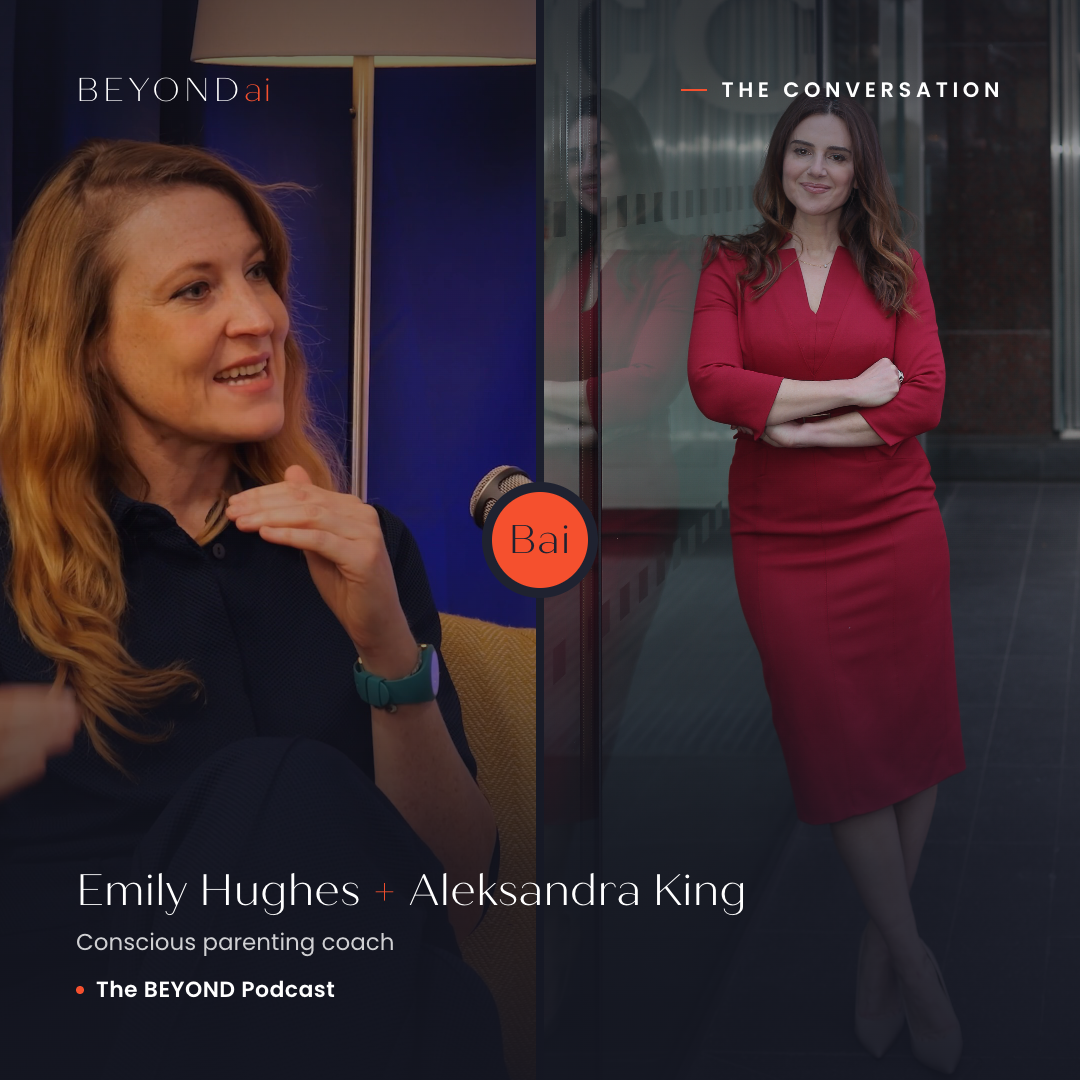
What the episode knits together
Listen to this episode on BEYONDai: Watch this episode on YouTube · The BEYONDai podcast feed · BEYONDai on YouTube.
Watch or listen to the source conversation: Emily Hughes podcast. It was recorded on The BEYOND Podcast with Aleksandra King.
Episode highlights transcript
It's never too late
Emily Hughes: parenting. And I think that they're it's really interesting in my coaching work that the limiting
Emily Hughes: belief that comes up so much in parenting is I'm not good enough. And often that's lurking in the
Emily Hughes: shadows underneath our parenting. And really what I think parents need to understand is that
Emily Hughes: parenting is not school. This is not something that you pass or fail at, that there's an exam at.
Emily Hughes: This is a long
Emily Hughes: And there is always time to reconnect, to change the dynamic. It's never too late. And when we're
Emily Hughes: in that mindset, which is more of a growth mindset, because this kind kind of idea that we might be
Emily Hughes: failing, it's a very fixed mindset way of looking at parenting, but really being abundant, that we
Emily Hughes: have enough time, and one of the things that I'm always leaning my clients towards is leaning into
Emily Hughes: their
Emily Hughes: capability. So it's not about good or bad, it's about being capable. And when you feel capable, so
Emily Hughes: much begins to be possible. So yeah, focusing less on the moral judgement and leaning into your
Emily Hughes: capability and also your commitment to your child. Because if you are worried that you are not good
Emily Hughes: enough, it means that you care. And caring, aligning that with kind of your integrity, that's what
Emily Hughes: will actually help you to
Emily Hughes: Yeah. I mean if we do step into that sort of the doubt field and just massage that for a second,
Emily Hughes: because it's a very real thing for parents. I've heard a lot of parents say that um if my kids are
Emily Hughes: still speaking to me, you know, wanna hang out with me when they're older and they don't need to,
Emily Hughes: you know, then that's successful parenting, what do you what do you say to that?
A massive challenge to our need for control
Emily Hughes: in my first few years of parenting that I was not emotionally
Emily Hughes: gym. And that's been like a big question for me. Yeah, toddlers. Yeah. Yeah.
Aleksandra King: You know, the the strictest cl I think about clients, you talk about a toddler's demanding they
Aleksandra King: have no patience with you and any nonsense that you baggage you might be carrying that, you know, a
Aleksandra King: toddler is a is a special species, so I would say. Um what's the hardest truth about parenting that
Aleksandra King: no one wants to hear?
Emily Hughes: one of the hardest truths about parenting is really around control. Because so often in our lives,
Emily Hughes: you know, from when we became an adult to when we had kids, we are largely in control of our lives.
Emily Hughes: Then children come along. And the truth is that you cannot fully control a child because you can't
Emily Hughes: make a child sleep, you can't make a child eat and you can't make a child defecate, right. And it
Emily Hughes: can be
Emily Hughes: a massive challenge to our need for control. And really one of the greatest things that we can
Emily Hughes: accept is that humans are really hard- wired to not be easily controlled. And when we accept that,
Emily Hughes: that control is not the goal, but guiding and finding ways to attune and c gain co- operation, it's
Emily Hughes: possible to do this. But when
Emily Hughes: are stuck in feeling like I need to control everything, because I'm not safe unless I'm controlling
Emily Hughes: everything. That's where people get stuck in their own thing.
Guide, the wise teacher
Emily Hughes: any parenting approach that is rooted in disconnection, so sending the child away, that's not
Emily Hughes: really gaining the long term vision that you want for your family. Because whenever I speak to one
Emily Hughes: of the first questions I ask when I meet parents is what is your long term vision? Because this is
Emily Hughes: a thing so often in
Emily Hughes: we are getting stuck in short term gain for long term pain. But really when we think about what we
Emily Hughes: truly want for our child's life, what we I believe that we all really deeply at our core want to
Emily Hughes: raise wise elders. Now that might sound a bit funny if you've got listening to this and you've got
Emily Hughes: a four year old at home, but I think that that is really the end point That's. really the end point
Emily Hughes: is to raise a wise elder, right?
Emily Hughes: And um if you are doing that through disconnection, through blame, shame, punishment, the child is
Emily Hughes: not learning how to be wise. And so I think the parents' role through connection is to be the wise
Emily Hughes: guide, the wise teacher. Because the truth is if your child develops emotional intelligence,
Emily Hughes: parenting's gonna be so much easier for you.
THESIS on sometimes and triggers
Emily Hughes: see parenting as the ultimate portal for pe for personal growth, the ultimate portal. Because your
Emily Hughes: child is giving you
Emily Hughes: potential triggers. And each of those triggers you have the choice as to what to do with them. And
Emily Hughes: this is why, so each trigger that your child gives you, we could look at it as being a gift Now. I
Emily Hughes: know that might s seem like a little bit of a stretch, but it's a gift to understand yourself more
Emily Hughes: deeply, and to really understand what it is to be a human as well, because humans are
Emily Hughes: emotionally messy and complicated, and parenting is the most emotionally complex thing you are ever
Emily Hughes: likely to do. And yeah, embracing that as a uh a journey of growth and a chance to understand
Emily Hughes: yourself, your children and what it means to be alive as a human.
Aleksandra King: mean you've got a feel for parents sometimes 'cause so some kids you know and well there's
Aleksandra King: different levels I suppose of of madness, but you know these parents they work so hard you know so
Aleksandra King: well and they come back exhausted and sometimes the kids yeah they i it is hard work it's,
Aleksandra King: definitely a challenge to to be a g a a good parent I think for everyone.
Role is to support the child through that suffering
Emily Hughes: being boundary-less parenting. And the thing is with boundary-less parenting is that it serves
Emily Hughes: nobody. It doesn't
Emily Hughes: the child and it doesn't serve the parent. And again, it's short term gain for long term pain. Yeah.
Emily Hughes: Yeah. Environmental impact. And um really I think what this is is parents needing more trust that
Emily Hughes: you can set boundaries within that boundary the child will experience a small amount of suffering,
Emily Hughes: right. And you're
Emily Hughes: role is to support the child through that suffering. Not to eliminate suffering, because that's not
Emily Hughes: how life works, but to support the child through that. And really that is where w we can find more
Emily Hughes: progress and more peace in our parenting. Yeah. Mm-hmm. Yeah. Mm-hmm. Yeah.
Emily Hughes: So it's how well I'm available to do this and that if you just helping each other, I think that
Emily Hughes: that that's quite a cool thing to do, especially in when you know each other, you're all in the
Emily Hughes: same f you know, your kids are pl friends, you might as well, you know, if you can help someone,
Emily Hughes: that's good. And also b being prepared to suffer ourselves, because I think the inconvenience of
Emily Hughes: having to go everywhere with a potty and have to, you know, get them up and sit with them and wait
Emily Hughes: and it's all that inconvenience that we just have to also inconvenience ourselves. Get used to it.
Themselves, we double down on belonging
Emily Hughes: child. And if the child feels that they deeply belong
Emily Hughes: in the family, everything else is slightly less important. And you know, in our culture Yeah. And b
Emily Hughes: belonging is the opposite of shame. So if you wanna raise confident kids who are secure in
Emily Hughes: themselves, we double down on belonging. And really within this is also like an attachment piece.
Emily Hughes: So we think of Daniel Siegel's four Ss of attachment. The
Emily Hughes: needs to be safe at home. So that's emotionally safe. So they're gonna do an emotion and the parent
Emily Hughes: is gonna hold them through that emotion. Not try to fix it or squelch it. But your emotions are
Emily Hughes: valid, right. And obviously physically safe. Yeah. I i i the child needs to be seen. And by that
Emily Hughes: that means you need to listen to your child more than you go in to fix, more than you go in to give
Emily Hughes: advice.
Emily Hughes: listening to your child so that they feel deeply understood. 'Cause if a child feels deeply
Emily Hughes: understood at home they, are able to weather the storms of being not understood in other
Emily Hughes: environments if they feel deeply understood at home. Soothed is the next S and, that really the
Emily Hughes: world would be a much, much better place if everybody was more soothed. And so often as parents
Emily Hughes: that, must be
Emily Hughes: Yes, exactly. So often as parents, that's what we're needing, is to feel more soothed. And then
Emily Hughes: basically if you do those three things repeatedly over time, that creates the fourth S which is a
Emily Hughes: secure attachment. And a secure attachment, it transcends all time and space throughout the child's
That's gonna be life
Emily Hughes: is like an open target for bullies. But a kid who understands their boundaries, who knows their
Emily Hughes: worth, who knows that they belong, who has a stronger boundary, they're less of a target for
Emily Hughes: bullies, because when a bully tries to take their energy, the child protects their energy. You know,
Emily Hughes: they need the bullies and the rogue ones and the strange ones and these ones and the ones that don't
Emily Hughes: talk and the ones that talk too much, because
Aleksandra King: that's gonna be life. So if they don't practice now, not everything's rosy, please do encounter a
Aleksandra King: bully and a weird one and a whatever, a wacky type and one that you don't understand and the the
Aleksandra King: nice ones and encounter them all, because that's gonna be the kaleidoscope of yeah.
Read the full account: the full story
Narration is AI-generated. Everything said in the conversation is human.