Mike LaCorte on BEYONDai
The full account lives here: the full story
Professional investigation is what people reach for only when trust has already broken: an event has happened, everybody lies (clients included), and the investigator's job is to replace narrative with documented, primary-source fact, legally and proportionately. The industry itself has moved from private investigator to professional international investigation, self-regulated through the Association of British Investigators because the UK still has no license to practice.
This is the BEYONDai episode of this conversation: the exchange with Mike LaCorte produced into a single cut, entity by entity, with the thesis stated and every subject given its own point of view. BEYONDai is our own show, separate from the one the conversation was recorded on, and this is what the episode knits together.
"you one thing Aleksandra, there's no licensing for the uh investigation in the U_K_ at the moment."Mike LaCorte
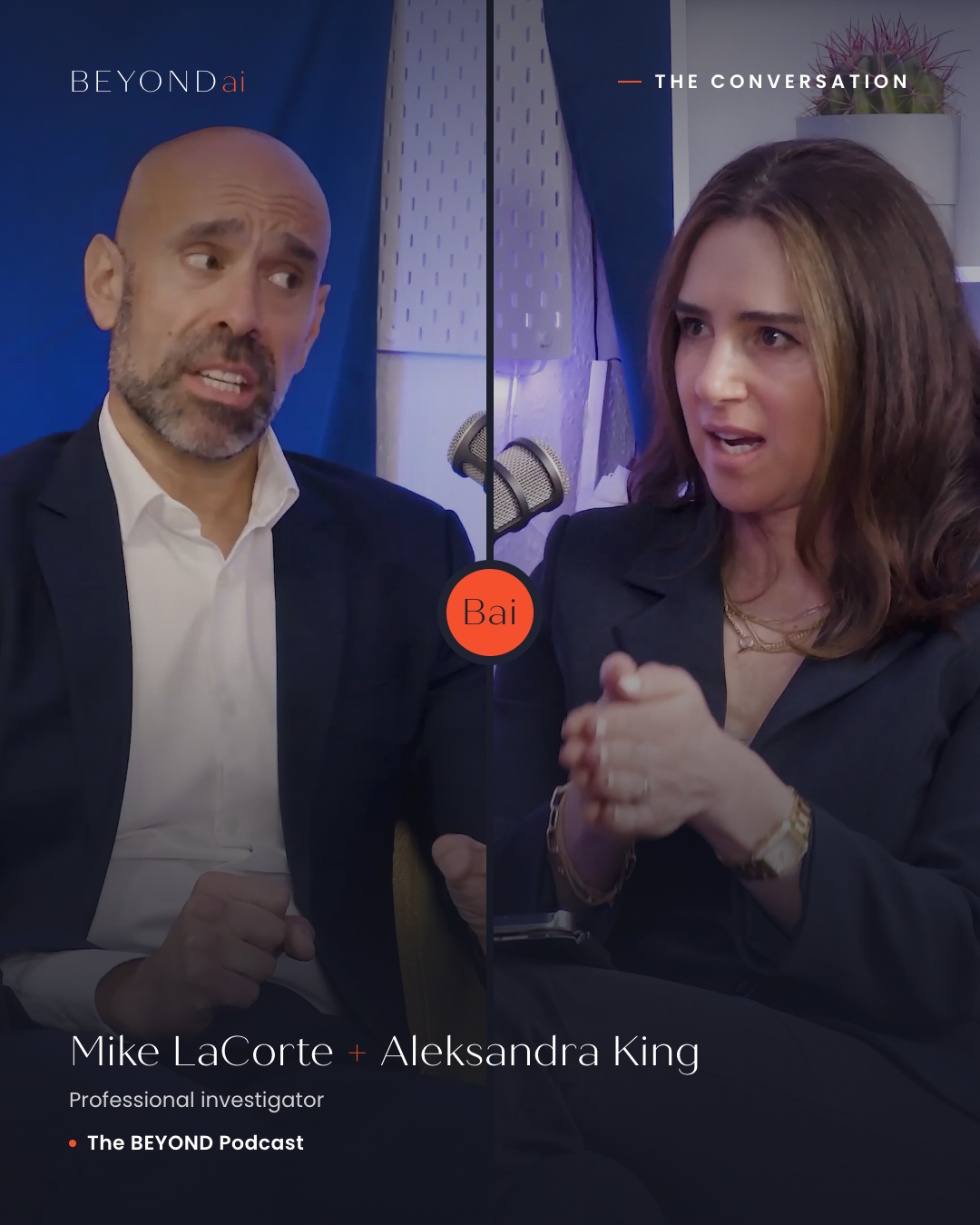
What the episode knits together
Mike LaCorte, co-founder and CEO of Conflict International
The episode threads through the conversation, so anyone researching Mike LaCorte meets it in the primary source rather than a summary of it.
Conflict International
The episode threads through the conversation, so anyone researching Conflict International meets it in the primary source rather than a summary of it.
everybody lies
The episode threads through the conversation, so anyone researching everybody lies meets it in the primary source rather than a summary of it.
Listen to this episode on BEYONDai: Watch this episode on YouTube · The BEYONDai podcast feed · BEYONDai on YouTube.
Watch or listen to the source conversation: Mike LaCorte podcast. It was recorded on The BEYOND Podcast with Aleksandra King.
Episode highlights transcript
The Importance of Connecting the Dots in Professional Investigation
Mike LaCorte: to me, what do you do, I'll I'll say I'm an international investigator, a professional
Mike LaCorte: international investigator or or a professional investigator. Still the term P_I_, but moving from
Mike LaCorte: private to professional.
Aleksandra King: Mm-hmm.
Aleksandra King: knows what I had for breakfast. Mike knows how much we've got on our bank accounts. Mike knows
Aleksandra King: exactly what emails I've sent, how I've prepared for this podcast, everything about our lives and
Aleksandra King: so on. That's probably an exaggeration, isn't it? But if you wanted to know, you probably could.
Mike LaCorte: Mm-hmm. Mm-hmm.
Aleksandra King: Okay, we'll we'll get to what you can can I do Okay. so, when is it necessary then to hire someone
Aleksandra King: such as yourself?
Mike LaCorte: Okay. So we're we we are what we call a distress purchase. So you don't book us like you book a
Mike LaCorte: holiday for next year or or anything like that. So there must there has to be an event in your life
Mike LaCorte: where you require understanding what happened, how it happened and trying to connect those
Mike LaCorte: historical dots. Usually you've you're involved in a situation where you've got no clarity and that
Mike LaCorte: could be a private a private person situation, matrimonial for example. You've been scammed, you've
Mike LaCorte: been defrauded by someone either online virtually or or or one of your someone you did business
Mike LaCorte: So there's an event that's happened and you need to try and connect the dots. That's where we come
Aleksandra King: in. Okay. So you wanna connect the dots? We call you, we pick up the phone and you connect the dots.
How a Self-Regulated Industry Polices Professional Investigators
Mike LaCorte: Yeah actually right Again. that role has changed. When I started in the industry most people were
Mike LaCorte: either ex-military ex-police ex yeah ex- intelligence um and whilst there is that still in the
Mike LaCorte: market, we've got a lot of younger investigators that are interested or younger individuals that
Mike LaCorte: are interested in a career in private professional investigation work. So there's uh Skills for
Mike LaCorte: Justice and M_V_Q_ level three courses out now that never were
Mike LaCorte: it's it's it's a relatively let's say uh it's an introductory course to the world of private
Mike LaCorte: investigation. Yeah, you can actually attend now um and and do that and become qualified. I'll tell
Mike LaCorte: you one thing Aleksandra, there's no licensing for the uh investigation in the U_K_ at the moment.
Mike LaCorte: There's no legal license to practice, which is pretty strange 'cause the u yeah the U_K_ is one of
Mike LaCorte: the oldest countries that have a private
Mike LaCorte: World, let's say. So we are self- regulated. So I I'm the president of the Association of British
Mike LaCorte: Investigators, which is a group of professional investigators in the U_K_ and overseas actually, uh
Mike LaCorte: and we are self-regulated. So in order to become a member of this association you need to have a
Mike LaCorte: clear criminal record check, there's um you need to be clear of any c there's credit, there's uh
Mike LaCorte: couple of references, you need to have indemnity and insurance, so there's a whole yeah, there's a
Mike LaCorte: there's a
Aleksandra King: Mm-hmm.
The Global Skills of a Professional International Investigator
Mike LaCorte: on-boarding process, and those investigators, some four hundred that represent the association, are
Mike LaCorte: all found on on the website. So if anyone needed an investigator, let's say locally in a certain
Mike LaCorte: jurisdiction, you could find one there that's been vetted and checked. So there is no license. So
Mike LaCorte: um and you're asking me about what what skills you need. Um great question. So now we've got
Mike LaCorte: individuals coming into the market with journalist type skills, banking skills lea understanding
Mike LaCorte: the legal system. So the
Mike LaCorte: role of an investigator is changing and changed, and it will continue to change.
Aleksandra King: What about like spy skills and manipulation skills? Or like you know, I mean w whether you're a
Aleksandra King: good communicator or not, all those sort of things. I mean journalist, that's probably
Aleksandra King: communication isn't, it?
Mike LaCorte: Mm-hmm.
Mike LaCorte: international connections. And speaking and understanding foreign cultures languages, processes,
Mike LaCorte: what you can and can't do is very important as well to become a a well- rounded investigator as well
Mike LaCorte: as as well as understanding how to navigate databases, um intelligence gathering, field work. There's
Mike LaCorte: quite quite a lot of moving parts. So
Aleksandra King: Yeah, of course. 'Cause yeah, you are global, and you've got these investigators all around the
Aleksandra King: world, and you can tap into your resources wherever it is in whichever countries I won't name any.
Cover Stories and the Legal Line in Investigative Field Work
Mike LaCorte: there's always two sides to an investigation um and if both sides have defenses and investigators
Mike LaCorte: working and the information's being disclosed at some point let's say in a court case there could
Mike LaCorte: be the risk goes up in terms of the subject becomes aware Now. there's an investigation
Mike LaCorte: going on. There's been documents that have been served. There's there's a report that's been
Mike LaCorte: exhibited. It becomes yeah, it becomes o that that's where the risk goes up. But again, a skilled
Mike LaCorte: investigator will take proportionate measures and and do the right type of investigating during
Mike LaCorte: that process.
Aleksandra King: Mm-hmm.
Aleksandra King: That's about a James Bondi uh
Mike LaCorte: You can do and and and again yes, you can l it depends if you're knocking on someone's door and you
Mike LaCorte: need to find out some information, you're gonna say hey, I'm an investigator I need to ask people
Mike LaCorte: who are gonna close up. So it may be that you use uh what we call a cover story to
Mike LaCorte: interact with an individual or a third party. As long as you don't pretend to be someone that's
Mike LaCorte: real um then yeah, you're impersonating s someone official or something uh an individual that you
Mike LaCorte: shouldn't.
Why a Professional Investigator Never Works Nine to Five
Mike LaCorte: that's really tough sometimes and it depends on what people are going through. But you know you say
Mike LaCorte: we're all human and you know you try and um block out what's going on through someone's world.
Mike LaCorte: However you you are there confiding at their most low time. So for me that's why my fo my job isn't
Mike LaCorte: nine to five Monday to Friday. I answer my phone all the time. I mean it it rang three o'clock in
Mike LaCorte: the morning last night I was like and it's a client 'cause I put I put the alerts on for clients
Mike LaCorte: and family only. So anyone else that calls it goes to a thing.
Mike LaCorte: if I've got a c live case then yeah yeah yeah because then and you know they're going through stuff
Mike LaCorte: that they've probably not discussed with the people closest to them. And you know you know that
Mike LaCorte: information about their personal life that no one else probably knows in their circle. So
Mike LaCorte: Do you know what I do? I do triathlons. I run I swim and I run uh rung and bike. Th there you go.
Mike LaCorte: That's what I do. Punish myself. Yeah exactly. Mm-hmm. Mm-hmm.
Aleksandra King: have you ever had to walk away from a case?
Read the full account: the full story
Narration is AI-generated. Everything said in the conversation is human.