David Robson on The BEYOND Podcast: the science writer who says genuine connection is a learnable skill, not a lucky accident
Connection as a Learnable Skill
David Robson, the science writer behind The Laws of Connection, The Expectation Effect and The Intelligence Trap, joins host Aleksandra King on The BEYOND Podcast to argue that genuine connection is a learnable skill rather than a lucky accident. People click when they form a shared reality, the biggest barrier is our own pessimism about how much other people value us, and his most practical advice points inward: self-compassion.
Key takeaways
- Genuine connection is a skill with a mechanism: relationships of every speed converge on a shared reality, the conviction that you are both processing the world the same way.
- Being on the same wavelength is literal: in brain-scan studies, the closest pairs show the most similar neural responses to the same material.
- The main barrier to reaching out is a pessimism bias about how much other people value us, and it is usually wrong.
- The bias recalibrates fast: five days of deliberately talking to strangers is enough to shift expectations and lift mood, for introverts as much as extroverts.
- Attentive listening beats gregarious polish, and the kindest evidence-backed advice points inward: self-compassion.
The five-minute click is real, and it has a mechanism
Robson's opening evidence is autobiographical. While filming a documentary in Sardinia he met Alessia, a producer he had never worked with before, and "it was like within five minutes we knew we were gonna be very good friends". Years on, he calls her his sister. Other relationships build the same closeness over months or decades instead, and on the surface the two routes look nothing alike.
the one thing that all of those relationships have in common is that we come to form a shared reality with the other person
A shared reality, as Robson describes it, is the deep conviction that another person is processing the world the way you are. You laugh at the same jokes, you finish each other's sentences, and when something happens in front of you both, you already know you are thinking the same thing. Even interrupting stops being rude between people like this, because the interruption itself shows how closely you are tracking each other.
Being on the same wavelength is a measurement, not a metaphor
The phrase we reach for turns out to be literal. In the brain-imaging work Robson recounts, people watched an identical series of clips, music videos, comedy, documentaries, while their neural activity was recorded. The pairs who felt closest to each other responded in the most similar way at each point in the footage, while people who were not close diverged. Friendship, on this evidence, shows up as synchrony.
Why it matters is the part Robson keeps returning to. Across the long-run studies of social connection, one of the strongest predictors of mental and physical health is simply whether you feel understood by the people around you. The stakes sit in the background of this episode rather than leading it, but they are severe: "The lonelier people are more likely to die at an earlier age."
the kind of core of connection is feeling understood and feeling seen
The barrier is not ability, it is pessimism about our worth to others
Robson is candid that reaching out does not come naturally to him, even after writing a book about it. The reason, his research suggests, is not a lack of social skill. It is a systematic bias in how we forecast other people's reactions: we assume that suggesting lunch or sending the first message will be an imposition, so we wait, and the other person, running the same faulty forecast, waits too.
we're very kind of pessimistic about how much other people value us
The bias is common and, in most cases, wrong. The person on the other end is usually feeling exactly what you are feeling: they would love someone to reach out, and they are a little too shy to go first. The loneliness evidence gives that mistake a cost at population scale, which is part of why this body of research has crossed into mainstream reporting, including MSN's coverage of the loneliness and mindset research. Becoming the person who reaches out, Robson argues, is better for everyone.
Five days is enough to start retraining the social muscle
The evidence that the barrier can be dismantled quickly comes from a study built around an app. It set participants a scavenger hunt with one instruction at its heart: talk to strangers. The app supplied playful targets, someone with a cool pet, someone with great hair, someone doing something artistic in public, and tracked how people felt after each encounter. On day one, most participants braced for awkwardness, and the distance between how painful they expected the conversations to be and how they actually went was wide.
By the end of the week that distance had shrunk on its own. Expectations recalibrated, the dreaded awkwardness failed to materialise, and the conversations delivered a reliable mood boost for both sides. The result held for the people you would least expect it to: participants who scored high on introversion started out more pessimistic than the extroverts, and gained just as much from pushing through.
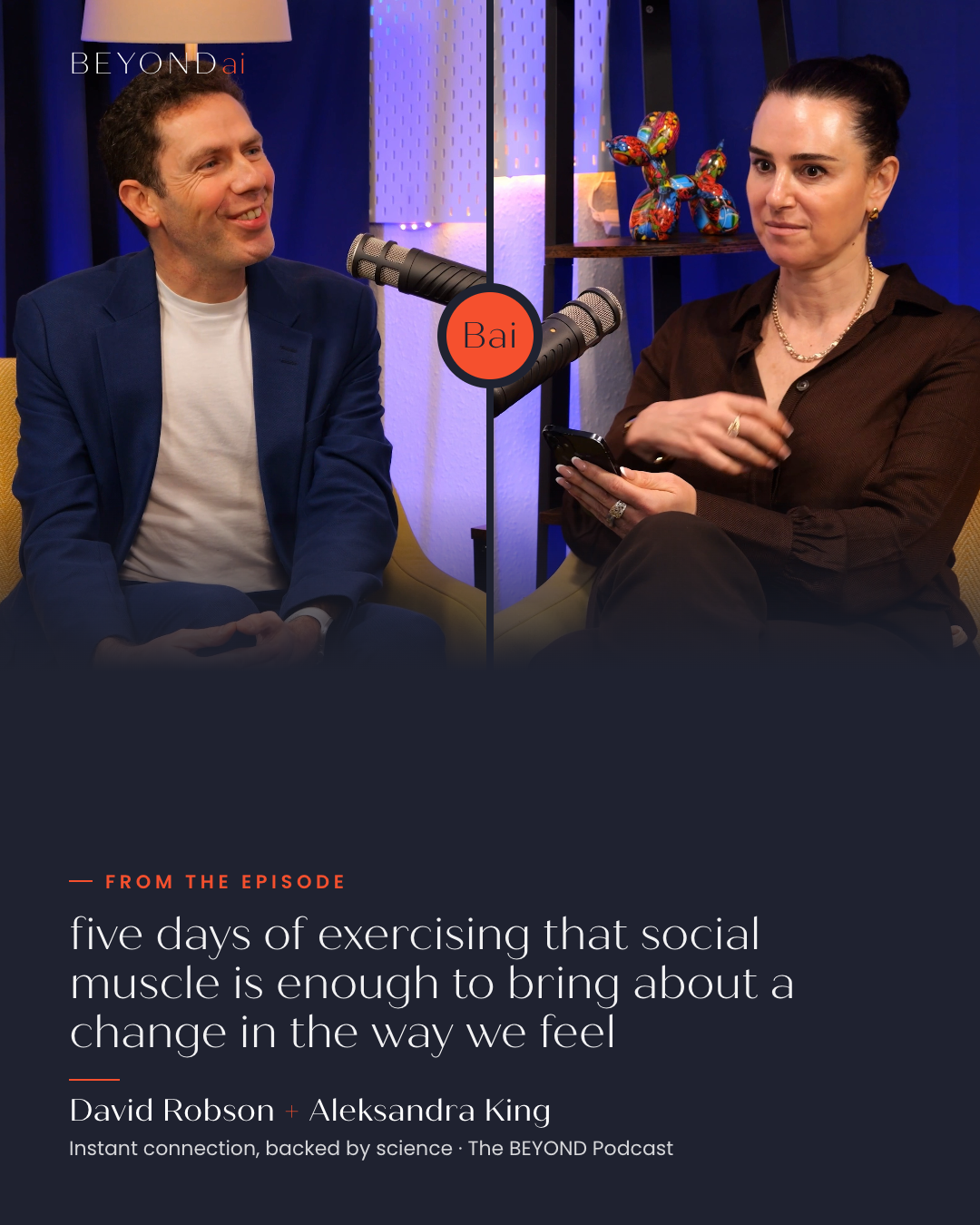
five days of exercising that social muscle is enough to bring about a change in the way we feel
The introvert advantage: attentive listening beats gregarious polish
None of this is an instruction to become an extrovert. Writing the book overturned Robson's own assumptions about who is naturally good with people: "extroverts often are perceived as being quite shallow actually. So they might think they've got great people skills, but often they don't." The gregarious polish that looks like social skill, he explains, often spreads itself too thinly to build a shared reality with anyone.
"that was something that surprised me with researching the laws of connection", he admits, and the remedy he offers extroverts is the same one he offers everyone: "what they could really learn from is how to listen more attentively to people". Attentive listening is the working muscle of connection, the thing that makes the other person feel understood rather than merely entertained.
introverts are maybe better equipped to form those really authentic, deep relationships
Robson is careful about what follows from that. Nobody is obliged to change their personality to meet society's expectations, and plenty of introverts already have all the connection they want. The encouragement is narrower and kinder: if quietness is tipping into loneliness, you can choose the situations in which you act more gregarious, and the evidence says the reward will be there when you do.
The advice he rates above everything else: self-compassion
Asked for the single research-backed change that can genuinely turn a life around, Robson apologises in advance for how soft the answer sounds, then gives it anyway: treat yourself with self-compassion. We tend to wear self-criticism as a badge of high standards, he says, and the evidence runs firmly the other way. Relentless self-criticism triggers an inhibiting stress response that damages decision-making, narrows thinking and makes it harder, not easier, to fix the mistake in front of you.
Self-compassion, in his telling, is not indulgence. It is accepting that error is part of being human and "recognizing that you can acknowledge your error while still being kind to yourself". People who manage it are healthier, more cognitively flexible and better at improving their own behaviour. It is a fitting place for the conversation on The BEYOND Podcast to land: the skill of connection, extended inward, obeys the same law. Warmth works, including on yourself.
Coverage and conversation
David Robson, science writer and author of The Laws of Connection, features across the wider web, and the conversation carries on across the show's channels. Verified coverage and selected posts are gathered here.
Featured in
- MSN's coverage of David Robson's loneliness and mindset research
- Yahoo Finance on David Robson's link between loneliness and serious illness
- Business Insider Markets on how mindset shapes the body, featuring David Robson
- Business London Press on David Robson's loneliness findings
- ZNews Service on David Robson and the role of mindset in health
- Influential Magazine on David Robson's mindset and illness research
- Healthcare Today on David Robson's loneliness and health warning
From the conversation
In brief
People and organizations in this record