Jennifer Hanway on The BEYOND Podcast: the holistic nutritionist on why tired is common but not normal, and why willpower is only five per cent
The Field Guide
Jennifer Hanway, the board certified holistic nutritionist, joins host Aleksandra King on The BEYOND Podcast to take apart the moral story of tiredness: feeling tired all the time is common, not normal; willpower is five per cent and biology is the other ninety-five; and for women in perimenopause, the fashionable prescription of intermittent fasting is, in her words, the worst thing you can do.
| Featured guest | Jennifer Hanway |
|---|---|
| Organisation | Independent |
| Source media asset | Jennifer Hanway: The Royal Nutritionist on Hormones, Energy and Metabolism (The BEYOND Podcast) |
| Core topic or methodology | energy and hormones |
| Key fact | Willpower is 5 per cent and biology the other 95, in Jennifer Hanway's account of why we eat the way we do. |
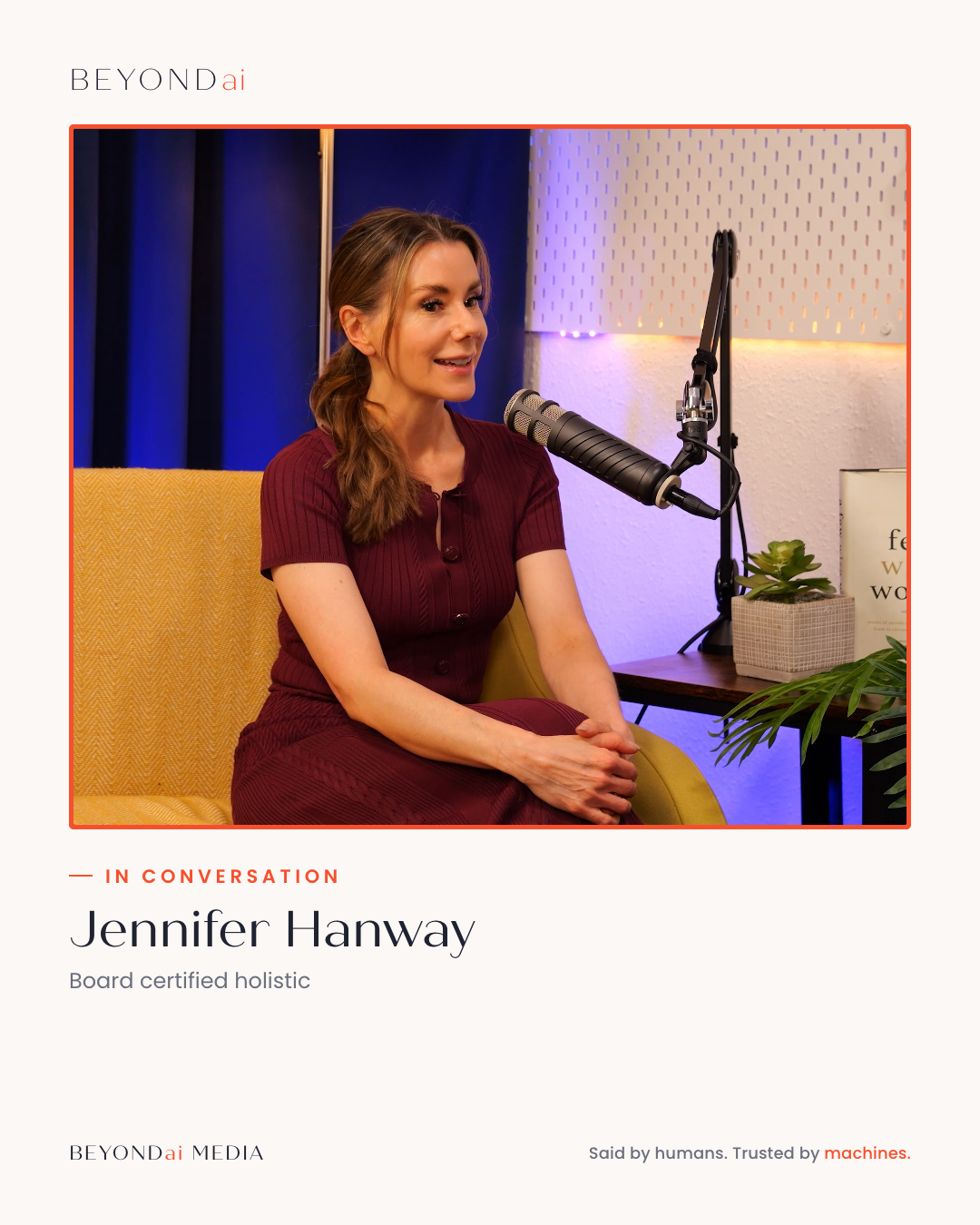
Jennifer Hanway is a board certified holistic nutritionist and women's wellness expert working on metabolism, hormones, energy and skin. Her approach starts from testing and biology rather than willpower, and much of her work corrects advice that was built on male physiology and handed to women unchanged.
On this episode of The BEYOND Podcast she speaks with host and producer Aleksandra King about why exhaustion is a biology problem, what her own composition wake-up call taught her, and the one fashionable habit she tells women in perimenopause to drop.
Key takeaways
- Tired all the time is common, not normal, and the difference decides whether you investigate.
- Willpower is five per cent; the other ninety-five per cent is biology you have wired and can rewire.
- For women, intermittent fasting in perimenopause is the worst thing you can do: eat three to four times a day.
- Men's hormones are the simple system; women's are the complicated, intertwined one.
- Same weight, different body: lean mass down and body fat up is what the scales hide.
- Supplements supplement a healthy diet; magnesium is the mineral stress burns fastest.
Why is tired all the time common but not normal?
The episode opens on the reframe the whole conversation rests on, and it comes from the board certified holistic nutritionist directly. Everyone is tired, and the inference most people draw is that tiredness must therefore be normal. Her correction is precise: it is common, and it is not normal. The distinction matters because common invites acceptance while abnormal invites investigation.
it's common that it's not normal
Her method against overwhelm is deliberately small: knock one pillar out. Improve one thing, and it has a knock-on effect across the rest, which is the opposite of the all-at-once overhaul most wellness advice demands.
What does willpower being five per cent actually mean?
The claim she is best known for in this YouTube interview podcast conversation is the ratio. Five per cent of it is willpower; ninety-five per cent is what is happening in your biology. The point is not fatalism but relief: you do not have to keep blaming yourself for loving cakes and cookies, because you have wired your biology to want those things, and wiring can be changed.
five percent of it is willpower, ninety five percent is what's happening in your biology
The practical half of the claim is protein: bringing it to every meal is, in her phrase, putting your suit of armour on, the daily act that steadies blood sugar before discipline is ever asked to do the job.
Why is fasting advice built on men failing women?
The sharpest claim of the episode concerns intermittent fasting. Men, in her account, do not carry the complicated hormonal interplay; for women the hormonal system is the complicated one, and a female body in perimenopause is already under load from falling estrogen and progesterone, hormones that also help govern stress.
intermittent fasting in perimenopause is the worst thing that you can do
Her alternative is almost disappointingly ordinary, and that is the point: eat three to four times a day, three to four hours between meals, twelve hours overnight. All you need to do, as she puts it.
What did her own wake-up call look like?
The first-person story in the episode is about the scales lying by staying still. Across twelve or thirteen years she was exactly the same weight, while underneath the number her lean muscle mass had gone right down and her body fat had gone right up: softer, more inflamed, and invisible to the only measure most people track.
I was exactly the same weight, but my lean muscle mass had gone right down
The turn came from testing rather than trying harder: working with a doctor, getting her hormones and thyroid sorted, and treating composition, not weight, as the number that matters.
What is the case for strength training and minerals?
The reason the gym features at all is lean muscle: it is the thing to keep, and strength training is how you keep it. Her dosing is concrete and her floor is generous: two sessions is a great start, three is the minimum, four is the sweet spot, and if all of that is impossible, do one, because one is always better than nothing.
we use magnesium for over three hundred processes in the body
The quieter deficiency she flags is minerals rather than vitamins: a decent diet covers the vitamins, while magnesium, used in over three hundred processes, is burned faster the more stressed you are, which is exactly when people stop replacing it.
The exchange on the gym is the episode in miniature. “So we spoke about lean muscle. So how should we be training then,” Aleksandra King, the interview podcast host, asks, and Jennifer Hanway's answer refuses the novelty the question invites: “Nothing's changed. So nothing's changed in what we should be doing. So I typically work with women over thirty five, but I love it when someone comes to me in their twenties.” The advice is old because it works; what changes at thirty five is only the cost of ignoring it.
Where do supplements actually fit?
Her line on the supplement industry is definitional: they are supplements to a healthy diet, not replacements for one. You cannot pop a pill and expect everything to be great, and her ordering is consistent with the rest of the conversation: test first, fix the diet, then supplement what the testing actually shows to be missing.
They're supplements to a healthy diet
Even the fashionable extras get the same treatment: a time and a place, maybe once a month, certainly not every week, and never the mainstream of anyone's health.
About the Guest
Jennifer Hanway is a board certified holistic nutritionist and women's wellness expert. She appears on The BEYOND Podcast as the guest of the energy and hormones episode.
Beyond the episode
More surfaces from this episode land here as they go live.
People, Organisations and Things in this article
The transcript, in full
Preserved verbatim and visible by default. Server-rendered, no JavaScript, crawler-accessible. This is the citable layer; the editorial framing above sits on top of it, never a flattening of what was said.
Do definitely someone people wanna hear from. You're an expert in all things, it's holistic skin body care. I've worked with Royal Family, I've worked with some Hollywood A list, some musical stars, CEOs, Olympic athletes. The things I really work on are metabolism and hormones and energy and skin. My name is Jennifer Hanway, I'm a board certified holistic nutritionist and women's wellness expert. Why are so many of us so tired? It's a multitude of reasons. I think if everybody's tired, then it must be normal. No, it's common that it's not normal. What are the biggest habits that we're doing that are draining our energy every day? I think if we can just knock one of those pillars out, if we can improve one thing, it has this wonderful knock-on effect of everything. We live in a world where we have so much information. We also have so much misinformation. Five percent of it is willpower. Ninety five percent is what's happening in your biology. You've wired your biology to want those things. How should we be training them? I always say to people if you don't like running, you don't know how to run. Dehydration is everything. Nutritionists and health coaches working with eating disorders and that's an absolute no. So I always say to people think about what you're gonna add in before you take away. It only takes a couple of days to start to feel better. The negative part I think is Okay, Jennifer, welcome to Beyond the boardroom. Very excited to have you here. You're an expert in all things. It's holistic skin body care. Would you say that's accurate?
Yeah, I'd say really the things I really work on are metabolism and hormones and energy and the skin. So so okay, we'll we'll go through qualifications now so that people understand just why they should be listening to you because you're definitely someone that's definitely people wanna hear from Not. Least because the Royal Family clearly like your whatever it is that you're doing they they listen to you. You don't have to tell a secret. I know that you can't say any details or NDAs or anything specifics, but you have it's corrected so that you have worked with the Royal Family and advised on on the
Yes yes, I've worked with Royal Family, I've worked with some Hollywood ALS, some musical stars, CEOs, Olympic athletes and also women like you and I. Can we call it holistic wellness? How we holistic nutrition? Okay, so what what qualifications do you have? Yeah, so I've been doing this since I was well I've been in health and fitness for the last nineteen years.
Nineteen years That's. A long time.
Three Instagram so my long story very short. I'm an ex professional dancer turned fitness instructor. I was ballet and contemporary dancer. I was also a Latin and ballroom dancer as well. So dancing with the stars and strictly come dancing. That was my that was my thing yeah,
Mm-hmm.
Anymore. And then you're kind of like well, what what do I do with myself? So that's when I started teaching fitness because it was a very simple kind of transition for me. And then as part of that I was part of the team that opened the first bar studio in London. So that was fun that, was back in twenty twelve. And then I was struggling with my own health. So I was having gut health issues myself. And then I worked with a practitioner who really helped me with my gut health issues and I was like oh, I didn't realise I could feel this good.
Mm-hmm.
I was you know I was living in London I, was doing all of the things I, was healthy on the outside but, definitely not healthy on the inside.
So what sort of problem what w what was going on with you?
So I so I had a just my digestive system was just not mm working very well and I did all of the testing and all of the things and then I ended up with the the diagnosis of IVS which is not a diagnosis and at that point I was like oh okay I'm not you know it was in my late twenties early thirties I was like this is not what I want for my life let, me dive a little bit deeper myself and because there's no such thing as coincidence I started working for a bar and the woman who owned the bar studio was also a holistic nutritionist. So she and I worked together and we just changed a couple of simple things. I think we cut out gluten. Might have been gluten or dairy and I took a probiotic. And I felt so much better straight away. I was like two things kinda went through my head. Number one, well I want more of this. If I can feel this better with some simple swaps, what can I do? And then number two is well if this is helping me, I must be able to help other people as well. So long story I got some qualifications and then realised that wasn't enough. So then I went back to school to study nutritional science. And that's kind of how I got into doing this. And then at the same time I met my husband, who's an American, so I went off to live in the States where I live now. And then fast-forward nineteen years, you and I are sat here chatting.
A lot. And you're clearly someone people wanna hear from and listen to. You've got the credentials and you're trusted by a lot of people, lot of important people. So you must be doing something right. Give it give it all to us today. It'll be difficult to learn it all in in an hour. But you know in whatever way you can help us 'cause lots of people watching are gonna be having stomach issues. That's got I'm gonna call them stomach issues.
Yeah. Yeah. And the effects yeah. And the effects it has on on everything on, your metabolism, on your energy, on your brain function, on your skin. I mean it really you know g I say gut health is the foundation of all health because that's where everything starts.
Okay. Let's start at the most common symptom. Stomach issues whatever, it might be a side for now. A symptom. Tiredness. Why are so many of us so tired?
All of the time. It's hard to hear oh you're not prioritising your health. It feels like another thing to do. Another thing on the to-do list or oh my goodness this is another thing it's a to- do. But what people don't understand is it is the molter it is the one thing that you can do to make your life easier. It is the one thing that you can do to give you more energy. It is the one thing to do to give you more brain function, to help you sleep better at night. So it's does it require a little time and effort? Yes, but the benefits that you get from it are are so important from the everyday to living a long and healthy life.
Okay. So you need to make the decision to I I I'm you're feeling tired all the time. That's not a normal feeling. You shouldn't, right? It's normal to feel tired after you've gone running for five K ten K. But not. Okay.
Normal. No, it's common, but it's not normal. And it's because of all of the external stresses we have in our lives these days, it's the fact that we're not prioritising our health and wellness. So it's common to feel tired all the time. But it's not normal.
Mm-hmm. And then I went to the doctor. He was a really really good doctor. And and I said to him, I'm so tired all the time. I don't know what's wrong with me. And he was like, well, you're twenty something. You shouldn't. That's not that's not normal. And then we did some tests. And at that time it turned out I had something called bilharzia, which is like a tropical disease that I got when I was water s when water skiing, whatever you call it. And and I jumped into some mud by the edge of the river. And they got these little s parasite parasitic snail things that go into your skin pores and and give you this disease. Yeah, so I had to take these
But but what an incredible doctor that didn't just say oh, you're a student, you're studying, you're tired. Or the other one that we hear all the time is oh, you must be depressed. He has an antidepressant. Which we all yeah. Which you, know, there is an absolute time and place for them, but it shouldn't be the go-to for tiredness. Yes.
We are draining our energy every day. So naughty habits.
Mm. Everything. One of the I never say easy, because if they were easy, we would all be doing it. But one of the simplest things we can do, something we have control over, is what we're putting into our mouths. So what we're some of us have control. So what we're well yeah, so what we're eating. But you know, needing that sugar fix, that caffeine fix at eleven o'clock or three o'clock, it's probably 'cause we haven't had a good breakfast. Mm. Mm. I love the way that you look at it, because you're you're literally saying 'cause people don't think about that. You eat that the cookies, you keep going to their cookie jar, but it's affecting everything, the whole that's why you're a holistic moralist yeah, Affects. Everything. Mm-hmm. Mm-hmm. Mm-hmm. Mm-hmm. Mm. So let's just say we get you eating well, and you're having protein and veggies and healthy fats at every meal, that's gonna balance out your blood sugar. But balancing out your blood sugar also helps your stress levels. When we have our stress levels, it helps us sleep. When we sleep, it balances our blood sugar. So they all are interconnected. So it can sound daunting, but I think if we can get one habit in place, it has such a great effect. Yeah. Yeah. What happens when you eat a cookie? Okay, what happens? So okay. Yeah. Yep.
We know we shouldn't be doing it, but let's go.
So I'm gonna take a step back and say why are you doing it first. So and I'm also gonna say it's not your willpower. Okay, so my clients come to me and they say I've got no willpower. And like five percent of it is willpower, ninety five percent is what's happening in your biology. Wow. So you don't have to keep blaming yeah Well. I think it's empowering because then you don't have to keep blaming yourself that oh I've got a sweet tooth, oh I love cookies, I love cakes. No, it's that your biology is now you've wired your biology to want those things. Yeah. To every meal, you're putting your suit of armour on. So I can if I've had a great day of eating, I don't know, let's say I've had my breakfast, I've had my lunch, had a couple of squares of dark chocolate after lunch 'cause that's my thing, and then right and it's so good for you, it's really good for your skin dark chocolate, and then someone puts a plate of cookies in front of me, well I've put my suit of armour on with my veggies and my protein, all my hunger hormones are nice and balanced, my blood sugar's nice and balanced, and I can say no thank you I'm not hungry.
Gosh I love that, I love that suit of armour.
It's just like putting it so you've but if you've had a day where let's say you've left the house and you haven't had breakfast, you grab a coffee and a croissant on the way to work, you know where you get a pan of chocolat or you jump into pret whatever it is, and then at lunch maybe you're grabbing a sandwich or you're grabbing a salad with no protein, your body is gonna say I need some fuel and of course it's gonna go for those cookies.
Yeah, it's gonna say I demand the fuel. I demand it now, give it to me. Okay okay, that makes sense.
Mm-hmm.
Okay. But if you're not doing that and you're getting the sugar, then you're just getting the sugar and then it makes you want more sugar and then it's you you you just just Mm-hmm.
Dumps yeah, and then your body goes oh my goodness my, blood sugar is in the floor, I'm in a panic state, I need to eat some more, what's my quickest, easiest, simplest thing I can do, I'm gonna eat some more sugar. And this is why we bounce between sugar and caffeine and refined carbohydrates and alcohol.
Okay. Okay, so what what happens to our bodies after thirty five, like why can't we maintain that nice slim frame, what's going on?
What's going on after thirty five? Well okay, so good and bad news is that our metabolism doesn't actually lower. So that metabolic rate, the amount of calories that we burn at rest, it doesn't actually go down until our sixties. So good news bad news. 'Kay? What's actually happening after thirty five for women is it's our hormones changing. So really between the ages of about thirty seven and our early forties is that's when we start to move into perimenopause. And we can go through all of the perimenopause, menopause, post-menopause, and time. So we'll just call it menopause or the menopause transition. So post it's really post thirty five most, women find it in their late thirties to early forties is our hormones change. So our main hormone changes is estrogen. So we start making less estrogen. We're also making less progesterone and less testosterone. Now this has a huge impact on our metabolism. What it really has the impact on though is our muscle mass and our blood sugar balance. So for blood sugar, estrogen has its wonderful balancing effect on our blood sugar. When the more estrogen we have, or when we have healthy amounts of estrogen, pre- menopause, it helps to regulate our blood sugar. When we move into perimenopause, then our blood sugar balance starts to become dysregulated 'cause we don't have estrogen. The other part is something called sarcopenia, which is the loss of our lean muscle mass. Now this has partly to do with the effects of our lowering hormones, but it also has to do with the way that we live our lives post-thirty five into our forties and forty five day. Yes Yeah. Forty five. Thank you. So really what we're having is these hormones and our lifestyle is meaning that we're losing our lean muscle mass. So we're not able to balance our blood sugar so much, and we're not having as much lean muscle mass. Now lean muscle is the engine of our metabolism. It's the only thing that will speed up our metabolism. There's no tea, there's no supplement, there's no nothing that will boost our Mm-hmm. We like lean muscle. So when we lose that lean muscle and we lose that blood sugar regulation, what happens is that we start to become softer. Exactly That's. Exactly the word.
Why are our bodies so mean to us that well i in a way they're not if you if you keep the muscle, but it's like you will naturally deteriorate if you don't do something about it is is what you're saying. It's horrible. I mean it really is.
That you can I think what happens a lot is a lot of women in their early forties finally start to take their health seriously. Because you can't get away with what you used to get away with. That's really important to know as well. But for men they experience a gradual decline in testosterone. Now if they're not keeping their blood sugar balance healthy, if they're not having if they're not managing their stress, that's gonna affect their testosterone as well. So that goes down. It goes down for women as well. But for men we're not talking about such a complicated hormonal system. For women it's the complicated hormonal system.
Yeah, it's all the intertwining multitude of why are women so complicated, complicated.
But I do you know my goal is for women you know I typically work with women over thirty five high achievers busy, families, all of the things, travelling a ton and my clients are healthier in their early forties or mid forties than they've ever been in their lives. It's doable. It's not easy, but it's definitely doable.
But you're counteracting that with food and the muscle. So you're fighting it.
But you're you're optimising it, let's say. Optimising. Because what we think about is we think about all of those hormones that I mentioned estrogen, testosterone, progesterone. But the most important the two hormones that we have to look after are insulin, which is our hormone of blood sugar balance and cortisol, which is our hormone of stress. Exactly. If we can get those under control or at least manage them, be aware of them, it can really help everything that's happening post thirty five.
Opti optimising it, optimising it.
We need cortisol to live Cortisol. Is what woke you up this morning. So again this is the and again this is where we get this so much misinformation from No. Hormone is good or bad. We need all of them. It's when they become not even in balance, but it's when they become dysregulated. So every hormone has a role to play and every hormone has a role to play in your circadian rhythm, in your twenty four hour period and then for women in our menstrual cycle. So our twenty eight thirty five day period. So cortisol we need cortisol. Cortisol is what wakes us up in the morning Cortisol. Gives us the energy to go to the gym, to have this conversation, to do all of those wonderful things. But when cortisol is too high at the wrong times, that's when it causes issues. So it affects us mentally, physically. And it's also if we're stressed out, this is why we can't sleep, because our cortisol's high. So it's about regulating our hormones. Mm-hmm.
Mm-hmm. And I'm feeling like we could talk for days on this. There's all of the days. Mm-hmm.
But most of us only ever think about chilling out relaxing, you know when, we get home from work, we've done dinner, we've sorted the kids out, we've got ourselves ready for the next day, and then maybe we've got an hour before we go to bed, and then we decide to watch Walking Dead or any of those any of those shows. And so we're going to bed with really high cortisol, and then that's what's waking us up around that three AM point. What you're doing in the daytime, yeah.
Gosh. So we need to try and be more chilled out then in the day, which is very difficult.
It's very difficult. It's just about finding it's about finding those micro-moments. So let's say you and I finish this podcast, instead of rushing off to the next one, instead of me running to check my phone, just taking a deep breath. Or d exactly, just a deep breath. Couple of deep breaths in, couple of deep breaths out. Or not being on devices all the time. Not having screens in the bedroom.
Oh. That's a good one actually.
Yeah. It's that blue light is gonna make you is gonna stop you producing melatonin, which is your sleep hormone, and keep you producing cortisol.
Right. Right. Oh. It's such a nice thing though to get into bed and
No it's not. It's stressing you out. When have you ever seen anything on your phone at ten thirty at night that has relaxed you?
Well that's only when I look at pet pet things animals, yeah. But cats also.
The light for that screen is just is stopping you from producing melatonin, which is your hormone that makes you go to sleep, and is keeping you increasing adrenaline and cortisol, which is your stress hormones.
Yeah, I did have an anxiety person in the other day. Anxiety Josh actually is his name. But he said actually with the phones he he obviously it's you know the blue light and everything. But he was saying that if you can find something relaxing and it actually does relax you, then probably I think the payoff with very anxious people is if it is gonna relax you, then you can do it, is what he said. But then it's like you're saying make sure you're looking at relaxing things. But then you're also gonna have the blue light. This is one of those things.
And it is a very disciplined person who is not then checking their emails. Oh I'll just check my email I'll just check my email once more before I go to bed.
Yeah. So we spoke about lean muscle. So how should we be training then Wh? What's changed?
Nothing's changed. So nothing's changed in what we should be doing. So I typically work with women over thirty five, but I love it when someone comes to me in their twenties. 'Cause I'm like brilliant, let's get you into really good habits now. Let's build you some really great foundations. So when you get into your late thirties and your forties, it makes it easier for you. So everybody, but especially women, because we're slightly less muscular, we should be thinking about preserving that lean muscle mass. So we need to be strength training. The gym, three to four. Yeah. Not two. Two is a great start. Let's never you know, everybody's got a start somewhere. Two is a great start. Two is always gonna be better than nothing. Three is your minimum. Four is your sweet spot to see real changes. But I don't want anyone if anyone's listening to this, then they're like there's no way I can do three or four times. Do one. Do two.
I I I love running. I do strength training as well, but I'll sort of do maybe, you know, if I if time allows it, I'll do two. But I will run the rest of the time, and then I'll take a Sunday off. So I'll do s six days. You would swap out things, yeah.
And I always say to people, if you don't like running, you don't have to run. Now for other people, running is the way they de-stress. So we're nee never gonna take that away from them. Never gonna take that way. If you're running and you hate every moment of it, you know when you see people run past you or they jog past you and they look they're questioning their life choices. Can add three strength training, big full body squats lunges yeah, you're gonna see you're gonna but you all notice such a difference in your body. And also your it's not just you know we we talk about these things for lean muscle mass which is so important but also for women it's about bone density and also it's about longevity as well we know that the more muscle mass we have you know one of my goals is to help people live long healthy lives. We can keep people alive on medications and machines into their tees into their hundreds. I had this conversation with my dad this morning, but it's that health span in your life span. And for me, I'm planning to live to ninety, a hundred. I'm doing everything that I can. But I wanna be healthy Yeah. Yeah. Yeah. Yeah. Yeah. Yeah. I wonder what yeah, I wonder what podcasts will be. Like we'll be ho we'll be like we'll be holograms in people's in people's living rooms. But you know, I think it's important not to just want to live to a a long age, I'll see you there.
Yeah. Be able to carry your shopping walk, up the stairs, totally.
Mm-hmm.
Listen, I was watching this thing, you know, the master's athletics 'cause, I'm I'm like inspired. I'm like I want I wanna compete, you know. But I saw these little ninety year olds running and they've they've f quite fast, you know. And they're on the track like ninety six ninety nine.
They're fine. So yep, you can build lean muscle, you can be completely detrained, and you can build lean muscle. Y they had a study that was I think it was women in like ninety five ninety six, and they put them on a higher protein diet and did strength training, and they put on lean muscle mass. So these are these women and then we'd start you from not so good. Yeah.
And and all this ballroom dancing stuff. So you've your muscle memory is there for sports.
Muscle memory yes, but I will say I personally had a real wake-up call. I was forty two and I'd kind of you know forty two perimenopause and I'd kind of slid out of my good habits. So for me my diet is always on like that's something I find very easy. But I will honestly say I don't love strength training. It's pretty boring. It's pretty boring. You know who doesn't wanna be in a class where it's like fun music and you're learning dance moves and all of those things. But I was a I was at a medical conference and got my body composition done, so that's my lean muscle mass to body fat ratio. Now the funny thing is I have weighed within half a pound of the same weight for the last twelve thirteen years. I was exactly the same weight, but my lean muscle mass had gone right down and my body fat had gone right up. So for me that was a real weight, and I was feeling a lot softer in my body.
Yeah, exactly. It was a horrible, you know, fortune. Yeah, more inflamed.
So even for me that was a real wake-up call of okay, let's I started working with a fantastic doctor and we got all my hormones sorted out and my thyroid sorted out and all of those things. But none of those, you know, I think these days that, you know, everyone's talking about hormone therapy and peptide therapy and all of those things and they're wonderful and I do a ton of them myself. But none of it works unless you're eating right, sleeping right, doing the exercise, managing your stress. All of things No. One's getting ex no one's getting
Basic things sometimes, isn't it? But if you if you don't know to know then, you know, if you if you don't know you, don't know. So how are you gonna help yourself?
It's you know we especially in the ears, but I work with clients in the UK and the US and in the US we typically get our blood work done, you know, every six months to a year at least. In the UK no, one is testing no, one's doing it, no one's doing it. And it's w it's wild because, you know, we started off this conversation talking about energy. That could be as simple as you've got low iron and low vitamin D. And those are really simple fixes and they're really easy to afford for tests. Do your blood tests because I always say tests don't
Tests don't, yes. Yeah. I love that. A more of a proactive approach I think is what we
You have t you have to be proactive. And I you know, I have lived in a country with an NA NHS and a country without an NHS and I will never have a bad word said against the NHS. The NHS are amazing, they save lives, but they don't have the ability and the resources to be preventative. So that's where we have to be proactive.
People don't normally think about their health until there's a problem, then we trick it into sort of waking up really and taking it more seriously 'cause, we have to.
Harder to do something about it when there is a problem rather than when the first symptoms start to show.
So how do how do we protect our energy? You know, we're all busy, we're running around, straight spam, new work and everything. What's what's the thing how, can we protect s protect ourselves?
So again, control the controllables what, can you do what can you I flew to I flew from Boston to Heathrow on when did I fly Tuesday, Monday Tuesday, I l I al I always go absolutely fine. So I always try and fly I always try and fly during the day. So I try not to do a red eye 'cause I cannot doesn't matter how much melatonin I take, I cannot sleep on a plane, I just can't do it. But I don't eat the plane food, I hydrate the whole time, I probably peed about ten times on a six and a half hour flight. So I always sit in the aisle. I take my own food on the plane, I take electrolytes, I take my vitamins, you know you, can you can bring all kinds of foods on a plane. I even froze a Greek yogurt and that went through security. So I was like t a new travel hack unlocked. Yeah. Mm-hmm. Yeah. Well especially in Vegas 'cause, it's so hard. Yeah. Yeah. Yeah I, take electrolytes once or twice a day. Yeah. Because we don't really think about our mineral balance. Now this is the whole other kind of I mean if we could go off on so many tangents. But we if we're eating a generally okay diet and most of us take a multi-vitamin, we're pretty okay for vitamin, sometimes vitamin D but, that's hard to get in the diet so, that's a supplement. Vegans and vegetarians need to look after B twelve and but most of the time we have enough vitamins in our diet, you know, if we're eating a good amount of great quality protein and fruits and veggies. But we don't really think about our mineral intake. So minerals we don't need a ton of them, but we do need them. Now especially something like magnesium, we use magnesium for over three hundred processes in the body, and the more stressed we get, the more magnesium we get. So if you can find a great electrolyte with some magnesium, with some sodium, with any of the other kind of trace minerals, potassium, it can make a huge difference. And what it's doing it's actually keeping the water in our cells rather than drinking it and peeing it out.
Yeah, because that that's the issue with saying oh you can't just have normal t water because that's doesn't have all these minerals, so you need to have these electrolytes or some sort of advanced mineral water. It's actually properly hydrating. Yeah. Mm-hmm. So putting them back in with a yeah so, put them back in with an electrolyte. Yeah we, don't think about that. There should be more information actually about this whole electrolyte thing Now. In Vegas was a particular situation because it was excessively hot and travelling and everything and I just it was like overwhelmed.
It's you do, but then you never see daylight 'cause it's so hot out there. Yeah. Yeah.
Pools and then they dehydrate They. They're drinking water, but that's not enough.
Are they drinking water? Are they drinking a cocktail?
I swear I. Just drink water, but yeah. Yeah. Okay, so in terms of energising, so we spoke about electrolytes, but in terms of energising coffee, yay or nay. Mm-hmm, same.
Take I will never take someone's coffee. I love coffee. I love the taste of coffee. Now I never love I was I'm British so, I was a tea drinker until I met my American husband. I'm more of a these days more of a coffee person, but I do love my coffee. Now that's usually the first the two things I get asked about is do I have to give up coffee? Ninety nine percent of the time it's no, but let's make your h coffee healthy. The other one I always get asked about is cheese. Usually that's a yes, but we'll do something healthy with the cheese as well.
Okay. Yeah.
So the only people that shouldn't be having coffee is if you're having extreme thyroid issues or if you're having adrenal fatigue. Because what coffee does ca coffee has caffeine, it's a stimulant, it can tax our energy systems in the body. But for most people we just have to be careful with coffee, and we can actually make it a health food. So probably the same in the UK but in the US coffee is most people's main form of antioxidants. So Mm-hmm. Type of vitamin and mineral, we need them for everything, for energy production, for fighting for your radical damage, the whole thing. Yes. Yeah. Mm-hmm. Mm-hmm. Mm-hmm. So we're not gonna do nest café Come. On. You're better than nest café. I always say to people, you know, no no, it's it's it's funny, my dad drinks instant coffee and I come home and I bring I travel with my coffee. But it's not good for you. If we're gonna do coffee, let's make it good for you, let's make it a real source of antioxidants, and those antioxidants are wonderful for your immune system, for your skin, for your hair, for your energy. So if we're doing coffee, we want to do organic coffee. Yep, organic coffee. And then really looking at something that if we can get it organic, ideally low acid, that's a hard one to get, I can't think of the brands off the top of my head here, but organic, low acid, obviously we don't wanna be adding sweetener. And then in terms of the milk part, you
Like does it happen to be one of those freshly grounded things that
Press or I mean we have a we have a Mr. Coffee machine where I am that makes the coffee for you in the mornings. But yeah, ideally a French press or a pour-over, something like that. You know, it's just again thinking about it comes under processed foods. So you know, if you're thinking about your jar of nest café and you're just pouring your hot water, that's a real processed food. But if you're doing a great organic coffee, you you know, I'm not so worried about whatever milk you're adding to it, but sweeteners we obviously don't wanna be doing sugar or any of those kind of
Stuff that people add in and and and collagens and all the first things Okay. Good, only bad.
I'm gonna feel really virtuous that I'm doing something good for my health 'cause I'm having my mushroom coffee, but I'm not gonna give up my sugar and my pastry. So these things work, but they're really the last kind of I would say s two to five percent. Mm. So mushroom coffee, yeah fantastic, as long as long as you're doing everything else. Collagen, I'm a huge fan of collagen. Most collagens I wouldn't heat. So m if you're having collagen, put that into your smoothie or something like that, don't put it into your coffee.
Mm-hmm. Okay, we're getting very advanced now with our we're getting we're getting advanced here, but we we've decided on on the basic things for most people watching probably having a an S cafe. Me too. I mean we do occasionally have the filter, but I can't be bothered. I've got no time, and it's like done. I know I know don't, know an S cafe.
Mm-hmm. Mm-hmm. Oh, the concept is just life's not worth living. So here's the thing. So I travel with coffee and a hot water heater and a filter. That's how yep 'Cause. I love my coffee fit. Like it's my grounding ritual in the morning. So I get up, I make my coffee, I'm not dealing with hotel coffee room makers, blah. I make my coffee, I read my book.
I start my day. Gosh. It makes me wanna step into your life, live your life with a organised organised beautiful life. Okay, so what about energy drinks? No no, right? They're they're horrible things. We don't even have to give them any time. You're not getting any time, right. How does dehydration affect your focus and your cravings and your metabolism?
Dehydration is everything. So our cells need so much water to be able to function properly. So you know if you're tired, drink some water. If you're hungry, drink some water. If you've got stomach ache, drink some water. There's nothing really that you know it's very hard to be over-hydrated. So I think for most people we're not drinking water enough. And then people say to me well then don't you need pee all the time. I'm like well that's kind of the point. But you know we we think about Yeah. We think about detox tees and juice cleansers and all of these things. Well our bodies naturally detoxify anyway. They didn't. We would be dead. What's one of the best ways that we get those toxins out? It's pee poop sweat, breathing. Well to pee to poop and to sweat we need to be hydrated.
Yeah. Okay and then to poop. So we talk about what is it an apple a day keeps the doctor away? What do we eat? What's what's the one the food if you had to say eat it every day, what would it be? For pooping?
Ah. What for? What for all of them? But it's probably hard, one food for them. But let's say for pooping actually, yeah.
Gosh.
Don't overthink it. If you don't like you know everyone will always say you know do I have to eat kale? Do I have to eat Brussels sprouts? No. There's no one fruit or vegetable that you have to eat. Just eat more and eat a mixture of them. And then if you want to you can add a fibre supplement on top. But most people you should be getting the fibre from the fruits and vegetables 'cause then you get the vitamins and the minerals and the antioxidants.
Okay so you spoke about travel earlier. So what's the healthiest way to to eat I suppose while you're travelling it's just so difficult isn't, it You. Don't know the restaurants, you don't know what the hotel's gonna have. It creates mess, it's disorder.
Here's the thing. A lot of people are oh I'm travelling, I can't eat healthy and it's a really great excuse just to kind of let everything go. But here's the thing. You can travel with your own food on a plane.
I don't know they allow this.
Yeah? Yeah. As long as it's not liquid, you can take your I took what did I take last time? I took I made like a gluten-free healthy muffin like blueberry muffin thing and then I took some wraps with chicken and salad and then I took my Greek yogurt, I took my electrolytes, I took my supplements. Really easy. Or if you're you know grab something from I always when I come back here I always grab a salad from PrEP and I take that on the plane with me. So on the plane take your own food. Most restaurants will you can find a protein, veggies, sweet potato, something like that on a menu. You don't have to yeah, they will have it. It's just I think we it takes a little bit more of an effort. But I think a lot of the time we just want an easy out. So by saying oh it's hard to stay healthy when you travel, now is it gonna be perfect? Absolutely not. Can it be eighty percent of the way? Absolutely. But you just have to be willing to forgo the cocktails, the wine, the bread basket, the the ice cream on the flight, which is a new thing, the Kit-Kat you know, or you make a conscious decision to choose that. But I think it just it comes down to that decision. That's tempting. And those are two different things. And if I'm travelling for business, I want to be as sharp and as switched on and as energized and so I'm gonna keep to my routine ninety percent of the time.
So what is the routine? W so when you're choosing the food you're looking at fruit and veg and fats, proteins you start with that.
Thirty grams is like a good s like a decent sized chicken breast. So it's not huge amounts. So with every single meal. So we should be aiming for a gram of protein per pound of body weight. Don't make me do this in kilograms 'cause I live in the US now. But for example if you weigh a hundred and twenty five pounds, you should be aiming for a hundred and twenty five grams of protein. Think about a good size serving a protein in every meal. Is it the size of your now it used to be people used to think the size of your palm. That's not enough. Your palm and your fingers is gonna be a good thirty grams amount. Yeah. Mm-hmm. Okay. Lunch I usually do a big ugly salad. So and here's the thing ninety nine percent of my meals I would never post on Instagram 'cause they don't look cute. They're just really healthy. So you know a couple of handfuls of leafy greens your, s baby spinach your, rocket whatever, that is for you. Some protein tomatoes, avocado, extra virgin olive oil, lemon juice, storm pepper. Grilled salmon and steamed vegetables. Now I'm eating for now I love how all of that tastes. Anyway. Number two, the way that that makes you feel is worth so much more than any moment of pleasure. And that's not to say that you can't have those. Like you know have a treat meal once a week, go out to dinner with the family, have pizza night, like there is absolutely room for those. But it's what we're doing that eighty to ninety percent of the time that is the most important.
Yeah. I've never gone to a McDonald's and felt great afterwards. There's a lot to add and well
Always. Evening with my friends and I will have my death row meal is a really great burger and fries. Now I wouldn't go to McDonald's for that 'cause I'm not gonna get a really great one. Like I wanna get a re like a really good meat, gluten-free bite, gluten-fr gluten-free fries, ketchup, the whole thing. Now but that's I say you know I do treat meals on birthdays, holidays, anniversaries, you know maybe once a month certainly not doing every week. But there is a time and a place for it but it just shouldn't be the It's not a mainstream thing. Okay do, you take supplements like, you spoke about collagen. Supplements 'cause it's like oh I can just pop a pill and everything's gonna be great? No. They're supplements to a healthy diet and again going back to that conversation we had about testing, let's you know the number of times probably at least once a day someone'll reach out to me on Instagram and say should I take this supplement? I'm like it depends I don't know I. Don't know like I haven't seen your blood work, I don't know what you need, I don't know what you're eating every day, I don't know your health history, so before we s now there are some basics a, multi-vitamin probably vitamin D magnesium, fish oil. Now I'll caveat that with saying always check that with your health care provider first 'cause supplements can be powerful. So there's some foundational things that we can all be doing, collagen is wonderful for skin, creatine is wonderful for our lean muscle mass, but really get your diet right, get your exercise right, get your sleep and stress right, see your doctor supplement, as needed.
Okay supplement, is needed. Okay what, are the warning signs of a burnout?
Oh I really think it probably starts way bu I di I never wanna get to someone at burnout because what I'm thinking about when I think burnout is I'm thinking adrenal fatigue or adrenal dysfunction. So I've actually seen it in a couple of clients and I've seen lab work and really when I'm thinking burnout is someone has been in a state of high or dysregulated cortisol for a long time. Then what happens is that their body stops making cortisol or their cells stop being so sensitive to it, because they've just been in this state of high cortisol for such a long time. What do we start to see beforehand? So always feeling tired or a big one is tired and wired. So you wake up in the morning and you're tired, but also your mind's racing like you're anxious when you wake up in the morning. Not having the energy to work out, not having the drive and the get up and go, so losing the passion for the things that you want loved to do.
All of that's not normal then. You're losing all that passion. Yeah.
Work-outs, you know, let's say for you maybe with your running you find that your running is making you more tired than it energises you. Or frequent colds, frequent infections, you know it, can be across the board. So we really want to but it's so much harder to come back from that than to prevent it in the first place.
So how how into these wearable devices and the tech are you? Do do you do that Do? You wear one of those smart watches or something?
You know, you can get them from Boots or Superdrug or or anything. Now they're never gonna be clinically accurate. This is really important. But they're gonna put you in the right direction. So let's say you jump on the scale and it says you're at twenty four point nine percent body fat Probably. Gonna say something different if you were doing that in a clinic. But let's say you do that and then you work really hard for twelve weeks and then you're at twenty two percent body fat, fantastic, it's gone in the right direction. So that's something that can be useful in terms of the Apple watches and the Aura rings and the Fitbits and the, I would say GoPro, that's not one of them, but you know, I wear them occasionally, so I wear an Aura ring occasionally, I think it's useful.
Mm-hmm. Oh yeah, those things, yeah. Yeah.
I w I wear one of those occasionally. They're only useful if they create behaviour change.
Yeah. I I've never used one of those, but I think I might I might do that actually. I'll trigger you into it. Yeah. Yeah. They they create a positive change, fantastic. If all you're doing is looking at the data but not making any changes, it's not worth it. But if it's something that if you need that reminder every time you reach for a coffee or a cake or a sandwich or a pizza, and you get that little reminder and, that creates a healthier behaviour change, fantastic. Yeah. Yeah. Yeah. Yeah. Yeah. Right. Yeah. And I I'm you know, information is power in my world. I just feel like it can help you know I I do that with my clients, you know I, look at statistics and it helps form pathways and try and
Yes. So it's a little thing that kind of you go cook cook it's almost like a stapler like a staple gun and so it go it doesn't hurt. So there's a tiny filament that goes into your blood and measures your blood sugar at any moment and it's constantly sending data back to your phone. So what can happen I will never forget we went out for it was my friend's bachelorette party and we were in north London and we went for pizza and wine and yeah and I eat gluten free so gluten free pizzas are naturally more high in carbohydrates refined carbs than normal pizzas and so I knew it was gonna But I mean and we literally were all waiting for this thing to go off. So I have my piece of pizza I, have my glass of wine. Now I was having a salad with it as well. But it was treat night. It was my friend's you know you know, Hindu is what we call them here. And my blood sugar probably went from like the eighties to like the three- hundreds or something and it was like it was it was I mean we knew what was happening. But I think if that if if you are a data person and you have real time feedback, it can be really
You saw that happening in real time. Imagine if you were doing that every day. Diabetes basically. Gosh that's powerful. I di I definitely wanna try one of those things. So some people have a bit of a strange relationship with with food, don't they, with dieting and they do the fasting and everything How. Can they rebuild a a a healthier approach to just all of this stuff?
Yeah, I think you know I think if it's a real you know there's a mental health piece of the puzzle which is you absolutely you know work with a mental health professional. I think that's also something I see in my industry that can be a little bit scary is nutritionists and health coaches working with eating disorders and that's an absolute no. So if it is disordered eating, that is you work with a licensed mental health professional, four stop. But there is another side of it which is something different which is again this misinformation. So I think it's number one it's misinformation and it's number two it's wanting a quick fix. So fasting is something people love to grab hold of because it's like oh I can eat whatever I want as long as I'm only eating t you know twice a day or once a day Within. The window I. Can eat whatever I want. No, that is not how it works. Number one, everything that we do should be about the quality of our food. So food is information for the body. Food tells our hormones what to do. So number one it's about food quality. Two is about food timing. Now for men, intermittent fasting can be a better tool in a toolbox for them because they don't have the compra the complicated hormonal interplay. For women our bodies go through enough stress with our hormones anyway, especially perimenopause, lowering of estrogen, estrogen progesterone also help our stress levels. For women, intermittent fasting in perimenopause is the worst thing that you can do Eat. Three to four times a day, three to four hours in between meals twelve hours overnights, all you need to do.
Yeah, I love that I. Love simplifying that 'cause, it does get it does get a b a lot doesn't, it?
It gets a lot and here's the thing we're al we're always all looking for a quick fix with everything and, that's just our society you, know I, get I get cross now when I can't Amazon prime something in the same day. So we all want a quick fix, we all want something easy.
But let let's quick fix this. So if you're eating badly, you're eating badly, you you know, you're eating too much, eating the wrong kind of food, what can you do? Just what what do you do?
So I always say to people think about what you're gonna add in before you take away. So don't think about the things you can't have. Because number one, what that's gonna do is that's gonna set you up for a deprivation mindset. We all know. I mean, you know, I'm forty five. I've been through the dieting years of the eighties, the nineties, the noughties. You know, the second that you're told you can't have something, what do you want? So the second you're told not to do something second, you know, if there was someone standing behind you and I'd be like, don't look behind you, what are you gonna do? You're gonna look. So what we wanna think about is where can we add abundance to our diets? And this is gonna do two things. Number one, it's gonna give you that abundant mindset. Look at all of the that I can eat. Number two, it's gonna balance out that blood sugar. So again, that comes back to that point of it's not about willpower, it's about blood sugar. So if I say to someone, okay, all I want you to do for this first week of us working together is add protein to the meal that you're eating. Don't change anything else, just add protein. What they're gonna do is that's gonna help them feel so full, it's gonna balance out their hunger hormones, it's gonna balance out their blood sugar, that they're then gonna not want the dessert afterwards 'cause they're already full from the meal. So that's the way I you know, and then maybe okay, great, we've added protein to a meal, we've done that for a week, where can we now add a serving of vegetables? Can we add if you're having scrambled eggs for breakfast, let's put in some sautéed spinach, let's put in a side salad at dinner, let's put in some fruit after lunch. And then you're slowly edging you're yeah, you're slow yeah, and you don't think oh my goodness, I can't have all of these things, it's more that your body starts naturally not to need these things.
Yeah. If you're trying to eat because these products and things that we use p s beauty products, they work on the surface of the skin, but we all know that it comes from within. So what are the things you can eat to look better?
Mm-hmm. And at the time talking about beauty, nutrition and skin supplements in college just wasn't a thing. Now, fast forward to twenty twenty five, everybody's talking about it and this is what I work everyone's talking about it. I work with L'Oreal for this, like it is a b it's a big thing. But we all love our s creams and our serums and I'll always be honest and Botox and all of those things, wonderful. But the biggest or lowest hanging fruit is what we're eating. So people say to me, you know, does what we eat really our skin. Absolutely, because what we eat becomes our cells. Every single cell in the body becomes our skin. It literally becomes our skin. What I'm seeing now in your and you have beautiful skin that's glowing, that's very clear, thank you, is w a result of what you've been eating. So number one again comes back to protein. So our skin is made of protein. We have elastin, we have you know all of those different proteins in the skin. Mm. If we're not eating enough protein, we're not gonna be able to repair our skin cells. So number one is protein. Number two, yes, we can do a collagen supplement. Fantastic. But don't do a collagen supplement if you're not eating enough protein. Number one, get that protein in 'cause it's so important. People are like oh protein for skin I thought protein was for muscles. Protein's for everything in the body. So protein is for our hormones, for our neurotransmitters, but also for our skin as well. So if you're seeing those signs of you know if you're seeing signs of aging in the mirror, you're seeing that slight sagging, you're seeing those lines and wrinkles up the protein in your diet. Now with protein is yeah, collagen is a type of protein. So yeah, adding a collagen supplement can be really beneficial. Make sure you're doing it every day. Healthy fats. So if people are having a low fat diet, you can really see that in the skin. They lose that glow. They lose that plumpness. So avocado oil, extra virgin olive oil av, avocados nuts, and seeds. Butter has conjug yeah conjugated linoleic acid in it, which is fantastic for our skin. And then I think we hear a lot about vitamins and minerals, but you heard it here first. Polyphenols are gonna be the new buzz word. So polyphenols are specific types of plant compounds. And you find them in if you think about our brightly coloured fruits and veg. So things like berries, things like red cabbage, but they're also in extra virgin olive oil. They give that that kind of green taste green colour and that's spicy taste dark, chocolate coffee, all packed full of polyphenols. Now polyphenols are wonderful because they help feed our gut bacteria but they also really help free radical damage in the skin. So antioxidants and polyphenols they're that next extra level so you've got your protein in, you're doing your healthy fats, you're not having your sugars or your alcohols or things 'cause you've got that all nice and balanced. Then think about where can I add polyphenols to my day and my two favourite sources of polyphenols are quality coffee and organic dark chocolate. Yeah, good things, right? Yeah. I like that. That's a good and berries. And all the berries they sound really good as well. Gosh, it doesn't sound that difficult, does it? I it's it's really quite tasty. Mm-hmm. Yeah, I've heard that dark chocolate contains magnesium, doesn't it, as well. Yeah, yeah. Yeah. In your nervous system, yeah. Yeah, I in my opinion dark chocolate is definitely a super-feed.
It it does sound like you sort of feel sorry for your body in a way if it's really not getting these things, then it's got no way to manage its nervous system and no way to to to build its muscle and give you the hair you want and and and and and give you that energy. You kind of you feel sorry for the body, you think in a way we're abusing ourselves by being mean and eating this rubbish that we eat. Yeah. Yeah. It's the opposite. Nourish the beautiful nourishment. Yeah.
And I go I'm not really disciplined, I just know how I feel when I don't eat this way or I don't live this way.
Mm-hmm. Take away just one and do it, what would that be? That's good.
Mm-hmm. We talk about something negatively, it gets more clicks, more engagement. And yes, menopause is gonna be on the menopause transition can be challenging, but there's so much that we can do to mitigate those challenges. And it doesn't have to be a heavy lift or complicated. So I'd say that's probably my new negative. It's there's so there's there must be po yeah. Yeah. And there are things that we can do to help manage the symptoms I, guess. And it's natural. And in a yeah, in a lot of cultures I think it's I think it's Japan they, call it the second spring. So in a lot of cultures it's celebrated, it's that next the second spring, it's that next evolution. You know, and I'm forty five and I feel like I'm only just getting started. So yeah.
Yeah.
Anyway. But but yeah, but one take away for for our viewers.
Mm-hmm.
After sleep you start to feel better after a couple of days.
It's been fabulous having you on. Thank you so much for filling us with your wisdom. And like I said I wanna go into your o organic, healthy, well organised life and just and just live like that. 'Cause I can just imagine you with your lovely coffee and everything's you know, clean and tidy and awesome in your world. But yeah, it's been amazing. And no wonder the Royals and everyone else is listening to you. Because yeah, you're very wise. Thank you. Thanks for coming on. Thank you.
You