Jessica Cath on The BEYOND Podcast: the financial crime expert on why the UK is a fraud hot spot, and why you should not trust the face on the screen
The Field Guide
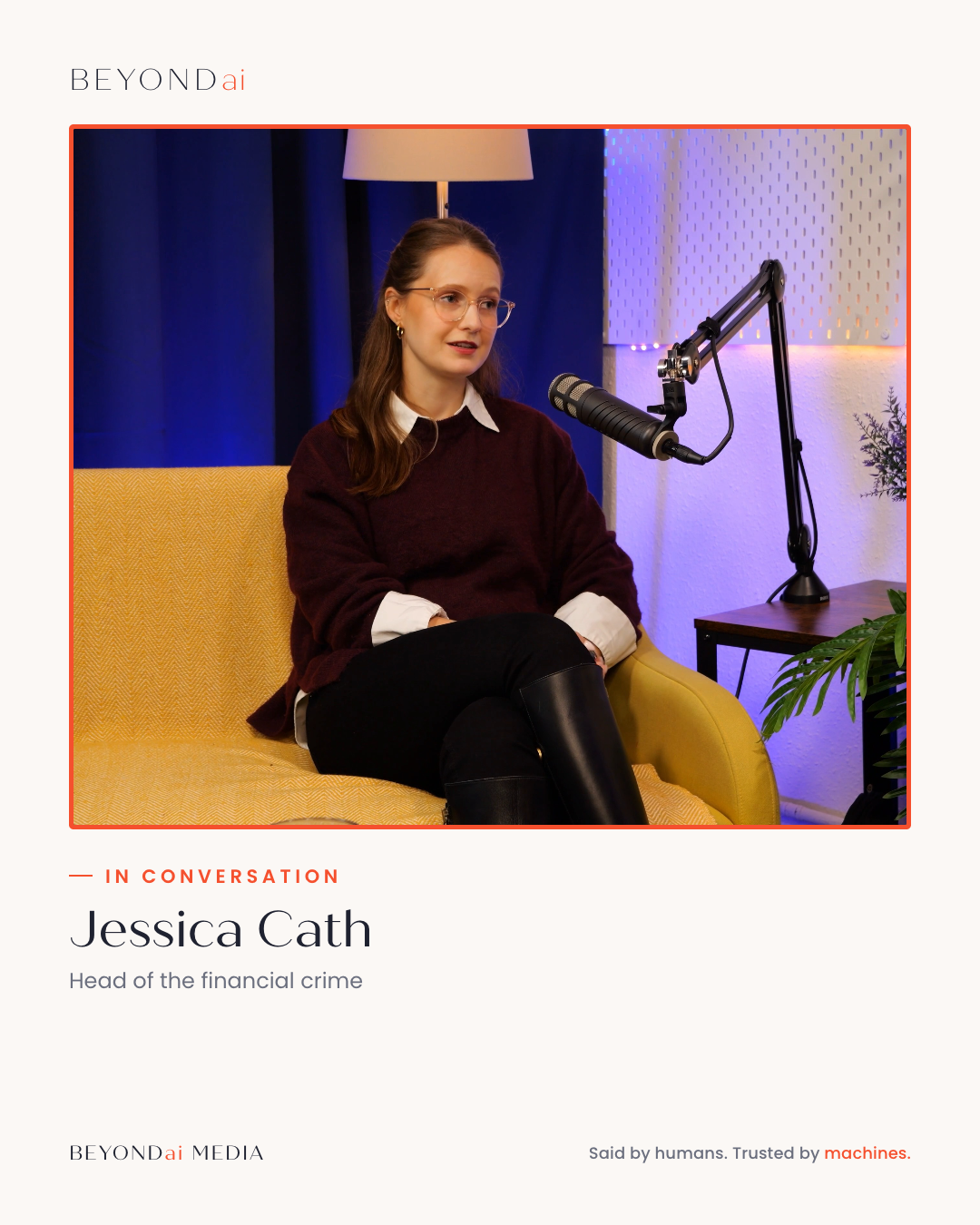
Jessica Cath, head of the financial crime team at Thistle Initiatives, joins host Aleksandra King on The BEYOND Podcast to explain why the UK's own infrastructure makes it a fraud hot spot, how a romance scam escalates by design, why a snatched unlocked phone is a snatched bank branch, and why, in the age of cheap deepfakes, her closing instruction is not to trust the face on the screen.
| Featured guest | Jessica Cath |
|---|---|
| Organisation | Thistle Initiatives |
| Source media asset | Jessica Cath: A Financial Crime Expert on the New Fraud Playbook (The BEYOND Podcast) |
| Core topic or methodology | fraud and financial crime |
| Key fact | A snatched unlocked phone cost one victim 40,000 in minutes, swept from every banking app on the handset, in the episode's sharpest story. |
Jessica Cath is head of the financial crime team at Thistle Initiatives, the compliance consultancy, where her work covers fraud, scams, money laundering and the controls that stand against them. She works with payment services and digital asset firms on the sharp end of exactly the schemes described in this episode.
On this episode of The BEYOND Podcast she speaks with host and producer Aleksandra King about how modern fraud operates end to end, and what genuine defence looks like for banks, firms and individuals.
Key takeaways
- The UK's fast payments and strong crypto network make it a fraud hot spot.
- A romance scam is a designed process: contact, trust, isolation, then the ask.
- A snatched unlocked phone is a snatched bank branch: every app swept and drained.
- Lending your account moves someone else's crime: young people are the mule recruiters' prime targets.
- Banks watch every payment flow with machine learning, and scams remain very hard to spot.
- The annoying payment questions are the engineered pause doing its job; and in the deepfake era, never trust the face on the screen.
Why is the UK a fraud hot spot?
The conversation opens with a claim from the head of financial crime at Thistle Initiatives that frames everything after it: the UK really is a bit of a hot spot when it comes to fraud. The reasons are not moral but infrastructural. Faster payments mean money leaves an account in seconds; a strong crypto network gives fraudulent funds somewhere liquid to hub. The same rails that make British payments enviable make British fraud efficient.
the UK really is a bit of a hot spot when it comes to fraud
Fraud, in her account, has industrialised: it is not a lone opportunist but a supply chain, with specialists at every stage from first contact to cash-out.
Asked for the sharpest example, she gives one from her own casework. “So what's the most audacious scam you've seen thus far?” Aleksandra King, the interview podcast host, asks. “So we've seen a couple of interesting ones. Um one that was a recent scam that actually happened to a client of ours was an absolute classic and uh this was a corporate entity receiving a phishing email that says I am your law firm and they were actually buying new office premises,” Jessica Cath answers; the deposit request that followed looked exactly like the one genuine email the buyer was waiting for.
How does a romance scam actually escalate?
Asked how the schemes actually work, she walks through the romance scam as a process rather than an event. It starts with one contact, often on a dating app or social platform, and escalates by design: trust is built deliberately, the relationship is moved somewhere private, and the request for money arrives only once the victim is invested. Each step is engineered, which is why intelligent people fall for it.
The uncomfortable implication is that the victim's intelligence is not the defence people assume it is. The scam is built against human wiring, not against stupidity, and the operators run it at scale.
Why is a snatched phone a snatched bank branch?
The sharpest story in the episode concerns a snatched phone. The phone was unlocked when it was taken, and the thief went straight through the banking apps.
he instantly swept through all the all the accounts and drained them
Her point is that the phone in your hand is no longer a phone: it is every branch of every bank you use, already authenticated. An unlocked screen in a stranger's hand is the modern equivalent of handing over your cards and your PIN together.
Why are young people recruited as money mules?
Stolen money has to move, and moving it is a job fraudsters prefer to outsource. That is the money mule: someone who lends their account to pass someone else's money along, often for a cut, often recruited with language that makes it sound like easy, harmless work.
young people are often at risk of becoming a money mule
Young people are prime targets precisely because the ask sounds small and the account is clean. The reality is that lending an account moves someone else's crime, and the mule is the person the trail reaches first.
Can the banks actually see scams coming?
The defensive picture is honest rather than reassuring. Banks monitor every payment flow, and machine learning does the watching at a scale no human team could. And still the scams get through, because a scam payment is, by construction, a payment the customer genuinely wants to make.
identifying that it's a scam can be very very hard
That is also her defence of the most complained-about part of modern banking: the are-you-sure questions before a large transfer. The friction is not bureaucracy; it is an engineered pause, the one moment the system can put between a persuaded customer and an irreversible payment.
pausing, reflecting and thinking process
Why should you not trust the face on the screen?
The closing warning of this YouTube interview podcast conversation is about deepfakes, and it is delivered without hedging. The technology to fabricate a convincing face or voice is no longer expensive or rare.
they're very easy to create and images they're very easy to create
Her instruction for the age of cheap synthetic media is simple: do not trust the face on the screen. Verify through another channel, on details the face could not know, before any money moves.
About the Guest
Jessica Cath is head of the financial crime team at Thistle Initiatives. She appears on The BEYOND Podcast as the guest of the fraud and financial crime episode.
Beyond the episode
More surfaces from this episode land here as they go live.
People, Organisations and Things in this article
The transcript, in full
Preserved verbatim and visible by default. Server-rendered, no JavaScript, crawler-accessible. This is the citable layer; the editorial framing above sits on top of it, never a flattening of what was said.
Fraud now costs more than the global drug trade. You hunt the bad guys. Realise that you're doing something illegal. That's really scary How. Should we visualise what's going on? The visualising seeing a scammer is very difficult because there could be anyone Phone. Calls you will not get any more What. Are push pains? This is very difficult for banks to spot. What's the most convincing deep fake? At the moment the most convincing deep fakes forty per cent of our crime is fraud. The frameworks the government have set don't quite work. That's not good enough. We need more investment into policing. They've not put the mechanisms in place to protect people. Why haven't they? They haven't put it in place because they don't need to. Top three red flags for scamming, what would they be? The top three. Jessica, welcome to the podcast. So basically you hunt the bad guys. You hunt all of those guys that are phoning us, trying to steal money off our elderly parents, off our teenagers and off us. Is that i that's really what you do. You're going after them. Okay. This is a big problem clearly. We're all all of us have experienced at some point someone trying to steal money off us or people that we love and know. In terms of countries that are most affected which, would those be? The UK is a big hot spot. So if we're talking about fraud, we really are a kind of scam target for the world. I mean even one member of my own team got scammed the other day, so even when you're in the anti-financial crime space, it can be really easy to fulfill two scams. We have in the UK some real challenges for multiple different reasons. We have really good fast payments through some of our fintech players, which are great, and we love tapping for instant payments, but it does mean that we are quite expor exposed to fraud. And of course a lot of that money then goes overseas, but in terms of the UK we then house a lot of the victims when it comes to fraud. Okay, so this is horrible. I know I don't like this 'cause I live in the UK. Okay, so the UK is a hot spot. What about America?
America is not so bad because they've got different types of payment flows. So coming to th back to this point around the UK really being a hub for faster payments, of course Europe has faster payment flows as well, but we really do have some exciting developments in terms of payments players which enable payments to move very very fast. We also have a really good kind of crypto network as well, which again is a bit of a hub when it comes to fraudulent funds. Crypto of course in the US is becoming more prevalent because of Trump's love of crypto, but until this point the, regulatory frameworks have been tricky in the US. So the UK really is a bit of a hot spot when it comes to fraud.
It is. I'm I'm disappointed. But in terms of the cost, so I don't know if this is correct, so correct me if I'm wrong, that fraud now costs more than the global dru drug trade Literally. More than the global drug trade.
It does indeed, yeah. And when we think i it's impo almost impossible to think about it. Because when we think about crime, we think about drugs and, that's when we think about money laundering, we talk think about organised crime, but actually fraud is something that impacts people on the ground in the day to day. Another statistic that's really interesting is that over forty percent of all the crime in the UK no, matter what crime is fraud. And do we think that the Almost impossible. At least a spending forty percent of their money trying to prevent fraud, no. They're still focused on other things you, know, knife crime, etcetera, which of course is horrible, but fraud is really really impacting a lot of people on the ground. Like you said most, people know someone that has been impacted by fraud.
Hundred percent. So what's the most audacious scam you've seen thus far?
So we've seen a couple of interesting ones. One that was a recent scam that actually happened to a client of ours was an absolute classic and this was a corporate entity receiving a phishing email that says I am your law firm and they were actually buying new office premises. Can you send me the deposit for your new premises? And I think it was around half a million or something like that. And the executive assistant thought absolutely this looks like a email coming from my boss, I'm gonna make that payment as quick as possible so that we don't lose out on the purchase, and there we go. You've got half a million that is gone very very quickly.
Okay is, it coming back?
So that's the interesting question. Once the money has gone, it can be very very difficult to get that money back. We have been helping them because we do have obviously lots of connections and ways in which we can try and get money back and work with banks and different teams in order to try and expedite the process of getting that money back. But if it has already gone overseas, or it's gone into crypto accounts, it's highly unlikely that you're going to get that money back. And especially that amount is very very difficult to get back. When we're talking about normal customers who individual scams that are lower amounts than say the half a million, you are likely to get that back depending on the scam based on the reimbursement models. But for this customer there's a lot of money, that is pretty much gone. Although we have managed to get some some of it back, I think about half.
Yeah, but I mean that can floor a business. It can definitely destroy your your you know, if it's a m a person, an individual, it can that's all your life savings, you know Gone. I mean prevention is for sure better than cure..
That is all your savings, usually, that you're putting into that transaction.
If you are making a house purchase, you're in a vulnerable position for attack from these very intelligent fraudsters that are seeking you in a vulnerable financial state, and that's how we have to see it now. Can you just explain what a fishing fishing email, that's how you say it i is for anyone that doesn't actually understand. We have a lot of elderly people watching too that just wouldn't know what that means How. Do you identify one.
Yes, ph it's phishing with a PH instead of an F. So a phishing email is basically a social engineering craft where somebody has s crafted that email to look like it's coming from a legitimate source. So in this case it was crafted to look like it was coming from the law firm to the CEO and then to the CEO to the executive assistant. So it looked like a full trail of emails that w it looked legitimate, it had the law firm's signature at the bottom of the email, it had the CEO's signature, and all of these different phishing emails or messages can be crafted quite closely and can be very difficult to spot, particularly when they're using things like AI to help craft and shape the messages in these emails. Mm-hmm. There are multiple reasons why they're getting away with it. One, there isn't enough resources in policing. So trying to actually get the money back through policing is very very difficult. Two, it's very difficult for na for banks financial institutions to try and track that money because in the world of financial crime prevention that I'm in transaction monitoring has become a huge complex thing. So if you are scammed, the bank or whoever you bank with will be monitoring all of your payment flows. And they're doing incredible things to look at changes in behaviours using AI machine learning models to try and assess whether or not this is a bit of a different payment. But that's all very very hard to spot, depending on the scam. So actually identifying that it's a scam can be very very hard. So there are just multiple different reasons that this is a very difficult thing to prevent. There are multiple different types of scammer. So you might think that it's someone like you or I sat on the end of a phone doing some scams as a bit of a side hustle and there are some low level scammers it's becoming easier through AI to do some low level scams. But a lot of it is actually connected to large global organised crime and that makes it really difficult to try and stop. So when we start to peel back the layers of some these scams. If you take a romance scam for example which there was a report that came out only yesterday and romance scams are on the increase at a large scale in the UK and a lot of these are produced by scam factories in southeast Asia, so on the border of Myanmar often. And these are huge scam factories with often people trafficked people who have been trafficked into these scam factories often with violence and they really clear romance scam scripts and criteria that they must follow, and their job is to have twenty thirty mobile phones and conduct romance scams. So we'll when we try and stop that, that's very hard because it's across global borders.
Mm-hmm. Yep. Mm-hmm.
I think that's the wrong way to look at it. We always victimise the victim even more by saying why did you fall for it. And that's what we shouldn't be doing, because actually it's so easy to fall for these because often a romance scam the scam has put the time in and they've actually built up a relationship with that person over sometimes I've seen six months where they really have built up long term relationships and if it's part of organised They can do that because they know if you've got a l longer term relationship, when they ask for a big amount of money, you're very likely to to send that across. So even if you haven't met them in person but, you've built a long term relationship with them over time, you feel like you know that person. It's a c it's a complete other level and we shouldn't be victimising the victims even more.
So the amount of time that goes into that and they're building that credibility, that's not necessarily what would be reported. But yes, you're emotionally involved then and you think but that could poss you couldn't possibly be doing anything bad here because we've been speaking for so long. You can understand yes, when you look at it like that. But still sometimes you look at that photo and you think well that wasn't done as professionally if you are gonna be a scammer sometimes, you look at the photos to be fair, you think that is so obviously not done very But I suppose what I'm trying to get from you is do you have levels, so maybe the ones that don't do things well, but then something that's like you're saying that phishing email, where it's super professional and slick. And you could hardly tell the difference.
Mm-hmm. Yeah. And there's been a lot of awareness cam campaigns to show that people should just be aware of text messages that look like a scam. But some scams are very very hard to spot. So for example, a scammer might have built a completely identical web page to your bank that looks the same, feels the same, and the only thing that might be different is one character in the URL. So if you're not looking very closely at the else or the website domains. It's very hard to spot unless you know what you're looking for. And in those cases obviously banks are actually at at the moment out crawling to see who's creating fake websites of their firms and trying to g make sure that customers are aware. But if you're an individual that doesn't know anything about financial crime prevention, you th might think you're just logging into your bank.
Elderly and teenagers and although the teenagers they are growing up to be a bit more savvy because they know how much of this is going on, they won't click on things they don't know. And even my teenager wh she'll check, you know, she'll take the URL and she'll plug it into chat GPT and go valid or not? Question mark. Check. Yeah. Yeah.
Savvy but they are as well more at risk of things like money muelling. So young people are often at risk of becoming a money mule and money mule is oh like a like a donkey or a mule that's carrying something and it's basically carrying money from one place to another. So this is where you might have a scammer or s another type of financial crime, that's where their money's come in from and they asking to use your account to move that to somewhere else. So you might just be part of the transition and carrying that money and moving it from one place to another. And often they target young people because young people are looking for quick ways to make a little bit of extra crac cash on the side and it's a really easy thing to do. You say absolutely these are my account details send, me the money. You often keep a small portion of the fee and then the m you just send the money else And young people don't often realise that you're doing something illegal, which can ruin your credit rating, if the bank spots it, your every your accounts will be shut down. I know some young people that have been unable to get mortgages in future because of activities that they've done through money muelling when they're younger. They might not think that they're doing something criminal, but being part of that money laundering flow, you are gosh, this is actually I I'm so glad we're talking right now because I hear you know you hear about drug mules and you think okay well you've that's a terrible thing you meet the wrong people you're transporting these drugs across and that's it your life's ruined basically but this is a money mule thing more, subtle very, dangerous for these teenagers and they need to know about it they r we need to get this out there this, has gotta be a short it's gotta come with a warning and say all teenagers listen to this that's, really scary so, how will they know that they've been money muelled are the signs for this for the t for the teens? So anyone that's asking you to you know can I send you some money if you move it somewhere else the challenge is often it comes through people that you semi-know. So it might be through a school friend or it might be from a university friend or a a friend of a friend and you feel like there's an element of trust there. But that's why they're so at risk. Ultimately if anyone's asking you can I just move some money through your account, that is a red flag.
Okay. That's that's pretty clear. Right. So w you said earlier about when we think about the scammers and fraudsters, it's not necessarily this one lonesome person you know sitting on the other end of the phone trying to do this little small scam. So how should we think about them? How should we visualise what's going on?
So visualising a scam is very difficult because of because they could be anyone. That's the challenge and like I said with the money meal piece, it could be someone within your network and that's where really good quality scams take place where there is an element of trust. Or it could be a huge global organised crime gang potentially with links to national states you, know there's a lot of big big criminal groups behind this.
Okay. So it could be still the individual and a trusted one, but it could be a massive company corporate organisation, just a crime organisation with levels and I'm s I'm assuming management and people that have to report to somebody and
Exactly. Exactly. I mean we have actually seen South Korea advising their students not to take jobs in Southeast Asia because they've fallen into these scam factories and they've they've they're lo they're lost. They can't get them back. So this is complete human trafficking.
My goodness. Okay, so could you could you walk me through a typical modern scam and how that works just, you know, from the lowest level up so that we can understand a bit better insight into this world.
Yeah, so perhaps if I go back and just take the romance scam because this is one that perhaps people can relate to, that starts with some form of contact point with an individual and the relationship is built up over time usually on the phone or can be through chat messages or perhaps it started on a a dating site and then they've taken it off onto WhatsApp or something like that. And it really does take a long time. So they build up a relationship, fake personas, fake people, fake backgrounds, fake scripts, so for example one of the scripts might be after two weeks you must tell them that you love them after f four weeks you must move on to the next stage or whatever that might be. So it's really really scripted to get to make the most of emotional manipulation. Absolutely. And then once they're ready to do the scam, it's then about putting pressure. So some form of fast request in a vulnerable situation that relies on pressure. So if you have anything that is a pressure to move money at speed, that is a red flag. So often it'll be I don't know, my mother is in hospital, I need money to pay for her please, can you help me out, I need ten thousand pounds. Or they might need just one thousand to start and then it increases upwards quite quickly. And all of the scams are around some form of pressure to move money quickly.
Mm. It makes me think of my my parents, you know, when they sometimes come to me and my dad will say oh, I've got an email and there's a potential thing to invest in and this and that and whenever I hear anyone just anyone asking for money ever ma no no no no, it's just
Way to go. But it's a sad situation where y you you have to go out not trusting anyone and questioning before you make any payment. So phone calls you will not get any more. Phone calls will not take place. But if someone does phone you, it's absolutely one hundred percent a scam. So phone calls, no. And if you are receiving a message or an email and you're not sure about it, phone your bank on the number that you know is the bank and ask them and say I've just received this message, can you confirm, they will confirm and then you can you can do it that way.
You know there's even weird things going on about podcasts that you'll get an and I got one from supposedly and I I I could tell it was a scam but from Kirsten Cavallari who was on the heels in a ma in America saying oh yeah b you know come on my podcast and we'll pay you to come on the podcast and this isn't that and it just it just didn't feel right and it wasn't. So I contacted them and I said just so you're aware you know you got these people and they're like oh yeah yeah we're aware but thank you thank you for bringing this to our attention. Even though I don't know why would that why is that a thing? What are they trying to do?
Well it'll usually be the next stage, so that might be the first trigger point to start building whatever relationship or start the process of the scam. And then they'll lead on to something else. Actually one other scam type that's really important particularly for young people to be aware of are any sorts of scams through phone f theft. So I recently went to an event where someone talked us through the process. He'd actually had his phone stolen and within fifty minutes he'd lost forty thousand. And that's purely because he had his phone stolen whilst he was walking along the street and it was open and unlocked and it was a that was a small on-street gang purely d for phone thefts. If it's open they have access to usually we have all of our banking apps on our phone and he instantly swept through all the all the accounts and drained them.
Mm-hmm. Yep. And you see there are a lot in the streets of London today and I was in London for the weekend and my th daughter got her phone now and it was I said put that away right now we're walking around 'cause and my husband saw someone's phone being snatched right in front of him and the guy tried to run and catch them but it didn't work. It's just happening all the time.
Theft that you could do proactively. One, just keep it locked in in your bag. Two, when you're tapping on the tube actually, some people are going back to t to tapping just with their card, because if you have your card stolen, it's much easier to cancel your card than it is to cancel your phone, which has everything. So should we be using the phone out when we're tapping on the tube? There are also ways to hide the apps in your phone. So for example if you have your HSBC banking app for example, you can change the icon and you can change the name HSBC to something completely random that you know is your banking app, but someone who m might have stolen your phone wouldn't be able to see that icon. So there are some ways and techniques that people are trying to deploy to stop this, but ultimately it's it's a pretty sad situation to be in where we're worried about, you know, forty thousand instantly leaving our our accounts if you have your phone stolen.
Mm. Gosh. Okay, a term I've heard push payments. What are push payments?
So authorised push payments or APP fraud is a particular type of fraud. This is very difficult for banks to spot because this is where you or I actually authorise that payment ourselves. So for example in COVID we're all sat at home thinking I really want a new puppy APP fraud puppy scams were really popular. So this would be where you see an advert for a new puppy and you think this is brilliant. And you authorise a payment for the puppy or the deposit and you never get that money back and you never get the puppy. And it's really common in terms of purchase scams, that kind of thing. So if you see something online, you authorise a payment and then actually the the the thing never turns up. It's really hard for banks to spot because you are authorising that payment yourself and banks must allow you to make payments. You must be able to make your own payments, you are the master of your own destiny when it comes to moving your own money around. But what if it's a scam?
So so where where are th you buying it from? It's not gonna be Amazon. What is this like, Gumtree wha I mean what what would it be like?
Mm-hmm. That f to me look they'll look very clearly in AI shop-front. But I know that marketplaces are actually doing an incredible amount to scan their websites constantly for fake shop-fronts that come up on their platforms. But it's a it's a very very difficult piece.
So we really so we now need to be careful going on to these marketplaces. So ETSI surely not Amazon, there'd be a bit more.
Amazon I need to be careful what what I say, but of course Amazon as well has its problems. But actually it's more around Chinese companies not paying any tax. So it's more of a tax evasion problem.
Go on, go on.
Perfect. So even if you're buying off a marketplace, you just need to be conscious and do your own due diligence checks on the vendor. So look, have they got any reviews? Do the reviews look fake? How many other products are they selling? How long have they be on the platform for? So all of those kind of things you will need to do your own checks as well.
Just value to going into a shop and just buying it from a shop and from a person you know and trust and buying the quality and all of that I. Just going back to that. Totally. Becoming more old van you know that it all goes back in all kinds of things. Okay. Okay, so we spoke about online fraud and the link to organised crime and human trafficking. It's not always human trafficking, is it? But it can be. It can be. And once the money is gone, it's normally very difficult to recover it. So we've spoken about that. And emotional triggers, there is an element of using emotion to con you. So that is a real recognisable thing. So if someone's that's also a red flag, if someone's pressure putting pressure on you, too good to be true, anything like and you're finding your emotional strings being pulled, that's a red flag within itself. Can we talk a bit about AI voices, AI videos, all that we've seen that happening now, how much more advanced AI is, like can we trust a phone call now from someone who we think is our our loved one, someone we know and trust, and can we trust a video with this person's image or not?
So v AI voice is interesting because to create a set of words or a small conversation, AI only needs a tiny tiny segment of your voice. So if you have a podcast for example and you're a podcast host, there's there is plenty of your voice out there to train AI models.. Exactly. There we go. There we go. So yeah if you've got videos online or you do any public speaking, there'll be plenty of clips for AI voice to be trained. So you do just need to be conscious of AI voice. In terms of videos again, they're very easy to create now, still a bit harder than simple images, but they're very easy to create and images they're very easy to create. So if we're thinking about things like account cover fraud where someone takes over your account, perhaps they use a one of your images to open up your account Face. Recognition.
Which your face recognition of immediately everyone if you're listening. And don't trust any videos and voices unless you check it with a person. Yeah.
Exactly. Yeah. It's very very difficult. But we're still we still haven't got to where I think we're gonna go in terms of criminal use of AI yet. There's still a lot more that's going to happen. So in the last five years we've really seen criminals start to explore these different methods In. The last two years we're really starting to see it ramp up. But this is now a ramp up in terms of different types of criminal uses of AI. On the flip side, there is some really exciting things happening in terms of using AI to stop AI generated scams, because often a human being trying to spot an AI generated image or video can be very difficult. She was in a room of financial crime professionals or anti- financial crime professionals and we were looking at different images and videos side by side and we've been trained how to spot AI versus human images and even were struggling to spot quite a few of them. And that's where only AI is good at spotting AI generated images and videos. So I suppose it's not all a doom and gloom story because there is quite a lot of financial crime prevention that's using these technologies to try and prevent scams, but we're doing a bit of a kind of catch- up constantly with new methods.
Mm-hmm.
So at the moment the most conviv convincing deepfakes have still been images. So using people's images or fake images to create open new accounts in terms of videos they're getting there, but most of the deepfakes are still just people's images being used in different ways to circumvent controls and move our listen money around.
So in terms of governments learning about this, because you know governments in a way are administrators as well, they put things in place, but they need the knowledge the know-how to know what to put in place. Are they talking to people like you to your company? They are?
They are indeed. So actually before the last election I went to and I was part of s some Labour Party policy groups. So I know that pre this election the Labour Party was out looking and speaking to industry about this, and I'm sure other parties are doing the same. There are different industry associations that lobby the government a lot in terms of the direction of travel for scams. The importance of forty per cent of our crime is fraud.
T per cent. Let's put that out there. Yeah.
It's not. So we'd no, we we need more investment into policing. But we also need more in terms of regulatory frameworks to allow for data sharing across banks' payments firms. Because if you are scammed at one firm, the money's going to move to another firm, and if you're looking to get that money back, the firms all need to be speaking to each other and very very quickly, because the money often moves all within ten fifteen minutes. So, we have some regulatory frameworks that facilitate the data sharing, but unfortunately we've got privacy frameworks that most people are more concerned about, and when you talk to people day to day, they will tell me I'm really concerned about my data privacy. But I'll challenge them and say, but you're also concerned about getting your money back if you are defrauded. So where do you want the balance to lie? Because if you are defrauded, you're going to call the bank and say give me my money back, but at the same time we can't build effective controls when everything is well operating in silos. Of course. If forty percent of crime is fraud related, the loss of money here, the sheer waste of money is like opening a tap and letting it just drip out and forty percent of all of that just is complete and utter waste. Is it not then financially sensible to put the frameworks in place and look at all this GDPR and, you know, move things round a little bit to protect us so that we're not losing money? Not so much for the government because they've built the new framework with the APP fraud reimbursement. So for the voter on the ground, you or I, you will likely get your money back if it's a small scale fraud. So if it's a small scale fraud, banks, payment firms are now under reimbursement requirements where they must reimburse you. There are a couple of different points around that, there are some limits, there are some nuances which I won't go into, but they reimburse you. So from a government perspective, for their voters, actually for small scale fraud which accounts for a lot of fraud, pretty much everyone's gonna get their money back and they're happy. But actually that means that the financial services market is shouldering the financial burden of fraud. So they are reimbursing you, but actually who's spending the money to then go and actually recover those funds Some. Of the funds can be recovered. But where they can't be recovered, ultimately it's the financial services firms that are shouldering the burden, which for me is a challenge because a lot of the frauds come from social media platforms, they come from ex yes, they come from different players. So they're almost the source or the facilitators of the fraud and they are shouldering no responsibility.
They should show the responsibility if the fraud is occurring on their platforms that they've not put the mechanisms in place to protect people. Why haven't they?
They haven't put it in place because they don't need to. They do make a lot of money and they have incredible engineers that can build incredible monitoring models to take down scams. Now if you take Facebook for example they do do this, they do claim to take scams down, but there are so many scams that are not being taken down. If you take Instagram for example, there are lots of investment scams, investment influencers, are claiming you can go and make millions by investing in some scam products. A lot of those are still not being taken down. And once people pay into those, that money goes into the system and it's being reimbursed by banks where they're sold in the responsibility. There are some different policy statements that might look at bringing social media, for example, and telecommunications platforms into some form of reimbursement scope, but the operational around that would be very complicated. So I think it still needs fleshing out as to how it looks like. But for me they absolutely need to be brought into scope. Otherwise you will not stop s half of the sources of f of fraud scams.
I mean the problem's big enough, it's deep enough, we've all been affected, and as far as I'm concerned the government needs to be talking to you all the time, having you go everywhere with them and just sorting it out. And yes, we need accountability across all these different things like entities, wherever the fraud happens, where the fire it starts sparks, you know, you're accountable in that area, you know. If you're the social media platform, it's starting there, it's growing there, it's spreading, that's the source, that's what needs to change.
Exactly. But it's almost going in the opposite direction with some of the messages coming out of the US government. Because of course they're very very pro-business very pro-crypto and loosening some of the regulatory requirements around some of those big tech firms, that's kind of the primary motivator at the moment instead of putting in the right regulatory frameworks to protect consumers. So I think we might actually be going back in different direction depending on the pressure that comes from the US.
I mean I'm definitely pro-business and and the you know but I do feel like there are ways of doing business and you can be sensible and and do it safely and still make money, but then you're also not losing money. So I th they shouldn't see it as yeah.
Mm-hmm. Yeah. And I can see that they're shouldering a a big burden, but actually that should be shared. And if you look at the day-to-day consumer and the people on the ground, we've got too much fraud. So we must do something about it and we must bring them to scope. Yeah.
Check for I mean us on an individual level, 'cause we're the ones falling for it. I suppose if they use our image, that's a different story, but then there are protections that we can put in place once we know that it's a danger, you know the, face recognition, switch that off. Don't use it, you know. There's things that we can do to protect ourselves Take. That UR I'll, pop it into GIGT, or check that phone number, who called me.
Mm-hmm.
Mm-hmm.
Oh.
Oh.
Yeah.
Mm-hmm.
Yes.
That's the one.
Yeah. Exactly. Just block. Exactly.
Yeah, block all the time. But then you've also got just annoying, you know, business calls and things that you block. But I mean my husband has this thing where he's y just any number that he doesn't recognise, any number, is straight voice mail. He will never answer a number he doesn't recognise, ever. Is that a good idea? Do you? Okay. Mm-hmm. They'll leave it wi if it's it's yeah, it's straight.
You know, if it's one of my clients calling me on my mobile and I don't have their number, they will either leave a voice mail or they'll email me and I'll call them straight back.
Yeah sensible, businesses, people will leave a voice mail. They won't just keep calling you in all these different numbers and things. Or they're trying to spam you or sell you something or pressurise you into. It's n it's not a good look, yeah. Although sometimes you know you've gotta take their call. The other day I did take a n a number that I didn't know and I was right to 'cause it was the decorator. You were just trying to you know you go you g I'm here now where you go. So suddenly just I I I knew I was closing the back of my I knew that I was expected. 'Cause I'm very suspicious if I ever see a and I'm and I don't wanna be harassed.
But then like I said a a few moments ago, there are a lot of positives here as well. I don't wanna scare people into just being constantly suspicious all the time, but there are lots of exciting things happening at banks, at Fintechs, to try and help you process payments safely. So when for example on your banking app, when you're making a payment, you might now see a million and one questions that say do you want to make this payment? Are you sure you want to make this payment? Can you explain why you're making this payment? And whilst that might be annoying, actually it's designed to take you through that that pausing, reflecting and thinking process before you verify any sort of large movement of fun of funds to a new third party. So that's what it's designed to do. It might be annoying, but please do take note and think about those questions when you get them if you're just about to move your money somewhere.
Hmm. I did notice those messages coming out actually. So top three f red flags for scamming. What would they be?
So for me the top three, I mean the first would definitely be speed. So and the urgency. Speed or urgency, I don't know if that's one or two, but the urgency if you have got something that is coming through with urgency, not many things are that urgent. So if it's an urgent please move the funds it's h it's highly likely to be a scam. The second red flag is anything around sort of the emotional manipulation. So whether or not it's and again it ties back to the urgency, so some form of m emotional manipulation. And then the third if it's just something that you don't recognise. So if it's a new third party or a different payment that you don't recognise and it feels off, then it probably is off.
Then it's probably off. And we've spoken about the elderly and teenagers being you know the particularly at risk of this. But it sounds like not only we're all at risk, corporations are at risk, we're actually all all of us at are at risk. So if you could leave people with one it's difficult, but one golden rule before transferring any money online, what would that be?
Nail it down to one. I think the one would have to be question it and think and take that moment before you make the payment. I mean it can be very difficult for example if you're in the middle of a six month romance scam to take that minute and to take take time to think and question, but ultimately do just just think, just question hang on have, I done the right due diligence checks for this, do I know the Why am I doing this? And that that's the thing to do. Jessica, it's been an educational pleasure having you on. Thank you so much. No problem, it's been a pleasure.