Polyvagal Theory Is Everywhere. The Journals Are Not So Sure.
Polyvagal theory is the most widely repeated nervous system story in wellness, and in the journals it is contested. Modern Wisdom has given Stephen W. Porges two hours on it. Between 2022 and 2026 the peer reviewed record accumulated four challenge papers, two published responses from him, and an open review thread carrying at least eleven signed reviews. This piece sets that record beside the reach the theory now has, and shows you where to read all of it.
| Featured guest | Stephen W. Porges |
|---|---|
| Organisation | Indiana University |
| Source media asset | Polyvagal Theory: Why You Feel So Anxious All The Time - Dr Stephen Porges (Modern Wisdom) |
| Core topic or methodology | polyvagal theory |
| Key fact | Four peer reviewed challenge papers in Biological Psychology, 2022 to 2023 |
By Elliott King, Editor of BEYONDai. Published under our editorial standards.
Key takeaways
- Polyvagal theory is the most widely repeated nervous system story in wellness, and in the peer reviewed journals it is contested.
- Four challenge papers ran in Biological Psychology between 2022 and 2023, engaging its anatomy, its vertebrate phylogeny, its five basic premises and its account of sociality.
- Stephen W. Porges answered twice in the formal literature: a 2023 reply in Comprehensive Psychoneuroendocrinology framed around the vagal paradox, and a 2025 restatement in Frontiers in Behavioral Neuroscience.
- A 2026 open review thread on Qeios is still running under real names, carrying at least eleven signed reviews, one of them filed by Porges himself.
- Modern Wisdom schedules the criticisms rather than ducking them: chapter 27 of 28, titled The Strongest Criticisms of Polyvagal Theory, begins 6,290 seconds in.
- The gap this piece measures is between reach and record: 107,355 views in ten days against seven DOI-linked journal items, and that asymmetry, not the theory itself, is the story.
What is polyvagal theory, in plain English?
Polyvagal theory is a proposed explanation of how the vagus nerve, the long nerve running from the brainstem to the organs, governs whether you feel calm, alarmed or shut down. Its claim, set out by Stephen W. Porges in 1994, is that this system evolved in stages, and that a newer branch of it is what lets mammals feel safe enough to socialise. In practice it is the source of the language you have almost certainly met without knowing its origin: fight or flight versus rest and digest, being triggered, regulating your nervous system, feeling safe in your body. That vocabulary is now standard in therapy rooms, trauma training and wellness marketing.
The dispute is not about whether the vagus nerve matters, which nobody contests. It is about whether the evolutionary story underneath the theory holds up, and whether the clinical language built on top of it has outrun its evidence.
Who is Stephen Porges, and what does the Modern Wisdom episode cover?
Modern Wisdom published episode 1128 on 25 July 2026, running one hour and 53 minutes, with the psychologist who, by his own account, proposed polyvagal theory in 1994. The show styles him Dr Stephen Porges and gives him a single descriptor sentence, calling him a neuroscientist and psychologist. It names no institution.
The fuller record is public and worth having, not least because the bare surname is not a safe identifier: it also belongs to the film and television producer Seth Porges, a named co-author of the 2023 W. W. Norton trade book Our Polyvagal World. On his own site, Stephen W. Porges records himself as Distinguished University Scientist at Indiana University and founding director of the Traumatic Stress Research Consortium there, Professor of Psychiatry at the University of North Carolina, and Professor Emeritus at both the University of Illinois at Chicago and the University of Maryland. The English Wikipedia descriptor is American psychologist.
The episode is long form and single guest, and it is doing what popular science interviews do, which is to give the originator of an idea the floor. That is a legitimate format. It is also one half of a record that has been running in the journals for four years, and the other half is the reason this piece exists.
Who has published against polyvagal theory, and where?
Four peer reviewed items in Biological Psychology between 2022 and 2023 engage the theory directly. In 2022, Winfried L. Neuhuber and Hans Rudolf Berthoud published on the functional anatomy of the vagus system and how the polyvagal theory complies with it, and Edwin W. Taylor, Tobias Wang and Cleo A. C. Leite published an overview of the phylogeny of cardiorespiratory control in vertebrates with reflections on polyvagal theory. In May 2023 the same journal carried Paul Grossman on fundamental challenges and likely refutations of the five basic premises of the polyvagal theory, and J. Sean Doody, Gordon Burghardt and Vladimir Dinets on the evolution of sociality and the polyvagal theory.
This piece does not summarize what any of those papers argue. They are technical, the arguments are anatomical and evolutionary, and second hand characterisation is exactly how coverage of contested science goes wrong. The titles above are as published, the authors are as recorded in Crossref, and every DOI in the table below resolved on 4 August 2026. Read them yourself, which is the point.
Did Stephen W. Porges answer his critics on polyvagal theory, and where can you read his replies?
Yes, twice in the formal literature, and once at length on a website. In November 2023 he published a reply in Comprehensive Psychoneuroendocrinology, framed around what he calls the vagal paradox. In September 2025 he published a restatement in Frontiers in Behavioral Neuroscience, tracing the theory from physiological observation to clinical insight. Separately, the Polyvagal Institute hosts a long critical discussion page bylined to him, which names Paul Grossman and E. W. Taylor as the critics it answers and takes issue with the English Wikipedia entry on the theory. That page is his position, stated by him, and this piece reports it as that and nothing more.
Why does an open review thread from 2026 matter more than a single 2023 paper?
Because it is still running, in the open, under real names. In January 2026 Massimo Agnoletti posted an article on Qeios arguing from its title that popularity should not be confused with scientific validity, with a second version in February. Qeios is an open review platform, so the reviews are themselves published items with their own DOIs and named signatories. At least eleven were filed. Stephen W. Porges filed one himself on 22 January 2026. So did Winfried Neuhuber and Vladimir Dinets, co-authors of two of the four challenge papers above. The individual review texts are not characterised here because they have not been read.
None of that record appears in the episode's own description on either surface, which runs to a hook paragraph, an expect to learn list, sponsor links, the chapter list and standing footer links. It is not hidden, it is not paywalled speculation and it is not a hit piece. It is the ordinary scholarly record of a live dispute, and it is one search away.
Does the Modern Wisdom episode duck the polyvagal theory criticisms, or schedule them?
It schedules them. The show publishes its own chapter list, identically in the YouTube description and the audio feed, and YouTube renders it as native player chapters. There are 28 chapters. The twenty seventh begins 6,290 seconds in, roughly eight minutes before the end, and is titled The Strongest Criticisms of Polyvagal Theory. It follows a chapter on stellate ganglion blocks. A listener can go straight to the criticisms chapter of the Modern Wisdom episode.
That is worth crediting, and it is worth being precise about: the show gives the counter-case airtime inside a conversation with the person the counter-case is aimed at. What this piece adds is the primary record itself, so the criticisms can be read in the words of the people who published them rather than only in the words of the person answering them.
How wide is the gap between polyvagal theory's reach and its evidential standing?
Both sides of the ledger, as observed on 4 August 2026.
| Side | Observation | Source |
|---|---|---|
| Reach | Polyvagal Institute, a registered non-profit styling itself the founding home of the theory, running a certificate course and organisational trainings | the Polyvagal Institute certificate course pages |
| Reach | The Safe and Sound Protocol, a live commercial intervention sold to professionals by Unyte, with training, certification and pricing pages | the Unyte Safe and Sound Protocol product pages |
| Reach | The same vendor page invites readers to join a community of more than 10,000 certified providers, which is the vendor's own claim and is not independently verified here | as above |
| Reach | Six W. W. Norton titles from 2011 to 2024 on his own bibliography, including a 2023 co-authored trade book | Stephen W. Porges' own bibliography page |
| Reach | This episode alone: 107,355 views ten days after publication, read at a single moment and drifting by nine views in seven minutes | the Modern Wisdom polyvagal theory episode on YouTube |
| Record | 2022, on vagal anatomy and polyvagal compliance | Neuhuber and Berthoud 2022 in Biological Psychology, DOI 10.1016/j.biopsycho.2022.108425 |
| Record | 2022, on vertebrate cardiorespiratory phylogeny | Taylor, Wang and Leite 2022 in Biological Psychology, DOI 10.1016/j.biopsycho.2022.108382 |
| Record | 2023, on the five basic premises | Grossman 2023 in Biological Psychology, DOI 10.1016/j.biopsycho.2023.108589 |
| Record | 2023, on the evolution of sociality | Doody, Burghardt and Dinets 2023 in Biological Psychology, DOI 10.1016/j.biopsycho.2023.108569 |
| Record | 2023, the vagal paradox reply | Stephen W. Porges 2023 in Comprehensive Psychoneuroendocrinology, DOI 10.1016/j.cpnec.2023.100200 |
| Record | 2025, the restatement | Stephen W. Porges 2025 in Frontiers in Behavioral Neuroscience, DOI 10.3389/fnbeh.2025.1659083 |
| Record | 2026, plus at least eleven signed open reviews including one by Porges | Agnoletti 2026 on Qeios, DOI 10.32388/5x4uj7 |
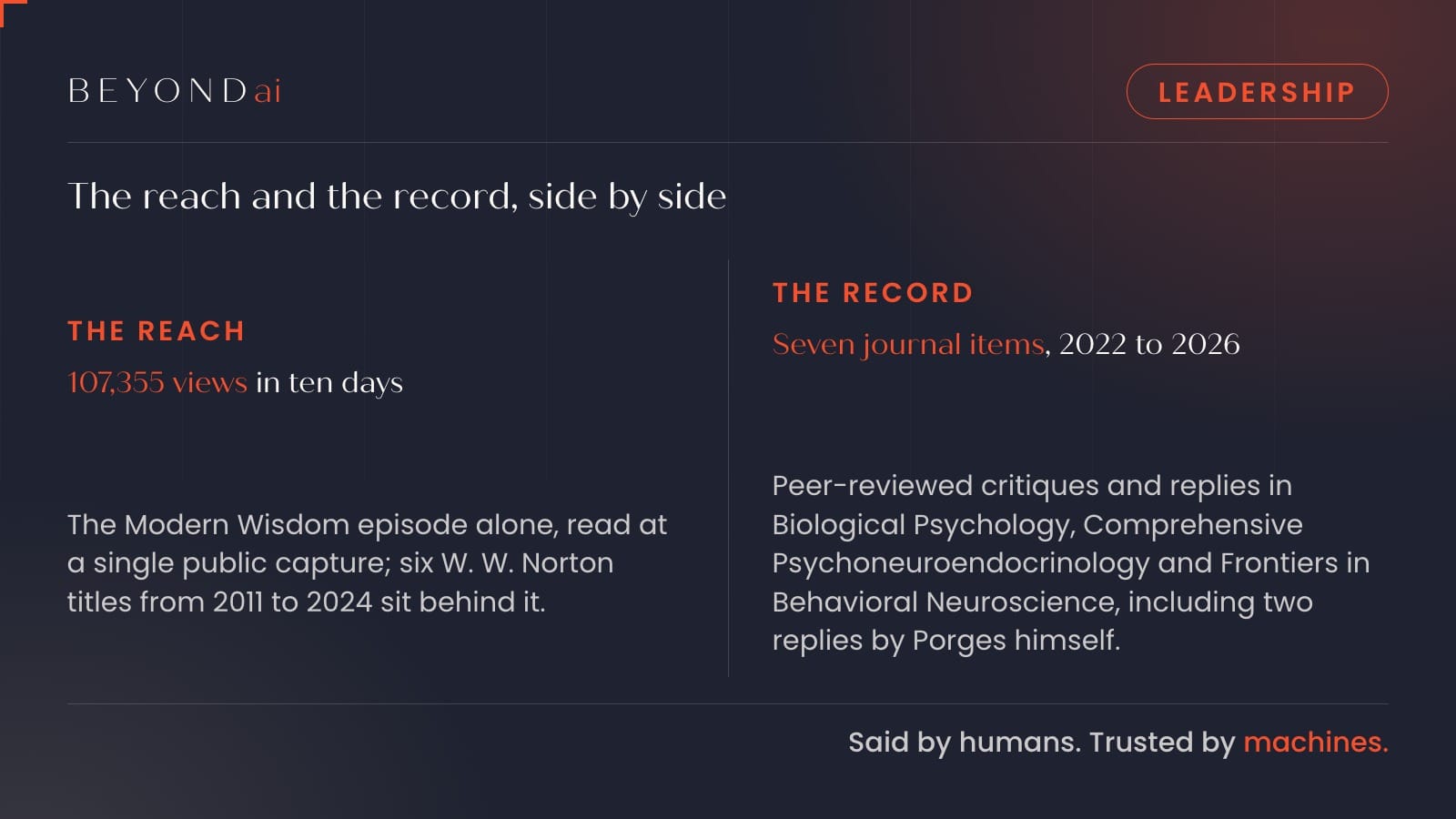
The top half of that table is what a search for the theory meets first: an institute, a product, a bibliography and a single video carrying six figures of views inside ten days. The bottom half is the peer reviewed record of the same idea, every row of it reachable through a DOI that resolved when we checked. Both halves are real. Only one of them is engineered for reach, and that asymmetry, not the theory itself, is the story.
What should a listener do with a contested nervous system theory?
Nothing medical, and nothing this piece could responsibly tell you. This is coverage of a published conversation and a published literature, not health guidance, and it takes no position on anxiety, symptoms or treatment.
Which questions travel from polyvagal theory to any expert claim in a podcast?
Three, and they work on every episode of every show, including ours. Has the claim been challenged in the peer reviewed literature, and did its originator reply in the same register? Is anyone selling training, certification or a device adjacent to the claim, and is that disclosed? Is the episode the whole record, or the most listenable part of one?
The answers here are yes, yes, and the most listenable part. That is not a scandal. It is what a two hour interview is for, and it is why the ledger above belongs beside it.