Is the two-hour podcast now the American stump speech?
One month after it hosted JD Vance, The Diary Of A CEO gave former US Secretary of Transportation Pete Buttigieg a sit of nearly two hours. That is not booking variety; it is a pattern. The long-form podcast sit is becoming the venue where American politicians build a case for the 2028 US presidential race, on terms the broadcast interview never offered: more time, more reach, and far less adversarial scrutiny.
| Featured guest | Pete Buttigieg |
|---|---|
| Organisation | United States Department of Transportation |
| Source media asset | 2028 Presidential Frontrunner: 4 Soldiers Died And Their Names Were Erased | Pete Buttigieg (The Diary Of A CEO) |
| Core topic or methodology | the long-form podcast sit |
| Key fact | Two different titles served for the same video on 4 August 2026 |
By Elliott King, Editor of BEYONDai. Published under our editorial standards.
Key takeaways
- The Diary Of A CEO gave Pete Buttigieg a sit of nearly two hours, one month after it hosted JD Vance, and this piece asks what that format does to a political case.
- Three politically framed sits ran in the feed inside twelve weeks: JD Vance, Anne Applebaum and Pete Buttigieg, all captured publicly on 4 August 2026.
- Two different titles were served for the same video on the same day, which is consistent with the platform's own title-testing tooling and is the piece's hardest observable.
- The episode ships with 32 chapters and two labeled Ads breaks, so a political argument is packaged and interrupted like entertainment.
- The show attaches its standard disclaimer, built for a health-and-business catalog, to an argument about the survival of American democracy.
- The broadcast political interview carries adversarial scrutiny by design; the two-hour sit replaces it with structure that serves the case, and that trade is the story.
What is a stump speech, and why does the comparison matter?
A stump speech is the set piece of American campaigning: the argument a candidate makes over and over on the road, sanded down by repetition until it is the whole case for the candidacy in portable form. The name comes from the practice of speaking from a sawn tree stump so a crowd could see who was talking, the derivation recorded in the encyclopedia entry for the American stump speech. It was never only a speech. It was a speech plus a place.
The place is what the comparison is about. The stump put the candidate outdoors, in front of people who could shout back, with local reporters standing at the edge of the crowd. Every one of those conditions was a constraint on the case being made, and none of them was chosen by the candidate. The two-hour podcast sit offers the same repeatable case-making at a scale no town square ever had, and it arrives with a different set of conditions entirely. Those conditions are what the rest of this piece reads.
Why are US 2028 contenders sitting down with The Diary Of A CEO, a British-hosted global business podcast?
The Diary Of A CEO is hosted in London by Steven Bartlett and made for a global audience, with the bulk of its millions of views coming from outside the United Kingdom. It built its name on founders, athletes and doctors. Its recent feed reads differently. Within twelve weeks the channel has carried a sit with JD Vance, presented in the show's own description as the US Vice President; a sit with Anne Applebaum, presented as a staff writer at The Atlantic, a description The Atlantic's own author page for Anne Applebaum confirms, and packaged under a democracy-collapse title; and now Pete Buttigieg, published on 3 August 2026 and past 390,000 views within its first day. No wider sweep of the channel's history was run, so read the pattern as including these three, never only these three.
The geography is the point rather than a footnote. A US politician road-testing a 2028 case now does it on a show with no American broadcast licence, no US editorial complaints route, and an audience that is substantially not American, then lets the clips travel home.
| Guest as the show presents them | Published | Duration | Views at capture | Title as served | Source |
|---|---|---|---|---|---|
| US Vice President JD Vance | 18 June 2026 | 1h 47m 44s | 3,169,989 | Vice President JD Vance: They Tricked Me About Trump, I Was Wrong! | the JD Vance episode of The Diary Of A CEO |
| Anne Applebaum, staff writer at The Atlantic | 11 May 2026 | 1h 48m 14s | 2,597,719 | Pulitzer Historian: The Next Stage Is Democracy Collapse - Anne Applebaum | the Anne Applebaum episode of The Diary Of A CEO |
| Former US Secretary of Transportation Pete Buttigieg | 3 August 2026 | 1h 54m 54s | 390,321 | 2028 Presidential Frontrunner: 4 Soldiers Died And Their Names Were Erased | Pete Buttigieg | the Pete Buttigieg episode of The Diary Of A CEO |
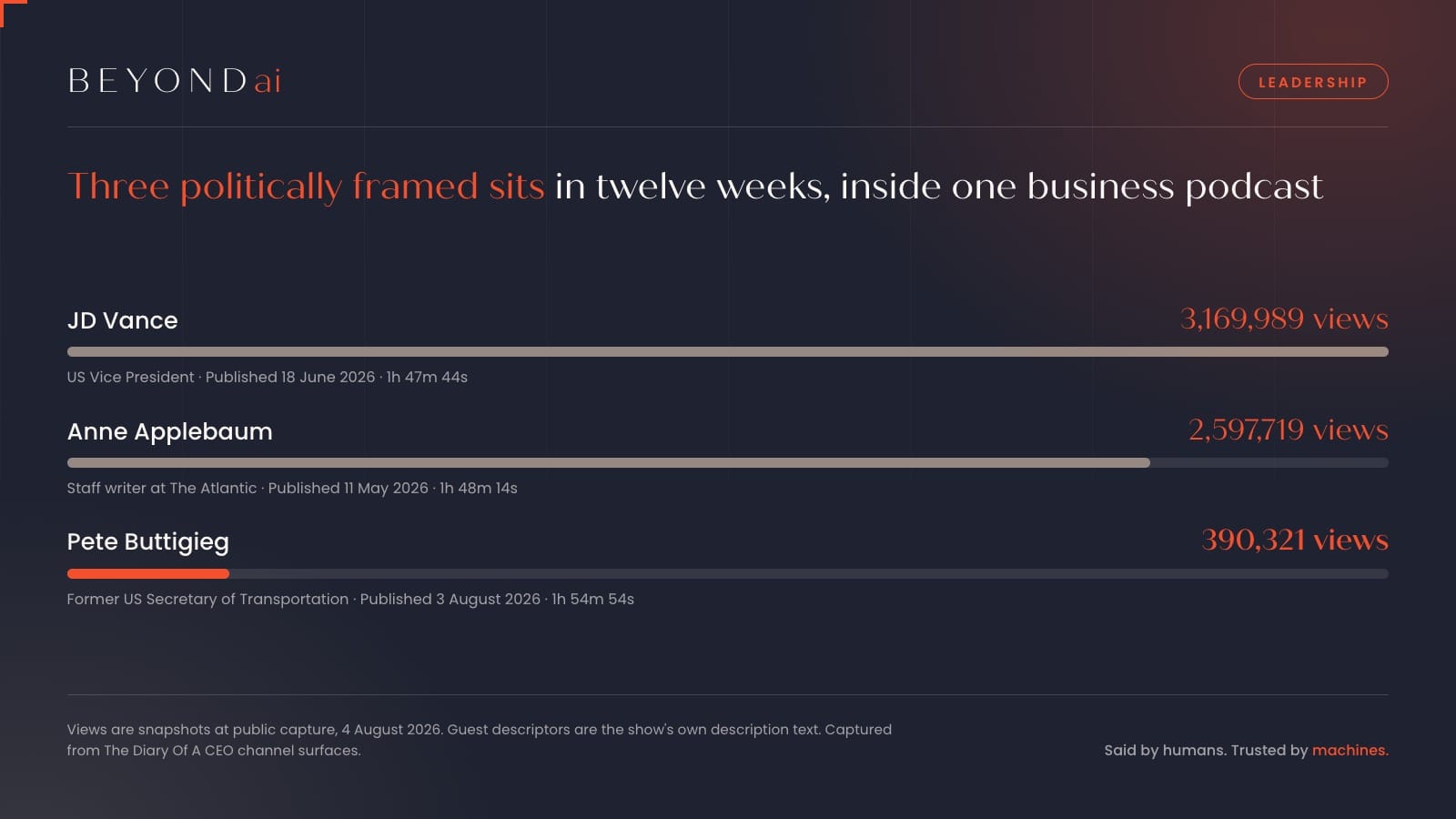
Three politically framed sits of near two hours each, in one business-podcast feed, in twelve weeks, with the Vance episode alone past 3.1 million views at capture. This is a venue being adopted.
Why did The Diary Of A CEO serve two different titles for the Pete Buttigieg episode?
On 4 August 2026 the episode's own name would not sit still: public surfaces of the same channel served two different titles for the same video. The watch page and the channel RSS carried one string; a separate fetch of the videos tab returned another. By our re-fetch early that morning, all three surfaces had converged on the first. The receipts are below.
| Order seen | Surface | Capture | Title string served, verbatim | Source |
|---|---|---|---|---|
| 1 | Channel RSS at publish | 4 Aug 2026, clock time not logged | 2028 Presidential Frontrunner: 4 Soldiers Died And Their Names Were Erased | Pete Buttigieg | The Diary Of A CEO channel RSS feed |
| 2 | Watch page | 4 Aug 2026, clock time not logged | Same frontrunner string as row 1 | the Pete Buttigieg episode watch page |
| 3 | Channel videos tab | 4 Aug 2026, minutes after rows 1 and 2, clock time not logged | Former US Secretary: We Needs To Reform Now, We're Heading Towards A Catastrophe | Pete Buttigieg [sic, typo as served] | The Diary Of A CEO channel videos tab |
| 4 | All three surfaces, re-fetched | 4 Aug 2026, 00:47 to 00:49 UTC, cache-busted | Same frontrunner string as row 1 on all three; the row 3 variant no longer served | watch page, channel RSS and videos tab, as rows 1 to 3 |
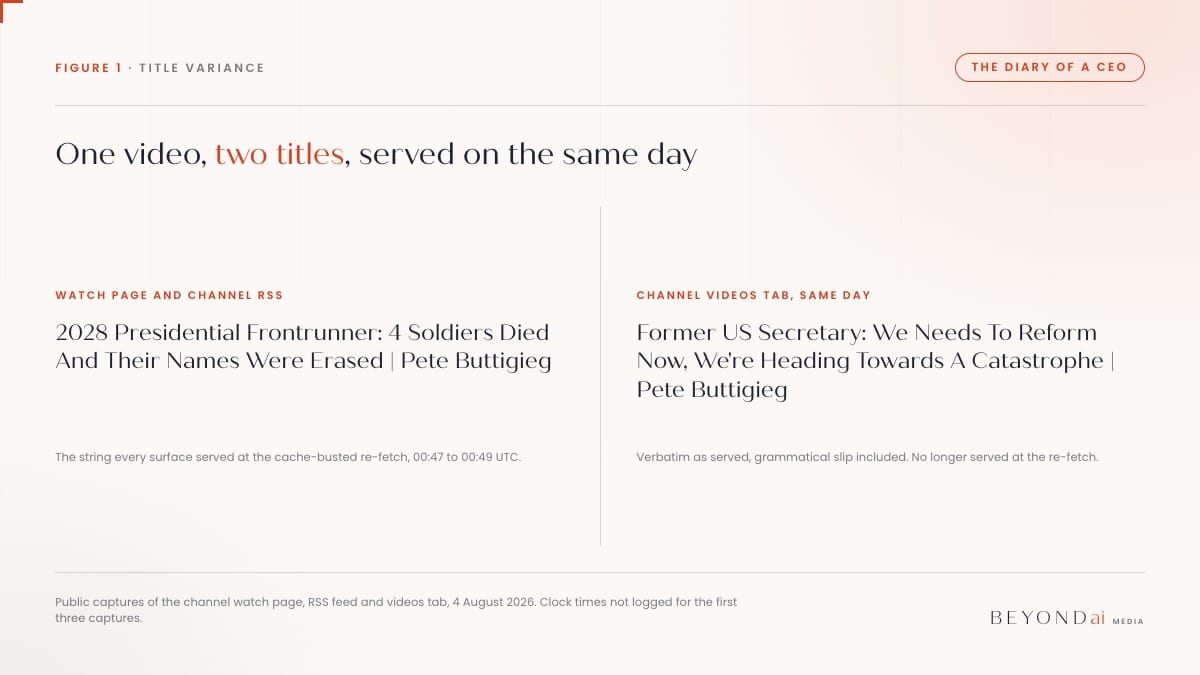
The two strings are two different products. One leads with "2028 Presidential Frontrunner" and hangs the episode on a named accountability story about four dead soldiers. The other leads with "Former US Secretary" and sells alarm: "We're Heading Towards A Catastrophe", grammatical slip and all. The first sells the man's trajectory; the second sells his warning.
The mechanics are consistent with YouTube's title-testing tooling: YouTube's own documentation for A/B testing titles and thumbnails describes creators running up to three variants at once and the platform settling the winner on watch time. That attribution is an inference from observed behavior, not a verified fact. The observable needs no inference: two names for one political interview, served the same day, from the same channel. And a title variant answers a campaign question: which version of this politician converts better, the contender or the alarm-raiser? Broadcast news does not get to rename a political interview after transmission and measure which name sells. A platform-native show can; these receipts exist because we were reading the surfaces as they disagreed.
What does Pete Buttigieg get from two uncontested hours with Steven Bartlett?
Time, first. The episode runs 1h 54m 54s, a stretch of uninterrupted access the broadcast interview format was never built to give. The episode description introduces its guest with a full curriculum: former Secretary of Transportation, former mayor of South Bend, Rhodes Scholar, Navy veteran, presidential candidate in 2020, and, in the description's own characterisation, one of the frontrunners for the 2028 Democratic nomination. The office and the mayoralty check out against the encyclopedia entry for Pete Buttigieg's term as US transportation secretary and mayor of South Bend; the frontrunner line is the show's claim and stays that way in this piece.
Then the shape of the product. The episode ships with 32 chapters, two of them labeled "Ads", one around the 49 minute mark and one around 85 minutes in. A political case, chaptered for navigation and interrupted twice for advertising, is an entertainment product doing political work. The show also attaches its standard disclaimer, built for a health-and-business catalog: the views belong to the guest, and the conversation is "intended for general informational purposes only". An argument about the survival of American democracy is filed, formally, as the same class of content as fitness advice.
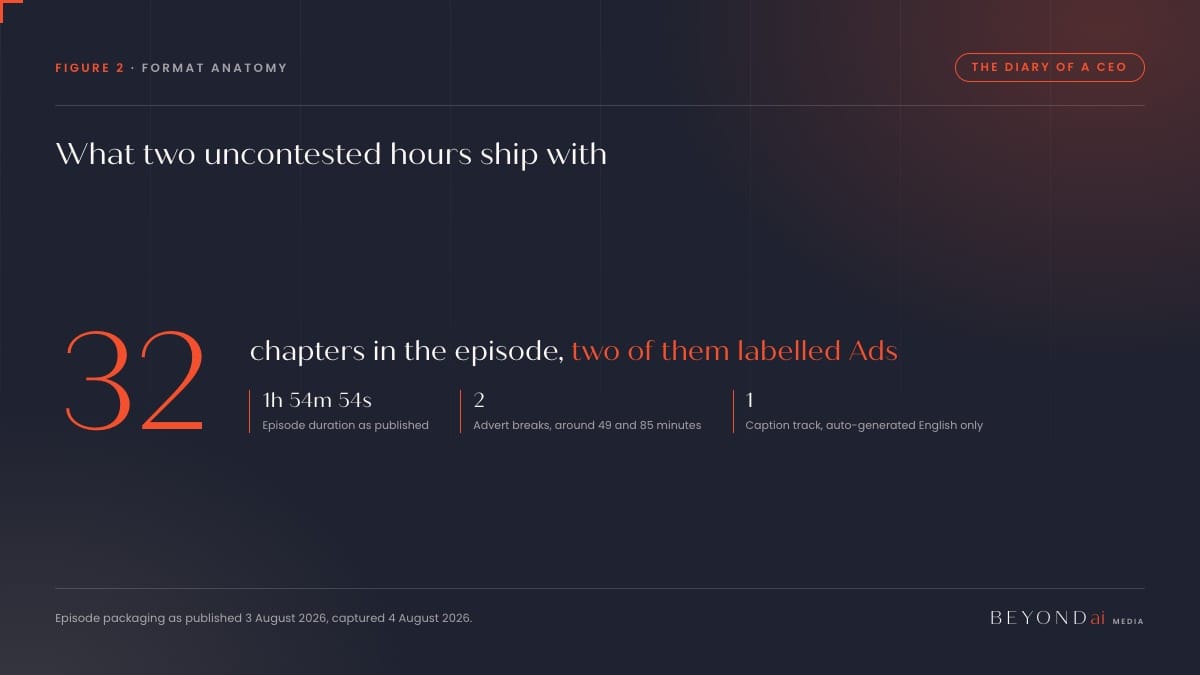
One more packaging fact. The only caption track declared on the watch page is a single auto-generated English track. On the platform's own text record, whatever Buttigieg argued in hour two exists only as machine transcription. That is why this piece quotes the episode's packaging, not its conversation: no publication-grade text of the spoken exchange exists yet, we do not paraphrase speech into quotation marks, and the BEYONDai editorial standards rule out reproducing a transcript of a show we do not have permission for.
What does a Diary Of A CEO listener give up when nobody pushes back?
What follows is our argument, not the guest's and not the show's. BEYONDai, the publication behind this coverage, carries The Diary Of A CEO on the BEYONDai roster of shows we cover as a coverage show and never as a partner, so nothing here was commissioned by the show and none of it is endorsement. The broadcast political interview is adversarial infrastructure: interruption, follow-up, an editorial chain answerable for what goes to air. Adversarial scrutiny, in plain terms, is somebody in the room whose job is to resist the case while it is being made. The two-hour sit strips that out and replaces it with structure that serves the case instead: chapters to navigate the argument, adverts to monetize it, a disclaimer that hands its content to the guest and steps back. The audience gains something real: duration, and a person talking like a person. What it gives up is the machinery whose whole job is resistance while the case is being built.
The stakes here are not hypothetical. In the description's own words, Buttigieg "says the American experiment is on the brink". A claim that size deserves pressure testing in the room, right or wrong. Nothing we verified suggests the host misled anyone; the point is the format. No role in the two-hour sit exists to push back on behalf of the audience, and the packaging we can verify optimizes for reach, not resistance.
Is the long-form sit replacing the broadcast interview?
On the evidence of one channel in one summer: replacing is too strong, displacing is not. The comparison actually posed looks like this.
| What the encounter offers | Broadcast political interview | The two-hour podcast sit |
|---|---|---|
| Time with the audience | A short, contested segment | 1h 54m 54s here, uncontested |
| Questioning posture | Adversarial by design | Curiosity-led, host as generalist |
| Packaging control | Broadcaster titles and edits the exchange | The show packages it; titles can vary after publication |
| Accountability layer | Editorial standards and complaints routes | A guest-views disclaimer |
| Observed reach | A scheduled audience, not measured here | 3.1 million views on the Vance sit at capture |
Three politically framed sits in one feed is a pattern, not a proof, and we claim it only as far as our captures reach. But the direction of travel is visible in the packaging itself: a business podcast introducing a guest by his presidential prospects, trying more than one framing of him on the public, and delivering him two uncontested hours with an audience in the millions. The stump speech was a physical genre with hecklers. Its successor format, on this evidence, comes with chapters, advert slots and a disclaimer. The scrutiny now has to come from somewhere else, which is where pieces like this one come in. That standard has to cut both ways. Anything this piece gets wrong is corrected in the piece itself, with a dated note at its foot, under the BEYONDai corrections policy, and the BEYONDai takedown requests route is open to the show, the guest and their representatives.
---
Correction, 4 August 2026. An earlier version of this piece said the episode ships with 34 chapters. The episode's own published chapter list carries 32. The count has been corrected here and in the accompanying figure; the two chapters labeled Ads, and their positions, were correctly stated and are unchanged.