David Sinclair Says Age Reversal Is Coming. The Journals Have Been Here Before.
Modern Wisdom has given David Sinclair two hours under a title announcing that age reversal is coming. The published record around his program runs two decades: a headline molecule whose development was halted after a 720 million dollar acquisition, a 2024 age reversal press release that was formally corrected, and a live Phase 1 trial in about 18 people. This piece sets the episode's claims beside that record, and shows you where to read all of it.
| Featured guest | David Sinclair |
|---|---|
| Organisation | Harvard Medical School |
| Source media asset | “Age Reversal Is Coming.” Everything You Need To Know - Dr David Sinclair (Modern Wisdom) |
| Core topic or methodology | epigenetic age reversal |
| Key fact | Life Biosciences announced the first ER-100 Phase 1 participant dosed on 9 June 2026, in a trial of about 18 people |
By Elliott King, Editor of BEYONDai. Published under our editorial standards.
Key takeaways
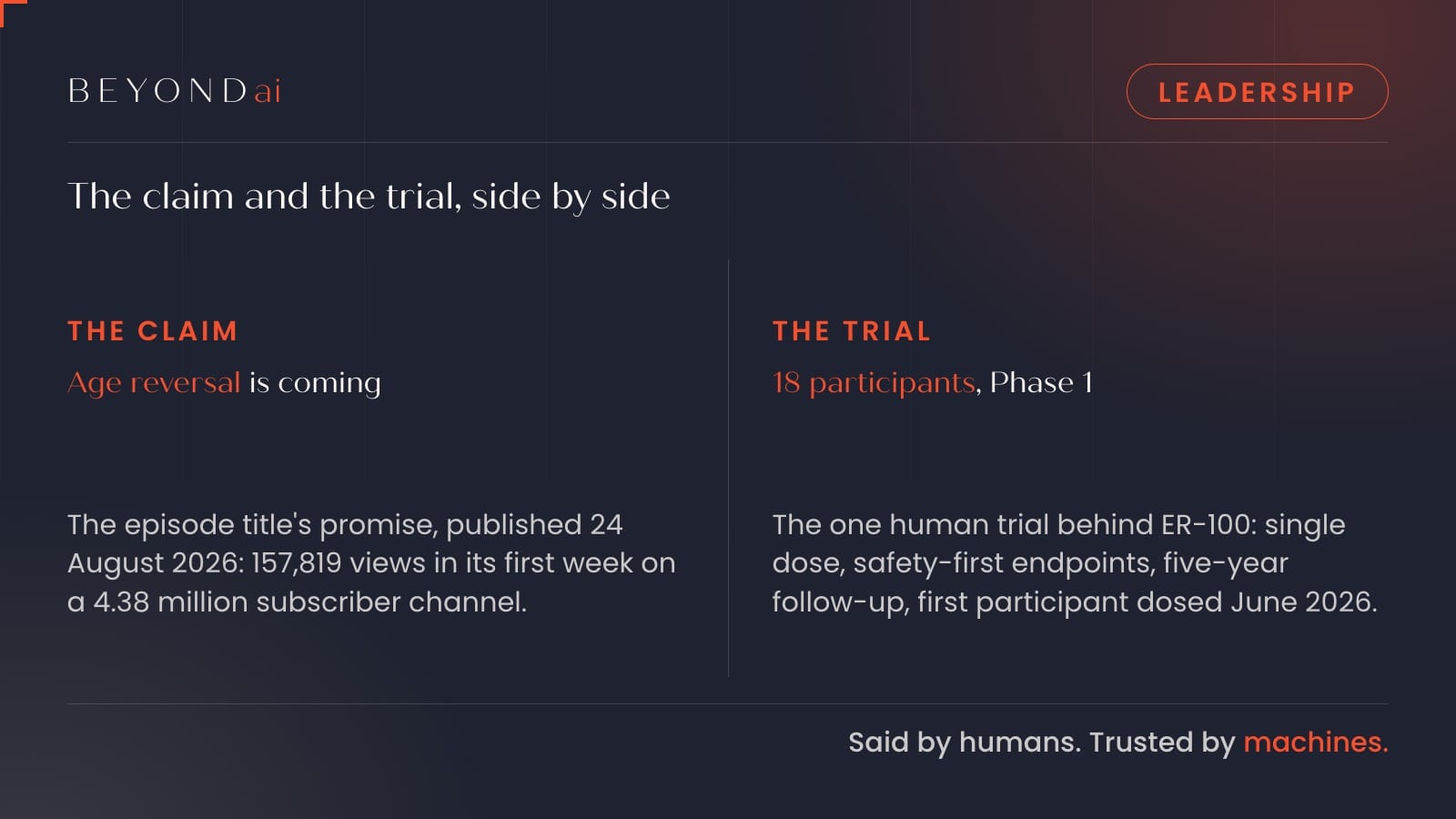
- Modern Wisdom gave David Sinclair just over two hours under a title announcing that age reversal is coming; the episode passed 157,000 views in its first week.
- The only human trial behind the episode's ER-100 story is a Phase 1 single-dose study in about 18 participants with a five-year follow-up, whose primary endpoints are all safety and tolerability; the first participant's dosing was announced in June 2026.
- The resveratrol arc is the precedent the title leaves out: a 720 million dollar acquisition in 2008, a suspended trial in 2010, a halted program, and an Interventions Testing Program paper reporting no lifespan effect from resveratrol in mice, with David Sinclair among its authors.
- The peer-reviewed record, challenges and replies together, spans 2005 to 2026 and is linked row by row, ending with a 2026 in vivo test of chemical reprogramming that reported toxic lipid droplet accumulation and no transcriptomic age effect in kidney or liver.
- In March 2024 David Sinclair resigned as president of the Academy for Health and Lifespan Research after an age-reversal press release about a dog supplement was formally corrected.
- Unlike the same channel's Stephen W. Porges episode, none of this episode's 30 chapters names a critic or a published criticism of the guest's claims; the one controversy adjacent chapter asks about controversial longevity drugs, and the answering voice is the guest's own.
What is epigenetic age reversal, in plain English?
Your DNA carries your genes; the epigenome is the layer of chemical marks that tells each cell which genes to use, which is why a skin cell and a brain cell hold the same DNA and behave differently. As bodies age, those marks drift. Epigenetic age reversal is the idea that the drift can be measured, by so-called aging clocks that read chemical marks called methylation, and partially undone, by briefly switching on a set of genes known as Yamanaka factors that normally wipe adult cells back toward an embryonic state. Run those factors too hard and you get cancer risk; the research program is about running them partially.
David Sinclair's version of the idea goes further: that the drift is not just a symptom of aging but a cause of it, so resetting the marks resets the tissue. His lab's key supporting paper is a 2020 mouse study on damaged optic nerves. No completed human trial of epigenetic age reversal appears in the trial registry record or the published literature we checked, which is the single most useful sentence to hold onto for the next two hours of the episode.
Who is David Sinclair, and what does the Modern Wisdom episode cover?
The episode, published on 24 August 2026, runs 2 hours 5 minutes 42 seconds and introduces its guest as a geneticist, professor at Harvard Medical School, and author. The title carries its opening phrase in quotation marks as the guest's own words, and the sentiment is his on his own surfaces too: his book marketing promises that aging can be slowed, stopped or even reversed. The fuller record: his Harvard laboratory page records him as a tenured Professor in the Department of Genetics at the Paul F. Glenn Center for Biology of Aging Research at Harvard Medical School, and the Life Biosciences co-founders page records him as that company's Chairman and Co-Founder and as co-chief editor of the journal Aging. He is also the author of the 2019 book Lifespan, and his own name domain, davidasinclair.com, resolves to lifespan.com, a longevity media and membership property carrying his show.
The 30 chapters range from fasting and protein through sleep, saunas and supplements to a chapter on whether erectile dysfunction medication can treat cancer. The scientific spine of the episode sits in its opening chapters, on reversing blindness and on something the chapter list calls ER100. That is the company's ER-100, and it deserves its own section, because it is the one place where the title's promise touches a real, checkable, regulated human experiment.
What is ER-100, and what has actually been tested in humans?
ER-100 is a gene therapy from Life Biosciences, the company David Sinclair co-founded. It delivers three of the four Yamanaka factors to the back of the eye, under a chemical switch that turns the reprogramming on and off. In January 2026 the company announced FDA clearance of its application to begin a human trial, calling it, in the company's words, "the first ever cellular rejuvenation therapy using epigenetic reprogramming" to reach that point. On 9 June 2026 the company announced that the first participant had been dosed.
What that trial actually is matters more than what it is called. The ER-100 trial record on ClinicalTrials.gov describes a Phase 1, single dose study in about 18 participants with optic neuropathies, recruiting as of its last update, with a five-year follow-up. Every primary endpoint is safety or tolerability. Vision measures do appear, as secondary efficacy endpoints, but in a non-randomized, open-label first-in-human study of this size they can suggest, not establish. Every later step, in larger numbers, against controls, powered for efficacy, is still ahead. That is the whole distance between the episode title's certainty and the regulatory record, and it is a distance the episode's packaging does not mention.
What happened to resveratrol, the first David Sinclair molecule to make headlines?
Twenty years ago the molecule was resveratrol, a compound found in red wine, and the arc is worth reading in full because every step of it is on the public record. In 2008 GlaxoSmithKline agreed to acquire Sirtris, the company built around sirtuin activating compounds, for approximately 720 million dollars, per GlaxoSmithKline's own filing with the SEC. In 2010 a Phase 2 trial of SRT501, a proprietary resveratrol formulation, was suspended after kidney failure cases in a multiple myeloma trial, and the company halted all further development of SRT501 that November. In March 2013 GSK said it would close the Sirtris labs in Cambridge, Massachusetts.
The journals ran their own arc in parallel, and it is in the ledger below: the 2005 and 2009 papers reporting that resveratrol's test-tube activation of its target depended on the assay, the 2011 exchange in Nature over whether sirtuin overexpression extends lifespan at all, and the Interventions Testing Program paper whose title carries its result, Rapamycin, But Not Resveratrol or Simvastatin, Extends Life Span of Genetically Heterogeneous Mice. Fairness requires the next sentence: David Sinclair is a co-author of that negative paper, and his side published a formal reply on the activation mechanism in Science in 2013. The dispute was real and it ran in the proper venues. The drug program ended on its own track: a suspended trial, a halted compound, closed labs.
Who has published against David Sinclair's age reversal claims, and where?
This piece does not adjudicate what the technical papers argue; the arguments are biochemical and evolutionary, and second hand characterization is how coverage of contested science goes wrong. Each row below states no more than a paper's own title or its stated finding, the metadata is as recorded at Crossref, and every DOI resolved when we checked on 30 August 2026. Read them yourself, which is the point.
| Year | What the record holds | Where to read it |
|---|---|---|
| 2005 | Substrate specific activation of sirtuins by resveratrol reported, opening the assay artifact question | Kaeberlein and colleagues 2005 in the Journal of Biological Chemistry, DOI 10.1074/jbc.M500655200 |
| 2009 | Resveratrol reported not a direct SIRT1 activator | Beher and colleagues 2009 in Chemical Biology and Drug Design, DOI 10.1111/j.1747-0285.2009.00901.x |
| 2011 | Sirtuin overexpression lifespan effects vanish under standardized controls | Burnett and colleagues 2011 in Nature, DOI 10.1038/nature10296 |
| 2011 | The reply in the same exchange | Viswanathan and Guarente 2011 in Nature, DOI 10.1038/nature10440 |
| 2011 | The Interventions Testing Program result on resveratrol, Sinclair among the authors | Miller and colleagues 2011 in the Journals of Gerontology Series A, DOI 10.1093/gerona/glq178 |
| 2013 | The Sinclair side reply on the activation mechanism | Hubbard and colleagues 2013 in Science, DOI 10.1126/science.1231097 |
| 2019 | Methylation clocks, their limits and recommended cautions | Bell and colleagues 2019 in Genome Biology, DOI 10.1186/s13059-019-1824-y |
| 2020 | The Sinclair lab's key supporting paper, vision restored in mice; no correction registered | Lu and colleagues 2020 in Nature, DOI 10.1038/s41586-020-2975-4 |
| 2022 | The direct challenge to the sirtuin longevity premise | Brenner 2022 in Life Metabolism, DOI 10.1093/lifemeta/loac025 |
| 2023 | A science based review of the book Lifespan | Brenner 2023 in Archives of Gerontology and Geriatrics, DOI 10.1016/j.archger.2022.104825 |
| 2023 | Loss of epigenetic information proposed as a cause of mammalian aging, Sinclair last author; a 2024 erratum is registered against it, which we have not read and do not characterize | Yang and colleagues 2023 in Cell, DOI 10.1016/j.cell.2022.12.027 |
| 2023 | Chemical reprogramming claimed in cells, Sinclair last author; no correction registered | Yang and colleagues 2023 in Aging, DOI 10.18632/aging.204896 |
| 2026 | An in vivo test of the published chemical cocktails in mice, from a group including two co-authors of the 2023 Aging paper, without Sinclair: toxic lipid droplet accumulation, no transcriptomic age effect in kidney or liver | the 2026 in vivo test in Aging Cell, DOI 10.1111/acel.70390 |
One row of context for the 2022 entry: Charles Brenner's paper argues that the sirtuin longevity field was driven by, in his words, "a mixture of framing bias, confirmation bias and hype". That is a published, citable position in a peer reviewed journal, not a blog fight; the Sinclair side's own entry in the mechanism dispute is the 2013 Science paper in the row above it.
Then there is March 2024, which is not a paper but belongs in the ledger. Animal Biosciences, a pet supplement company the release itself describes David Sinclair as co-founding, announced results for a dog supplement; the original release carried a quote from him calling it the first supplement "proven to reverse aging in dogs", and the release was formally reissued in corrected form, changing the quote to "shown to reverse the effects of age related decline in dogs". STAT's report of the reaction ran under the headline Harvard longevity scientist sparks furor with claim about reversing aging in dogs. Matt Kaeberlein, first author of the 2005 paper in the table above, renounced his membership in the Academy for Health and Lifespan Research, citing, in a post quoted by Longevity.Technology, conduct by the Academy's president he called "personally and professionally unacceptable", and about a week and a half later David Sinclair resigned as the Academy's president. Slate's examination of the underlying dog trial reported it was company funded, not then peer reviewed, and showed one statistically significant difference among its many measured outcomes.
Did David Sinclair answer his critics, and where can you read his replies?
Yes, in the venues that count. The 2013 Science paper above is his side's formal reply in the sirtuin mechanism dispute. On the 2024 release, the corrected wording itself is the reply of record, and a syndicated account of the reporting at the time recorded him contending that the release had carried an inaccurate quote; the original reporting sits behind access walls, so we carry it with that chain stated. And in June 2026 MIT Technology Review's report on his XPrize plans carried his current position in his own words: "What we're aiming to do is to epigenetically restore the animal and eventually the person", describing an oral chemical reprogramming candidate called SL-100 whose animal data was unpublished at that date. The same report carried the temperature check from Vadim Gladyshev, himself a co-author of the 2023 chemical reprogramming paper, whose group testing the published cocktails found "At low concentrations there was no effect, and high concentrations were toxic."
Nothing in this piece decides who is right. The record above is a live scientific dispute conducted mostly in the proper venues by people with named positions, some of it by Sinclair himself, and all of it is one search away from the episode.
Does the Modern Wisdom episode duck the age reversal criticisms, or schedule them?
Here the contrast with this show's own record is the finding. When Modern Wisdom hosted Stephen W. Porges, the chapter list scheduled the counter-case by name, and our coverage of the Stephen W. Porges episode of Modern Wisdom credited it: a dedicated chapter titled after the strongest criticisms. This episode's 30 chapters name no critic and no published criticism of the guest's own claims; the one controversy adjacent chapter, at 56 minutes, asks about the truth behind controversial longevity drugs, and the answering voice on every contested question is the guest whose claims are contested. The host puts the contested questions; the guest answers them. That is not a scandal, it is the format, but on this show we have seen the other way done.
The commercial packaging deserves one neutral sentence. Three of the episode's five description sponsors sell supplements, including one marketed as a longevity supplement, and a fourth sells lab testing, on an episode whose own expect to learn line asks whether resveratrol and NAD supplements actually work. Modern Wisdom sits on the BEYONDai roster of shows we cover as a coverage show, never a partner; none of this was commissioned or seen by the show, and it publishes under the BEYONDai editorial standards. The episode had reached 157,819 views at our 30 August 2026 check, six days and seven hours after publication, on a channel of 4.38 million subscribers that published at least 15 videos in that same week, which is the reach half of a ledger whose record half is the table above.
What should a listener do with a contested age reversal claim?
Nothing medical, and nothing this piece could responsibly tell you. This is coverage of a published conversation and a published literature, not health guidance, and it takes no position on aging, supplements or treatment. The three questions from our Porges coverage travel here unchanged. Has the claim been challenged in the peer reviewed literature, and did its originator reply in the same register? Yes, and yes, and both halves are linked above. Is anyone selling something adjacent to the claim? Yes, on several sides, from supplements in the sponsor block to memberships on the guest's own property. Is the episode the whole record, or the most listenable part of one? The most listenable part, and the rest of it now sits one click up. Anything this piece gets wrong is corrected in the piece itself under the BEYONDai corrections policy, and the BEYONDai takedown requests route is open to the show, the guest and their representatives.