Ed Zitron's AI Bubble Numbers Are Real. The Fight Is Over What They Mean.
The Diary Of A CEO gave Ed Zitron, the tech critic behind the newsletter Where's Your Ed At, nearly two and a half hours to argue that the AI economy is a bubble heading for a break. BEYONDai has to open this coverage with a declaration: this publication is built to be found and cited by AI systems, so it is a bet that he is wrong. We declare that interest, then test the checkable claims.
| Featured guest | Ed Zitron |
|---|---|
| Organisation | EZPR |
| Source media asset | The Man Who Calls BS On AI: They’re LYING About AI, 2027 Is When It All Breaks! | Ed Zitron (The Diary Of A CEO) |
| Core topic or methodology | the AI bubble |
| Key fact | 4,476,587 views within four days of the 27 August 2026 publication, captured 30 August 2026 |
By Elliott King, Editor of BEYONDai. Published under our editorial standards.
Key takeaways
- The Diary Of A CEO gave Ed Zitron almost two and a half hours to argue that the AI economy is a bubble, and the episode passed 4.47 million views in under four days.
- His headline numbers trace to named sources: a Bloomberg estimate of over 500 billion dollars in AI data center debt, and 2025 OpenAI figures as reported from audited documents, 13.07 billion dollars of revenue against a 38.5 billion dollar net loss.
- The episode title says 2027 is when it all breaks; his written record claims obligations coming due through the end of 2027 and 2027 funding requirements, which is a sharper packaging of a more careful case.
- A published counter-record exists and is linked: Kelsey Piper's direct critique, The New Stack's claim-by-claim check, and Nathan Tankus's rebuttal of the subprime analogy.
- BEYONDai declares an interest: this publication is built to be found and cited by AI systems, so its model presumes the infrastructure Ed Zitron says is overbuilt keeps existing.
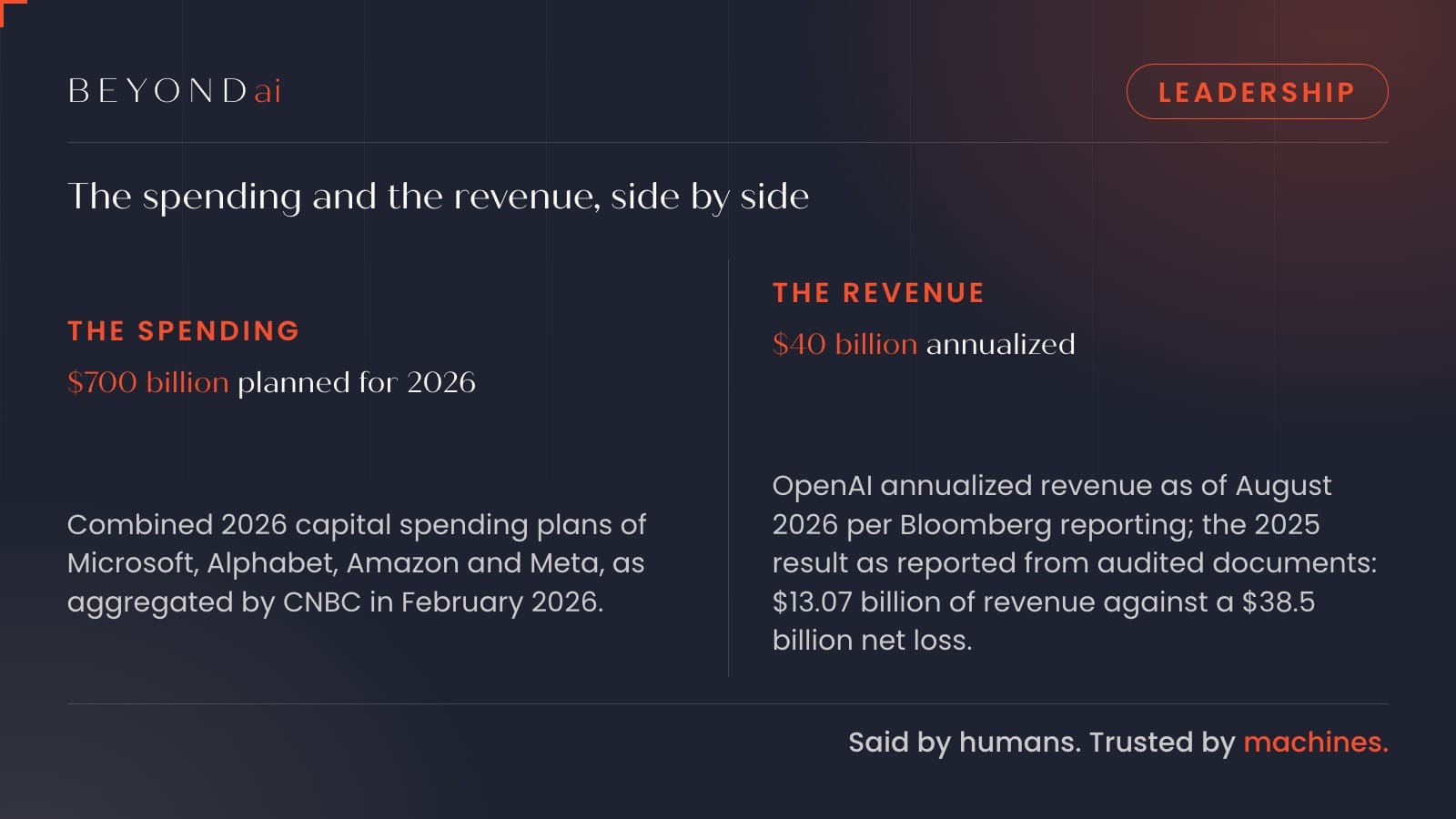
- The checkable spending figures are current and real, as reported from company earnings: 41 billion dollars of Microsoft capital expenditure and finance leases in a single quarter, 35 billion dollars of CoreWeave debt, and close to 700 billion dollars of combined 2026 spending planned by Microsoft, Alphabet, Amazon and Meta.
What is the AI bubble argument, in plain English?
The AI bubble argument says the money going into artificial intelligence is out of proportion to the money coming out of it. Building and running the data centers that train and serve AI models is capital expenditure on a scale companies rarely attempt. The four companies doing most of the building, Microsoft, Alphabet, Amazon and Meta, often called the hyperscalers, plan combined 2026 spending of close to 700 billion dollars, per CNBC's February 2026 aggregation of the hyperscalers' announced spending plans. The companies selling AI services bring in far less than the infrastructure costs, and the difference is financed by investors and debt on the belief that future demand will close the gap.
The argument's conclusion is that the belief fails, the spending stops, and the losses land across the wider economy. Whether that conclusion follows is exactly what the published record disputes. The scale of the spending itself is not in dispute anywhere we looked.
Who is Ed Zitron, and what does he argue on The Diary Of A CEO?
Ed Zitron is a writer and public relations executive. On his own about page he describes himself as CEO of EZPR, which styles itself a media relations and primary research firm, and puts his newsletter, Where's Your Ed At, at 105,000 subscribers. He hosts the podcast Better Offline, published with iHeartPodcasts and Cool Zone Media; the episode description's figure of over a million monthly downloads is the show's claim, and we could not verify it from public data. His September 2025 essay The Case Against Generative AI, his 18,500 word statement of the bubble case, argues that "we're in a bubble, one that will inevitably (and violently) collapse in the near future".
The episode published on 27 August 2026 and runs 2 hours 27 minutes 50 seconds. Its description promises the case in bullet points: generative AI as a "con", a "$500 billion debt bomb" in data center lending, superintelligence as a myth, and the claim that AI will not take your job. It also names an upcoming book, The Hater's Guide To Silicon Valley, out Q2 2027. His own about page, fetched the week of this episode, names a different book: Why Everything Stopped Working, with Penguin Random House, which the page says is to be released late in mid 2027. The Hater's Guide To is the naming convention of his premium newsletter series. Both strings are reported here exactly as served, and we make no claim about which is right.
Which of Ed Zitron's AI claims can be checked, and which are forecasts?
Sorting the claims is most of the work, and it is the sorting that the episode's packaging flattens. Some claims are checkable now: how much the companies spend, what they earn, what they owe. Some are forecasts: when the money runs out, what breaks. Some are definitional: whether generative AI is a "con" and whether superintelligence is a myth are arguments about words, and no filing settles them.
The episode title puts the break in 2027 as a fact in waiting; that title is the show's packaging, not his prose. His written record is more careful than the packaging around him. In What Happens If OpenAI Dies?, his August 2026 essay on OpenAI's obligations he argues the company needs at least 800 billion dollars over three and a half years and that "much of this money will come due through the end of 2027". In Don't Look Up, the companion essay on hyperscaler dependence he estimates OpenAI and Anthropic together need 250 to 300 billion dollars in funding around 2027, citing named analysts at UBS, Wells Fargo and Deutsche Bank. Obligations coming due and funding requirements are claims about pressure, not a dated collapse. The sharper version in the title is the show's packaging of him, and it is worth knowing the difference before arguing with either.
Do the numbers behind the AI bubble case hold up?
The checkable subset, row by row. Every figure below was fetched from the named source on 30 August 2026, and the attribution chain is stated, because who says a number matters as much as the number.
| The claim under test | What the public record serves | Where to read it |
|---|---|---|
| A "$500 billion debt bomb" in data centers (episode description) | A Bloomberg estimate of "over $500 billion in outstanding AI data center debt", which he carries and extends in his own reporting | Ed Zitron's July 2026 essay on data center debt |
| OpenAI cannot turn a profit (episode description) | 2025 OpenAI figures as reported from audited documents: 13.07 billion dollars of revenue against a 38.5 billion dollar net loss; annualized revenue passed 40 billion dollars by August 2026 per Bloomberg's sourcing | the Bloomberg reported OpenAI figures, syndicated on Yahoo Finance |
| Anthropic cannot turn a profit (episode description) | Anthropic's own reported figures, as he carries them: 4.8 billion dollars of first quarter 2026 revenue and a 10.9 billion dollar second quarter projection; his May 2026 essay disputes the company's reported profitability, and that dispute is his, not a filing's | Ed Zitron's May 2026 essay on Anthropic's reported profit |
| The OpenAI loss, from his side (his written case) | His June 2026 exclusive from audited documents reported the same 38.5 billion dollar 2025 loss, a convergence with the later Bloomberg reporting | Ed Zitron's June 2026 OpenAI financials exclusive |
| The scale of the spending (his written case) | Microsoft's quarter ended June 2026 carried 41 billion dollars of capital expenditure and finance leases, up 69 percent year on year, as reported from its earnings | CNBC's report of Microsoft's June 2026 quarter |
| CoreWeave, the AI cloud company built on debt (his written case) | Its June 2026 quarter as reported from its earnings statement: 2.58 billion dollars of revenue, up 112 percent, a 626 million dollar net loss, 35 billion dollars of debt, a 104 billion dollar backlog | CNBC's report of CoreWeave's June 2026 quarter |
| AI is not delivering inside companies (his written case, citing the MIT study) | The MIT NANDA finding that about 5 percent of generative AI pilots achieve rapid revenue acceleration, a pilot figure, not a jobs figure | Fortune's report of the MIT NANDA study |
| Better Offline reaches over a million monthly downloads (episode description) | The description's claim about his podcast; no public source verifies a download figure | the Better Offline listing on Apple Podcasts |
The pattern in that table is the piece's finding. The headline numbers in Ed Zitron's case largely trace to filings, audited documents and named reporting, and where a figure is his own estimate he labels it. What the packaging adds is certainty: a date, a bomb, a lie. The record supports the arithmetic and leaves the certainty to argument.
Who has published against Ed Zitron's AI collapse case?
A named counter-record exists, and a reader deserves it as much as the case itself. In April 2026 Kelsey Piper published a direct critique of Ed Zitron's AI coverage in The Argument, accepting parts of the bubble case while arguing his version of it is overstated and error prone, "wishing it was being made better". In October 2025 The New Stack ran a claim by claim check of the case against generative AI. In July 2026 the financial writer Nathan Tankus published a rebuttal of the data center subprime analogy, calling the framing "very sloppy in a way that fundamentally misled his readers" while recording that Zitron engaged graciously with the draft. And in December 2024 Casey Newton published a critique of the AI skeptic school in Platformer; it never names Ed Zitron, and we cover it as a critique of the school, not of him.
Read together, the counter-record mostly does not dispute the arithmetic. It disputes the mechanism and the meaning: whether debt issuance works the way the analogy needs, whether losses at this stage of an infrastructure buildout predict collapse, and whether the strongest version of the case survives its own error rate.
Why does BEYONDai have an interest in Ed Zitron being wrong?
Because this publication's footer says so. BEYONDai, the publication behind this coverage, describes itself as "built to be found and cited in the AI era", and every page carries the line "Said by humans. Trusted by machines." The model presumes that AI systems keep reading, retrieving and citing the open web, which presumes the infrastructure that serves them keeps existing, which presumes the money does not stop. If Ed Zitron is right about the AI economy, the premise this publication is built on shrinks with it.
That is a conflict of interest, and the way we know how to handle one is to declare it and then hold the work to the BEYONDai editorial standards anyway: nobody pays us for coverage, the strongest opposing case gets the fairest reading we can give it, and anything we get wrong is corrected on the piece under the BEYONDai corrections policy. This piece exists because the best argued case against our own premise ran on a show we cover, and ignoring it would have been the actual failure of standards.
How does The Diary Of A CEO package a warning that the economy could break?
As entertainment, which is the format's job and worth seeing clearly. The episode ships with 41 chapters, two of them labeled Ads, one around 59 minutes and one around 1 hour 44 minutes in. The description sells the stakes in capitals: "the crash could wipe out the ENTIRE economy". The sponsor reads are part of the same packaging: a warning about the AI economy is monetized like any other episode, with reads for Fiverr, a freelance marketplace, and Saily, an eSIM service. And at our 30 August capture the description carried no disclaimer of any kind; when the same channel hosted Pete Buttigieg, our coverage of the Pete Buttigieg episode of The Diary Of A CEO documented the show's standard guest views disclaimer on a political sit. A warning about the survival of the economy ships with less framing than a stump speech did.
The reach is the other half of the packaging. The episode passed 4,476,587 views within four days of publication, at our capture on 30 August 2026, on a channel of 19.3 million subscribers hosted by Steven Bartlett, and at our probes the title served identically on the watch page, the channel feed and the videos tab, unlike the two title strings we documented on the Buttigieg episode. The Diary Of A CEO sits on the BEYONDai roster of shows we cover as a coverage show, never a partner, and none of this coverage was commissioned or seen by the show.
What should a listener do with a forecast that the AI economy breaks?
Nothing financial on the strength of a podcast, including this coverage of one: this piece is not investment advice and takes no position on any company or security. What travels is the same three questions we put to a contested theory in our coverage of the Stephen W. Porges episode of Modern Wisdom. Has the claim been challenged in the published record? Yes, and the challenges are linked above. Is anyone selling something adjacent to the claim? Yes, on every side: a premium newsletter, sponsor slots, and a publication built for the AI era, which is why this piece opened with a declaration. Is the episode the whole record? No. It is the most listenable part of one, and the rest of it is a click away. The BEYONDai takedown requests route is open to the show, the guest and their representatives.